Gentle Carat earns a commission when you buy through the links on this page, at no extra cost to you. It never decides what we recommend or how we rank it — here is the full disclosure.
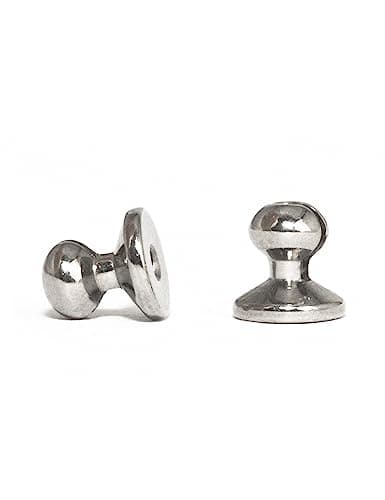
An earring back is a separately manufactured component, frequently made from a cheaper alloy than the earring it holds on, and almost never named in the listing. It sits against the back of your lobe for exactly as long as the earring sits in the front. If you have reacted to earrings that should have been safe, the back is the most common explanation and the cheapest one to test.
Why this is the most under-covered thing in the category
Go and read the ten best-ranking articles about earrings for sensitive ears. Nearly all of them will tell you, correctly, that the failure point is the post rather than the decorative front. Almost none of them will mention the back, and none of them will suggest replacing it as a first step.
That is strange, because the back is in contact with skin for the same duration, is made separately, is routinely sourced in bulk, and is the single component most likely to have been swapped since you bought the earring. It is also, at a few dollars, the cheapest possible test of the theory.
The five kinds of earring back
Earring backs, and what each is actually for.
Type
How it holds
Notes
Butterfly / friction
Two sprung wings grip the post.
The default. Loosens over time, easy to lose, most likely to be an unstated alloy.
Screw back
Threads onto a threaded post.
The most secure. Standard for children. Cannot be used on a smooth post.
Flat back / labret disc
A disc on the far end; the front screws or pushes in.
Spreads pressure. Best for sleeping in and for tender lobes.
La Pousette / locking
A sprung mechanism that clicks and releases deliberately.
Very secure, more expensive, usually only on higher-end jewelry.
Large-disc support back
A wide disc, often with a plastic pad.
For heavy earrings and thin or stretched lobes. Mechanical fix, not an allergy one.
Earring backs, and what each is actually for.
Diagnosing it in one step
If you suspect the back, the test is straightforward. Put a known-metal back — titanium, from a stated listing — on the earring that has been bothering you, and wear it as normal. If the irritation stops, the back was the problem and you have solved it for a few dollars. If it does not, the post is the problem and you now know that too.
The reason this is worth doing before buying new earrings is not just cost. It isolates one variable, and that is the only way any of this gets answered.
Posts: the part you cannot replace
Backs can be swapped; posts cannot. That is why the post is the thing to check before buying, and why a listing that names a post metal is worth more than one that does not.
Two post details that matter beyond metal: gauge, which must match your piercing (20G for most lobes, 18G for most cartilage), and thread direction on flat-backs — internally threaded and threadless designs keep sharp threads out of the piercing channel, and externally threaded ones do not. More on that.
Quick picks
Ranked on what the seller actually discloses. Tap a row for the full write-up, or go straight to the listing.
#
Product
Best for
Score
Price
1
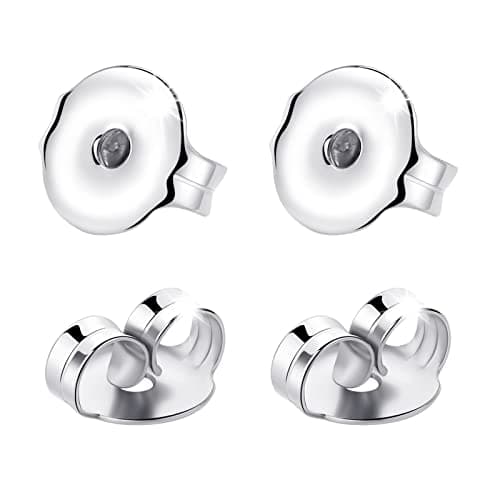
Limerencia Pure Titanium Replacement Earring Backs (2 pairs)The cheapest fix in this whole category: keep the earrings, replace the part that is actually touching you.
VGACETI Pure Titanium Earring Backs, 6mm x 7mm (2 pairs)Same idea as the pick above, at a stated size — which matters if the earrings you are fixing are heavy.
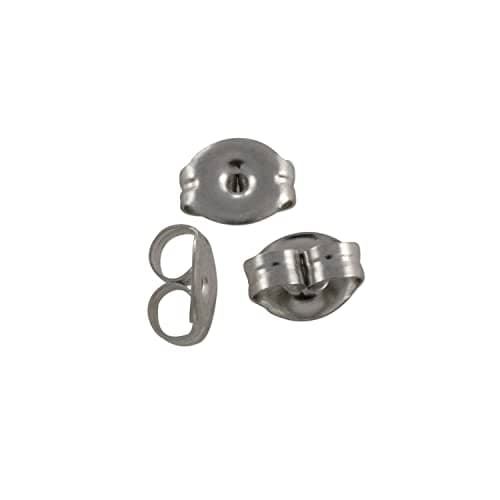
JewelrySupply Surgical Stainless Steel Earring Backs (10 pack)Ten steel backs for very little. Not the safest metal on this page, but the right answer if you keep losing them.
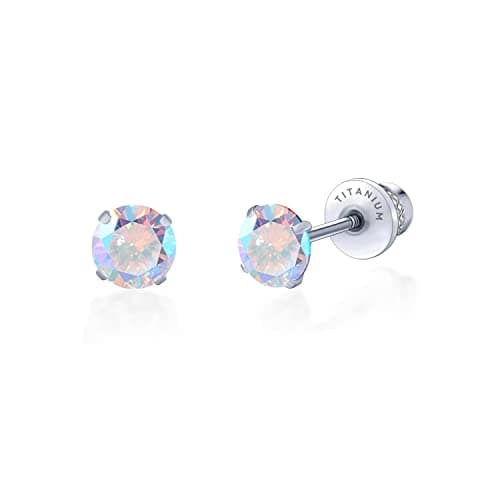
Limerencia F136 Titanium Screw-Back Flat-Back CZ Studs (20G)The clearest material claim in this whole category: the standard number, the gauge and the fastening are all in the title before you have clicked anything.
“Score” is a disclosure score, not a test result. It rates how completely the seller states the post metal, the back metal and the nickel claim, and how that metal holds up for reactive skin. The full rubric is published on our methodology page.
#1 · Fixing earrings you already own
Limerencia Pure Titanium Replacement Earring Backs (2 pairs)
The cheapest fix in this whole category: keep the earrings, replace the part that is actually touching you.
Post material
Not applicable — this is the back component
From the seller’s own product title: “Limerencia Pure Titanium Earring Backs Replacements”
Back material
Pure titanium
From the seller’s own product title: “Limerencia Pure Titanium Earring Backs Replacements, Hypoallergenic for Sensitive Ears, Secure Ear Locking for Stud Earrings for Posts”
Nickel claim
Says hypoallergenic, not nickel-free. The seller’s own words: “Pure Titanium Earring Backs ... Hypoallergenic”
This is the pick that most often solves the problem for the least money, and almost nobody writing about sensitive ears mentions it. A butterfly back is a separately manufactured part, frequently a cheaper alloy than the earring it holds on, and it sits against the back of your lobe for exactly as long as the earring does.
So if you have earrings you love that started irritating you, or one ear reacts and the other does not, changing the backs is the first thing to try. It costs a fraction of a new pair and it isolates the variable.
Titanium backs also grip differently from steel butterflies — generally more securely, which is a side benefit if you lose earrings.
Who it’s for
Anyone with a drawer of earrings they cannot wear. Try this before replacing any of them.
Skip it if
Skip this if the post itself is the problem. A titanium back on a plated brass post fixes half of a two-part contact and the half it does not fix is inside the piercing.
VGACETI Pure Titanium Earring Backs, 6mm x 7mm (2 pairs)
Same idea as the pick above, at a stated size — which matters if the earrings you are fixing are heavy.
Post material
Not applicable — back component
From the seller’s own product title: “VGACETI Titanium Earring Backs Replacements”
Back material
Pure titanium, 6mm x 7mm
From the seller’s own product title: “VGACETI Titanium Earring Backs Replacements, Hypoallergenic Pure Titanium Earring Backs for Women Men Sensitive Ears, Secure Ear Locking for Stud Earrings for Posts, 6mmx7mm”
Nickel claim
Says hypoallergenic, not nickel-free. The seller’s own words: “Hypoallergenic Pure Titanium Earring Backs”
The dimensions in the title are the reason this is a separate pick. A larger back spreads the load of a heavy stud over more of the lobe, which is the standard fix for the droopy-earlobe problem that gets blamed on allergies and is usually mechanics.
If your lobe is sore in a way that is pressure rather than itch — tender at a point, no redness spreading, no itching — a larger back is more likely to help than a different metal.
Commercially pure titanium rather than an alloy, so there is nothing in it to release.
Who it’s for
Heavier studs, stretched or thinning lobes, or anyone whose earrings sit at an angle rather than flat.
Skip it if
Skip this if your earrings are small and light. A 6mm by 7mm back on a 3mm stud is more hardware than the earring needs and will be visible from behind.
Ten steel backs for very little. Not the safest metal on this page, but the right answer if you keep losing them.
Post material
Not applicable — back component
From the seller’s own product title: “JewelrySupply Standard Earring Backs Surgical Stainless Steel”
Back material
Surgical stainless steel
From the seller’s own product title: “JewelrySupply Standard Earring Backs Surgical Stainless Steel (Package of 10)”
Nickel claim
Names a metal, makes no nickel claim. The seller’s own words: “Surgical Stainless Steel”
Losing earring backs is the most common reason people end up wearing a mismatched one from the bottom of a drawer, and a mismatched back of unknown metal is a very good way to reintroduce a problem you had solved.
Buying ten identical steel backs is a cheap way to make sure every earring you own has a known back on it. For a steel-tolerant wearer that is a real improvement in consistency.
For someone avoiding steel, the titanium options above do the same job at a higher price, and are the ones to buy instead.
Who it’s for
Steel-tolerant wearers who want every earring in the drawer standardized on one known back.
Skip it if
Skip this if steel is what you are trying to get away from. Standardizing on the wrong metal is still standardizing on the wrong metal.
The clearest material claim in this whole category: the standard number, the gauge and the fastening are all in the title before you have clicked anything.
Post material
F136 implant-grade titanium, 20 gauge
From the seller’s own product title: “Limerencia Hypoallergenic G23 Implant Grade Titanium Screw Back Earrings | 20G F136 Pure Titanium Flat Back CZ Studs”
Back material
Screw-on flat back; the same titanium is implied but the metal is not separately named
Not named in the seller’s product title — the headline nearly every buyer reads. That omission is the finding, not a gap in our notes.
Nickel claim
Says hypoallergenic, not nickel-free. The seller’s own words: “Hypoallergenic G23 Implant Grade Titanium”
Two numbers do all the work here. F136 is the ASTM specification for the Ti-6Al-4V ELI alloy used in surgical implants, and G23 is the grade designation for that same alloy. A seller putting both in the title is pointing at a published document rather than reaching for an adjective, and that is rarer than it should be.
The flat back matters as much as the metal. A flat disc sits against the back of the lobe instead of a butterfly clip pressing a small area, which is why piercers use this shape for anything that has to be slept in. Combined with a screw thread rather than a friction push-fit, it is about as low-drama as an earring gets.
What the title does not do is name the back separately. In practice a screw-back on a titanium post is almost always the same titanium, and the design leaves little room for it to be anything else — but the seller has not committed to it in the headline, and we score what is stated rather than what is likely.
Who it’s for
Anyone who has reacted to something before and wants to stop running experiments. Also the sensible default for a piercing you intend to sleep in.
Skip it if
Skip this if you want a decorative statement earring. A 20-gauge flat-back CZ stud is deliberately unobtrusive, and if you want to be seen wearing something, this is not it.
What are the best earring backs for sensitive ears?+
Pure or implant-grade titanium, from a listing that states the metal. Steel backs are fine for people who tolerate steel and cost less. The important thing is that they are a known metal rather than whatever was in the drawer.
Can earring backs cause an allergic reaction on their own?+
Yes, and it is common. The back is a separate manufactured component that sits against your skin for as long as the earring does, and it is frequently a cheaper alloy than the earring. It is the first thing to test when a previously fine pair starts irritating you.
Why does only one of my ears react?+
Almost always a mismatched back. Backs get lost and replaced individually, so one ear ends up wearing a different metal from the other. Standardize both and the asymmetry usually disappears.
Do bigger earring backs help with sore lobes?+
If the soreness is pressure rather than itch, yes. A larger disc spreads the earring’s weight across more of the lobe. If it itches and is red, that is an allergy and a bigger back will not help.
Are silicone earring backs a good idea?+
They remove metal contact at the back entirely, which suits some people, and they perish and go sticky over time. They are also frequently used as a spacer behind a metal butterfly rather than instead of one — in which case the metal is still there.