Gentle Carat earns a commission when you buy through the links on this page, at no extra cost to you. It never decides what we recommend or how we rank it — here is the full disclosure.
“Hypoallergenic” jewelry is jewelry a seller says is less likely to cause an allergic reaction. In the United States that is all it means: there is no federal standard, no test a piece has to pass, and no penalty for using the word on a product that releases nickel. It is a claim about intent. The useful information is the metal itself, which a good listing will name.
If you have ever bought earrings labeled hypoallergenic and reacted to them anyway, you were not unlucky and you did not do anything wrong. You bought a word.
The word has no legal definition here
The Food and Drug Administration has said plainly that “hypoallergenic” on cosmetics means “whatever a particular company wants it to mean”, and there are no federal standards governing its use. Jewelry is not even regulated by the FDA, so it has less oversight than a moisturizer. Nothing stops a seller printing the word on a listing for a plated brass stud.
Europe is different, and it is worth knowing why, because it explains the whole shape of this market. The EU does not regulate the word either — it regulates the thing the word is gesturing at, which is how much nickel the metal releases onto your skin.
So a European seller selling into Europe has a number to hit. An American seller has an adjective. That difference is why so many US listings say “hypoallergenic” and so few say “nickel-free”: one of those is a claim about a metal that can be checked, and the other is not.
What to read on a listing instead
Three things, in this order. It takes about four minutes and it is the entire method behind every recommendation on this site.
What metal is the post? The post is the piece that goes through your ear. It is the only part in contact with the inside of a piercing, so it is the part that decides whether you react. A listing that describes the decorative front in loving detail and never mentions the post has told you nothing.
What metal is the back? Backs are separate manufactured parts and they are frequently a different, cheaper alloy than the earring they hold on. “Titanium earrings” with an unstated back is half an answer.
Which word is used about nickel? “Nickel-free” names a metal that is absent. “Hypoallergenic” names a hope. The gap between them is worth understanding properly.
Which metals are hypoallergenic, ranked
Ranked by how much nickel they can release, which is the only ranking that matters if nickel is your problem. Price is a separate question and mostly runs in the same direction.
Implant-grade titanium (ASTM F-136) — a Ti-6Al-4V ELI alloy with no deliberately added nickel. The reference standard for surgical implants, and the thing most piercers will hand you. What the grade actually specifies.
Niobium — an elemental metal, not an alloy, so there is no nickel in it to release. Very well tolerated, very hard to buy. Why almost nobody stocks it.
Commercially pure titanium — still excellent, slightly softer, and what most listings mean when they just say “titanium”.
High-karat solid gold (14k and up) — safe in itself, but white gold is frequently alloyed with nickel to make it white, so the color matters more than the karat.
Platinum — inert and excellent. Priced accordingly.
316L surgical stainless steel — contains nickel, releases very little of it, and is fine for most people and not for everyone. The full picture on steel.
Sterling silver — the 7.5 percent that is not silver is usually copper, which is fine, but cheaper silver can carry nickel.
Plated base metal — last, always, because the plating is the only thing between your skin and an unnamed core, and it wears through at the post first. What plating does and does not protect you from.
Nickel content by metal. Content is not the same as release: steel contains nickel but releases very little, which is why most people wear it happily.
Metal
Nickel content
Typical price band
Best for
Implant-grade titanium
None deliberately added (ASTM F-136 alloy)
$
Healing piercings, ears that react to everything
Niobium
None (elemental metal)
$$
People who react even to titanium, or want anodized color
Pure titanium
None deliberately added
$
Everyday wear, lightweight styles
14k+ yellow gold
Usually none; white gold is the exception
$$$
Occasion pieces you keep
316L surgical steel
8 to 12 percent by weight, tightly bound in the alloy
$
Most people, most of the time, at low cost
Sterling silver
Usually none; cheap silver is unpredictable
$$
Style, if silver has never bothered you
Gold-plated base metal
Depends entirely on the unnamed core
$
Short-term wear only, if at all
Nickel content by metal. Content is not the same as release: steel contains nickel but releases very little, which is why most people wear it happily.
Three picks that state what they are
These are not the “best” earrings in some absolute sense. They are three products at three different price points whose listings actually answer the three questions above, which is a lower bar than it should be and one that most of the category fails.
Quick picks
Ranked on what the seller actually discloses. Tap a row for the full write-up, or go straight to the listing.
#
Product
Best for
Score
Price
1
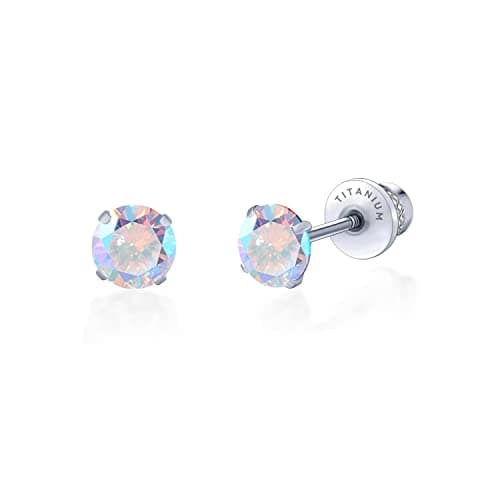
Limerencia F136 Titanium Screw-Back Flat-Back CZ Studs (20G)The clearest material claim in this whole category: the standard number, the gauge and the fastening are all in the title before you have clicked anything.
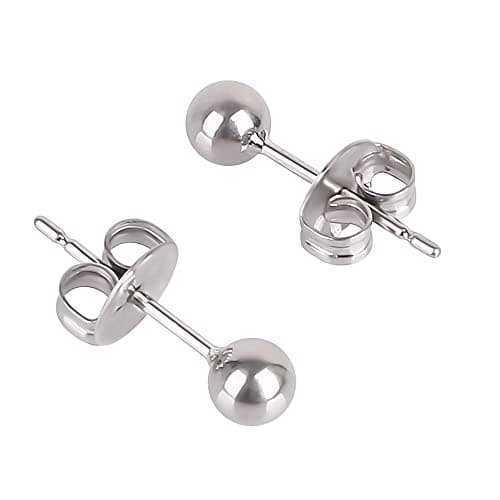
VGACETI Pure Titanium Ball Post Studs, 3mm and 4mmThe rare listing that says nickel-free rather than hypoallergenic, and names the post specifically rather than the earring generally.
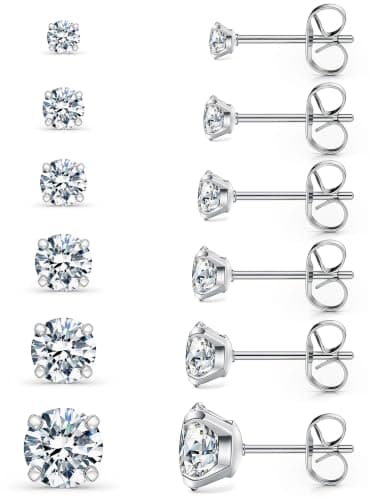
316L Stainless Steel CZ Studs, 6 pairs (3–8mm)The grade number is in the title, which is the single thing that separates a useful steel listing from a decorative one.
“Score” is a disclosure score, not a test result. It rates how completely the seller states the post metal, the back metal and the nickel claim, and how that metal holds up for reactive skin. The full rubric is published on our methodology page.
The clearest material claim in this whole category: the standard number, the gauge and the fastening are all in the title before you have clicked anything.
Post material
F136 implant-grade titanium, 20 gauge
From the seller’s own product title: “Limerencia Hypoallergenic G23 Implant Grade Titanium Screw Back Earrings | 20G F136 Pure Titanium Flat Back CZ Studs”
Back material
Screw-on flat back; the same titanium is implied but the metal is not separately named
Not named in the seller’s product title — the headline nearly every buyer reads. That omission is the finding, not a gap in our notes.
Nickel claim
Says hypoallergenic, not nickel-free. The seller’s own words: “Hypoallergenic G23 Implant Grade Titanium”
Two numbers do all the work here. F136 is the ASTM specification for the Ti-6Al-4V ELI alloy used in surgical implants, and G23 is the grade designation for that same alloy. A seller putting both in the title is pointing at a published document rather than reaching for an adjective, and that is rarer than it should be.
The flat back matters as much as the metal. A flat disc sits against the back of the lobe instead of a butterfly clip pressing a small area, which is why piercers use this shape for anything that has to be slept in. Combined with a screw thread rather than a friction push-fit, it is about as low-drama as an earring gets.
What the title does not do is name the back separately. In practice a screw-back on a titanium post is almost always the same titanium, and the design leaves little room for it to be anything else — but the seller has not committed to it in the headline, and we score what is stated rather than what is likely.
Who it’s for
Anyone who has reacted to something before and wants to stop running experiments. Also the sensible default for a piercing you intend to sleep in.
Skip it if
Skip this if you want a decorative statement earring. A 20-gauge flat-back CZ stud is deliberately unobtrusive, and if you want to be seen wearing something, this is not it.
VGACETI Pure Titanium Ball Post Studs, 3mm and 4mm
The rare listing that says nickel-free rather than hypoallergenic, and names the post specifically rather than the earring generally.
Post material
Pure titanium, ball post construction
From the seller’s own product title: “Ball Stud Titanium Earrings,Hypoallergenic for Women High Polished Colored for Sensitive Ears, 3mm and 4mm Pure Titanium Nickel-Free Lead-Free”
Back material
Not named in the title
Not named in the seller’s product title — the headline nearly every buyer reads. That omission is the finding, not a gap in our notes.
Nickel claim
Explicitly nickel-free. The seller’s own words: “Pure Titanium Nickel-Free Lead-Free”
This is the strongest nickel language on this page and the reason the pick is here. 'Nickel-free' is a definite factual claim about composition that the seller can be held to. 'Hypoallergenic' is not. Almost every competing listing chooses the second and this one chose the first.
Commercially pure titanium rather than the F136 alloy: no aluminum, no vanadium, one element. Slightly softer, which is why you see it as balls and discs rather than as thin structural parts, and completely fine for a healed lobe.
A 3mm or 4mm ball is the smallest sensible everyday earring. It is what you put in when you want the piercing to stay open and otherwise want to forget it exists, and at this price there is no reason to compromise on the metal to get it.
Who it’s for
First purchase for someone who has just worked out that nickel is the problem. Cheap enough to be a low-stakes test of whether titanium fixes it.
Skip it if
Skip this if you want the earring to be visible from more than a foot away. A polished 3mm ball is jewelry in the technical sense only.
The grade number is in the title, which is the single thing that separates a useful steel listing from a decorative one.
Post material
316L stainless steel
From the seller’s own product title: “6 Pairs Stud Earrings Set, Hypoallergenic Cubic Zirconia 316L Earrings Stainless Steel CZ Earrings 3-8mm (Steel color)”
Back material
Not named in the title
Not named in the seller’s product title — the headline nearly every buyer reads. That omission is the finding, not a gap in our notes.
Nickel claim
Says hypoallergenic, not nickel-free. The seller’s own words: “Hypoallergenic Cubic Zirconia 316L”
'316L' is doing all the work in this title. Most steel jewelry is sold as 'surgical steel', which has no legal definition for jewelry and could be 304, 430 or something unnumbered. A specific alloy designation is a claim you can go and read about, and 316L is the good one — the molybdenum in it is what resists pitting in sweat.
Six sizes from 3mm to 8mm covers most of what anyone actually wears, and cubic zirconia at this price is exactly what you would expect: bright when new, gradually less so.
For the large majority of people, including many with a mild nickel sensitivity, this is the correct everyday answer and titanium is an upgrade they do not need.
Who it’s for
Anyone who wears steel without trouble and wants a full size range for the price of one titanium pair.
Skip it if
Skip this if you have reacted to surgical steel before. 316L contains eight to twelve percent nickel by weight even though it releases very little, and if you are past that threshold no grade number will help.
Is hypoallergenic jewelry regulated in the United States?+
No. There is no federal definition of the term for jewelry and no test a piece must pass to use it. The FDA has said the word has no meaningful legal definition even in cosmetics, which it does regulate. Jewelry has less oversight than that.
What metal jewelry is hypoallergenic?+
In rough order: implant-grade titanium, niobium, commercially pure titanium, high-karat yellow gold, platinum, then 316L surgical stainless steel. Plated base metals are last, because what matters is the core under the plating and the listing rarely names it.
Does hypoallergenic mean nickel-free?+
No, and treating them as synonyms is the single most expensive mistake in this category. “Nickel-free” is a claim about a specific metal being absent. “Hypoallergenic” is a claim about likelihood, with nothing behind it. The difference in full.
Can I be allergic to something other than nickel?+
Yes. Cobalt and chromium are both recognized contact allergens and both turn up in jewelry alloys, and some people react to the adhesives used to set stones. Nickel is by far the most common trigger, which is why it dominates the labeling, but it is not the only one. Which one you are reacting to is a question for a clinician, not for us.
Why do cheap earrings sometimes work fine and expensive ones do not?+
Because price tracks the decorative front and the brand, not the post. A $12 pair of implant-grade titanium studs will treat your ear better than a $200 pair of white gold earrings alloyed with nickel. The metal in contact with the piercing is the variable, and it is only loosely related to what you paid.