Skip to content
Gentle CaratGentle Carat home

Hypoallergenic sunglasses and titanium frames

Glasses touch you in three places, all of them small, all of them under constant pressure. Which is why frame reactions are so specific and so easy to mislocate.

By Scooter M. · Verified on

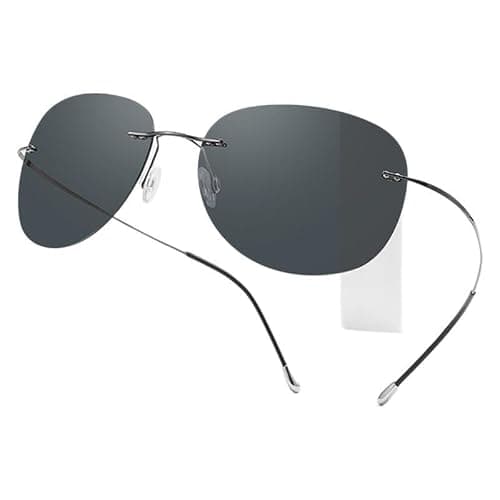
Thin metal-framed sunglasses on a plain white surface

Gentle Carat earns a commission when you buy through the links on this page, at no extra cost to you. It never decides what we recommend or how we rank it — here is the full disclosure.

Frames touch skin in exactly three places: the bridge of the nose and behind each ear. All three are small areas under constant pressure with sweat trapped underneath, which is why a frame reaction shows up as two red patches behind the ears and one on the nose rather than as a general rash. Titanium removes the nickel question; the nose pads and temple tips are usually a separate material and a separate answer.

Locate the reaction before you buy anything

Where a frame reaction appears tells you which component to change, and it is not always the frame.
Where the mark isWhat is touching you thereFirst thing to change
On the sides of the nose bridgeNose pads — usually silicone or acetate, not the frame metalThe pads. They are cheap and often replaceable.
Directly on the top of the nose bridgeThe frame bridge itself, on a saddle-bridge designThe frame metal, or a frame with separate pads.
Behind the earsTemple tips — usually plastic or rubber sleeves over the armThe tips, or a frame with metal-free arms.
Along the temple armsBare frame metalThe frame metal. Titanium is the fix.
Where a frame reaction appears tells you which component to change, and it is not always the frame.

Why rimless designs help

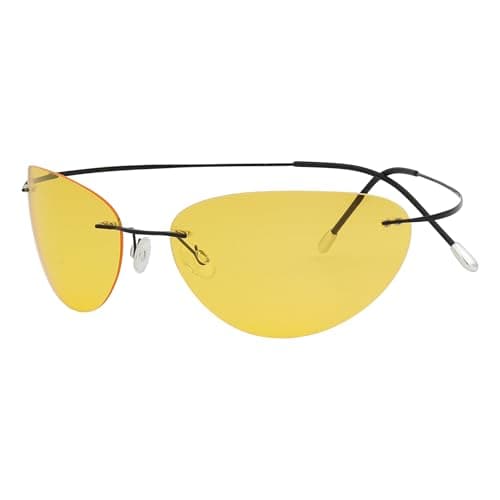
A rimless frame removes the metal from around the lenses, leaving only the bridge and the two temple arms. Less metal means less exposure, and on a frame worn for eight hours a day that is not a trivial reduction.

The trade-off is fragility. Rimless lenses are mounted on screws through drilled holes, which is a genuinely more delicate construction than a full rim. If you are hard on sunglasses, a full-rim titanium frame is the more sensible purchase.

The screws nobody mentions

Even on a frame sold as titanium, the tiny screws holding the hinges and lens mounts are frequently stainless steel, because titanium is difficult to machine at that scale. They are usually nowhere near your skin, so it rarely matters — but it is why “100% titanium” claims and screwless designs exist as a selling point.

Weight matters more here than anywhere else

A heavy frame concentrates pressure on the bridge of the nose, and sustained pressure produces indentations and soreness that look like a reaction and are not one. If your complaint is dents rather than itching, weight is the variable to change first — and titanium’s density advantage is the whole reason ultralight frames are made from it.

Quick picks

Ranked on what the seller actually discloses. Tap a row for the full write-up, or go straight to the listing.

#ProductBest forScorePrice
1Eyekepper Pilot Rimless Titanium Polarized SunglassesEyekepper Pilot Rimless Titanium Polarized SunglassesRimless titanium is the least metal a pair of glasses can put against your face, which is exactly the point.Minimal metal contact5.8disclosureCheck price
2RONSOU Ultralight Rimless Titanium Polarized SunglassesRONSOU Ultralight Rimless Titanium Polarized SunglassesFrameless titanium at a weight where you stop noticing them, which for a pressure-sensitive nose is the more useful variable.The lightest frame5.8disclosure$17.99 · Amazon
3No-Screw Rimless Titanium Polarized SunglassesNo-Screw Rimless Titanium Polarized SunglassesA screwless rimless construction, which removes the small steel screws that are usually the one non-titanium part of a titanium frame.Fewer parts to fail6disclosure$19.99 · Amazon
4Qi Song Ultra-Light Flexible Pure Titanium Rimless SunglassesQi Song Ultra-Light Flexible Pure Titanium Rimless SunglassesPure titanium rather than an alloy, in a rimless frame sold on how far it flexes — which is the practical answer for a pair that lives in a bag.A frame that bends instead of breaking6disclosure$29.99 · Amazon
5Pure Titanium Polarized Sunglasses, FramelessPure Titanium Polarized Sunglasses, FramelessThe one frame on this shelf that says what rests on your nose. Every other listing names the metal and goes quiet about the two parts actually touching your skin.The only listing here that names the nose pads6.8disclosure$39.99 · Amazon

“Score” is a disclosure score, not a test result. It rates how completely the seller states the post metal, the back metal and the nickel claim, and how that metal holds up for reactive skin. The full rubric is published on our methodology page.

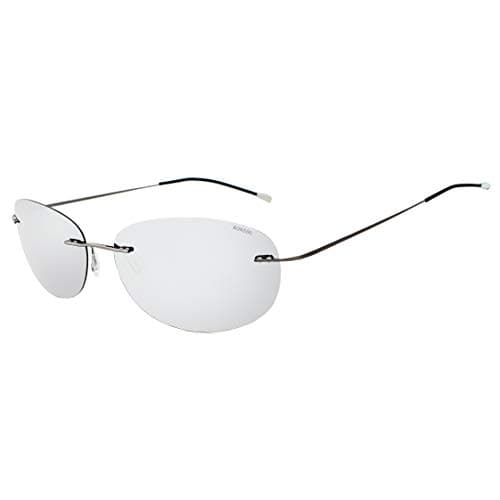
Eyekepper Pilot Rimless Titanium Polarized Sunglasses

#1 · Minimal metal contact

Eyekepper Pilot Rimless Titanium Polarized Sunglasses

Rimless titanium is the least metal a pair of glasses can put against your face, which is exactly the point.

Post material
Titanium frame
From the seller’s own product title: “Eyekepper Pilot Rimless Titanium Polarized Sunglasses for Men and Women”
Back material
Nose pads and temple tips not named in the title — the two contact points that matter most
Not named in the seller’s product title — the headline nearly every buyer reads. That omission is the finding, not a gap in our notes.
Nickel claim
Names a metal, makes no nickel claim. The seller’s own words: “Rimless Titanium Polarized Sunglasses”

Glasses touch skin in exactly three places: the bridge of the nose, and behind each ear. Those are small areas under constant pressure and constant sweat, which is why a nickel reaction from spectacle frames shows up as two red patches behind the ears and one on the nose rather than as a general rash.

A rimless design removes the metal from around the lenses entirely, leaving only the bridge and the temples. Less metal is less exposure, and on a frame worn all day that is not a trivial reduction.

The catch is that the two remaining contact points — nose pads and temple tips — are usually silicone or acetate rather than the frame metal, and the title does not say. If your reaction is on the nose specifically, the pads are the first thing to change, and they are replaceable on most rimless frames.

Who it’s for

Anyone who has had red marks from metal frames and wants to minimize the contact area rather than gamble on a different alloy.

Skip it if

Skip this if you are rough with sunglasses. Rimless frames mount the lenses on screws through drilled holes, which is a genuinely more fragile construction than a full rim.

Disclosure score

5.8

  • Post metal stated7
  • Back metal stated2
  • Strength of nickel claim4
  • Material for reactive skin9
  • Everyday wearability7

A disclosure score, not a test result. Nobody here wore these. Read how the rubric works.

RONSOU Ultralight Rimless Titanium Polarized Sunglasses

#2 · The lightest frame

RONSOU Ultralight Rimless Titanium Polarized Sunglasses

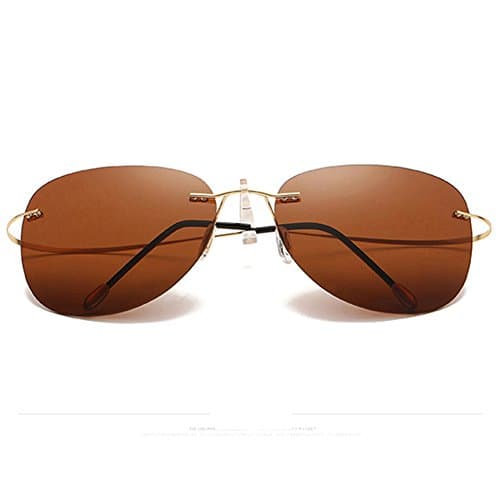
Frameless titanium at a weight where you stop noticing them, which for a pressure-sensitive nose is the more useful variable.

Post material
Titanium alloy frame
From the seller’s own product title: “RONSOU Ultralight Rimless Polarized Sunglasses for Men Women Vintage Titanium Frameless Colorful Fashion Shades”
Back material
Nose pads and temple tips not named in the title
Not named in the seller’s product title — the headline nearly every buyer reads. That omission is the finding, not a gap in our notes.
Nickel claim
Names a metal, makes no nickel claim. The seller’s own words: “Vintage Titanium Frameless”

Weight matters more than people expect for frames. A heavy pair concentrates pressure on the bridge of the nose, and sustained pressure produces marks and soreness that look like a reaction but are not one. If your complaint is indentations rather than itching, weight is the variable to change first.

Titanium's density advantage — roughly 45 percent lighter than steel for the same shape — is the whole reason ultralight frames are made from it.

As with all the frames here, the nose pads are unspecified and are the most likely point of contact irritation. They are also usually the cheapest part to replace.

Who it’s for

Anyone whose glasses leave dents on the bridge of their nose, or who wears sunglasses for many hours at a stretch.

Skip it if

Skip this if you want a bold frame. Ultralight frameless designs are deliberately near-invisible and will not make a style statement.

Disclosure score

5.8

  • Post metal stated7
  • Back metal stated2
  • Strength of nickel claim4
  • Material for reactive skin8
  • Everyday wearability8

A disclosure score, not a test result. Nobody here wore these. Read how the rubric works.

$17.99 · View on Amazon

#ad We earn a commission at no cost to you. Price as of October 27, 2026.

No-Screw Rimless Titanium Polarized Sunglasses

#3 · Fewer parts to fail

No-Screw Rimless Titanium Polarized Sunglasses

A screwless rimless construction, which removes the small steel screws that are usually the one non-titanium part of a titanium frame.

Post material
Titanium frame, screwless construction
From the seller’s own product title: “Titanium No Screw Rimless Polarized Sunglasses For Men Women”
Back material
Nose pads and temple tips not named in the title
Not named in the seller’s product title — the headline nearly every buyer reads. That omission is the finding, not a gap in our notes.
Nickel claim
Names a metal, makes no nickel claim. The seller’s own words: “Titanium No Screw Rimless”

The screws are the detail nobody mentions. A conventional rimless frame mounts each lens with a tiny screw, and those screws are frequently stainless steel because titanium is difficult to machine at that size. On a frame otherwise sold as titanium, they are the one component that is not.

A screwless design removes them. Whether that matters to you depends on whether the screws are anywhere near your skin — usually they are not, sitting at the lens mount rather than at a contact point — but it does mean fewer things to loosen and lose.

The title names titanium and stops there. No grade, no alloy, and no indication of which parts are titanium and which are not — which on this shelf is the norm rather than an outlier, and the reason the nose pads and temple tips are a separate question from the frame.

Who it’s for

Anyone who has lost a rimless frame to a missing screw, and anyone who wants the frame to be one material throughout.

Skip it if

Skip this if you need frequent professional adjustment. Screwless constructions can be harder for an optician to work on than a conventional mount.

Disclosure score

6

  • Post metal stated7
  • Back metal stated3
  • Strength of nickel claim4
  • Material for reactive skin9
  • Everyday wearability7

A disclosure score, not a test result. Nobody here wore these. Read how the rubric works.

$19.99 · View on Amazon

#ad We earn a commission at no cost to you. Price as of October 27, 2026.

Qi Song Ultra-Light Flexible Pure Titanium Rimless Sunglasses

#4 · A frame that bends instead of breaking

Qi Song Ultra-Light Flexible Pure Titanium Rimless Sunglasses

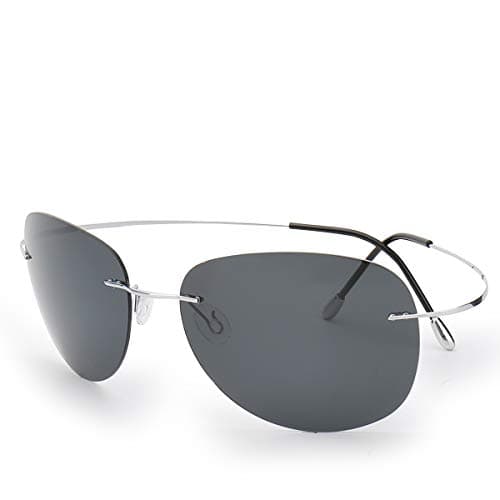
Pure titanium rather than an alloy, in a rimless frame sold on how far it flexes — which is the practical answer for a pair that lives in a bag.

Post material
Pure titanium frame, rimless
From the seller’s own product title: “Qi Song Ultra-light Flexible Pure Titanium Rimless Polarized Sunglasses (Grey)”
Back material
Nose pads and temple tips not named in the title
Not named in the seller’s product title — the headline nearly every buyer reads. That omission is the finding, not a gap in our notes.
Nickel claim
Names a metal, makes no nickel claim. The seller’s own words: “Flexible Pure Titanium Rimless”

Commercially pure titanium is one element rather than an alloy: no aluminum, no vanadium, and nothing that could be nickel. It is also softer than the Ti-6Al-4V alloy, and that softness is the whole reason a frame made from it can be bent back into shape rather than snapping.

Flex is the useful property for a pair you carry rather than a pair you display. A frame that gives when it is sat on or crushed in a bag survives the thing that actually kills sunglasses, which is not sunlight.

Rimless means less frame against your face to begin with — only the bridge and the temples touch you. The trade-off is the lens mounts, which are the fragile part of any rimless design regardless of the metal.

Who it’s for

Bags, travel, and anyone who has broken enough sunglasses to want a frame with some give in it.

Skip it if

Skip this if you want a bold frame. Ultra-light rimless designs are deliberately near-invisible, and pure titanium is the softest of the titanium options — it will mark more readily than Grade 5.

Disclosure score

6

  • Post metal stated8
  • Back metal stated2
  • Strength of nickel claim4
  • Material for reactive skin9
  • Everyday wearability7

A disclosure score, not a test result. Nobody here wore these. Read how the rubric works.

$29.99 · View on Amazon

#ad We earn a commission at no cost to you. Price as of October 27, 2026.

Pure Titanium Polarized Sunglasses, Frameless

#5 · The only listing here that names the nose pads

Pure Titanium Polarized Sunglasses, Frameless

The one frame on this shelf that says what rests on your nose. Every other listing names the metal and goes quiet about the two parts actually touching your skin.

Post material
Pure titanium, stated as pure rather than as an alloy
From the seller’s own product title: “Pure Titanium Polarized Sunglasses for Men Women”
Back material
Soft silicone nose pads, named in the title. Temple tips are still not named, so one of the two contact points is settled and one is not
From the seller’s own product title: “soft silicone nose pads”
Nickel claim
Names a metal, makes no nickel claim. The seller’s own words: “Pure Titanium Polarized Sunglasses”

This is ranked here for one phrase: "soft silicone nose pads". A frame touches skin in three places — the bridge of the nose and behind each ear — and on this shelf every other listing names the frame metal and then says nothing whatever about the pads. Silicone is inert, it is not a metal, and naming it closes the single biggest open question on this page.

"Pure titanium" is also a stronger claim than plain "titanium". Commercially pure titanium is one element rather than an alloy, so there is no aluminum, no vanadium and nothing else to react to. It is softer than Grade 5 and marks more easily, which is a durability trade rather than a skin one.

The honest reservations are about the listing rather than the material. There is no published brand — Amazon shows the seller as "Generic" — the title is machine-translated enough to contain a stray full-width comma, and it sits at the top of this page's price range. You are paying more for a frame with no name on it, and buying it on the strength of what it discloses rather than on a reputation.

Who it’s for

Anyone who has worked out that the rash sits on the bridge of their nose rather than anywhere the frame metal touches, and who wants that part specified before buying.

Skip it if

Skip this if a brand name matters to you, or if you want the cheapest titanium frame here — this is the dearest pick on the page and the one with the least behind it commercially. The temple tips are still unnamed, so if your reaction is behind the ears this does not settle it.

Disclosure score

6.8

  • Post metal stated8
  • Back metal stated7
  • Strength of nickel claim4
  • Material for reactive skin9
  • Everyday wearability6

A disclosure score, not a test result. Nobody here wore these. Read how the rubric works.

$39.99 · View on Amazon

#ad We earn a commission at no cost to you. Price as of October 27, 2026.

Questions people actually ask

Can sunglasses cause an allergic reaction?

Yes, and it is fairly common. Frames touch skin at the nose bridge and behind both ears under constant pressure. Nickel from a monel frame is the usual cause; the nose pads and temple tips are the other candidates.

Are titanium sunglasses worth it?

If metal frames have marked or irritated you before, yes — titanium contains no nickel and is much lighter, which addresses both the allergy and the pressure problem. If frames have never bothered you, the benefit is mostly weight.

What are eyeglass frames usually made of?

Cheap metal frames are usually monel, a nickel-copper alloy, which is why frame reactions are common. Better ones are titanium, stainless steel or beta-titanium. Plastic frames are typically acetate or TR-90.

Can I replace the nose pads on my glasses?

On most screw-mounted metal frames, yes, for a few dollars. Titanium and silicone replacement pads are sold specifically for people who react. It is the cheapest possible fix and worth trying before replacing a frame.

Are plastic frames a safer option?

Usually, since acetate contains no metal. The hinges and any core wire inside the arms are still metal, and some people react to acetate itself or to the plasticizers in it — less commonly than to nickel, but it happens.

Sources

Read next