Gentle Carat earns a commission when you buy through the links on this page, at no extra cost to you. It never decides what we recommend or how we rank it — here is the full disclosure.
“Implant grade” almost always means ASTM F-136, a standard for a Ti-6Al-4V ELI alloy — titanium with about 6 percent aluminum and 4 percent vanadium, made to extra-low-interstitial purity for surgical implants. Plain “titanium” on a listing can mean that same alloy, or commercially pure titanium, or a base metal with a titanium-colored coating. Only one of the three is promised anything by a standards body.
The three things a listing can mean by titanium
The four phrases that all contain the word titanium, and what each actually delivers.
What the listing says
What you are actually getting
Good for a piercing?
ASTM F-136 / G23 / implant grade
Ti-6Al-4V ELI alloy, made to a published surgical-implant composition standard. No nickel deliberately added.
Yes. This is the reference standard and what most piercers use.
Commercially pure titanium / Grade 1 or 2 / G23 unqualified
Unalloyed titanium. Softer, equally nickel-free, no ELI purity requirement.
Yes, for healed piercings. Excellent metal.
Titanium plated / titanium coated / IP titanium
A base metal — usually steel or brass — with a thin titanium-colored surface layer.
No. The coating wears at the post first, exposing whatever is underneath.
Titanium steel
A marketing coinage for stainless steel. Not a titanium alloy and not a recognized material designation.
It is steel. Judge it as steel, not as titanium.
The four phrases that all contain the word titanium, and what each actually delivers.
What F-136 actually specifies, and what it does not
ASTM F-136 is a composition and mechanical properties standard. It states what the alloy must be made of, how pure it must be, and how it must behave mechanically. That is genuinely useful: an alloy specified this tightly does not contain nickel as an intentional element, and the ELI designation limits interstitial impurities like oxygen and iron.
What it does not do is measure nickel release. That is a different standard entirely — EN 1811, which is the test method behind the European limits. So a seller citing F-136 is telling you what the metal is, not what it emits. For titanium those two things line up, because there is nothing there to emit. But it is worth understanding that they are separate claims, especially when a seller cites F-136 for a product where only the post is titanium.
The aluminum and vanadium question
People occasionally worry about the aluminum and vanadium in Ti-6Al-4V, since both are metals and neither sounds friendly. The relevant point is that they are alloyed into a titanium matrix which forms a stable, tenacious oxide layer, and the whole assembly is used inside the human body for hip replacements and bone screws precisely because it does not release meaningfully into tissue.
If you want to avoid the alloying elements entirely, the answer is commercially pure titanium (Grade 1 or Grade 2) or niobium, both of which are elemental rather than alloyed. Pure titanium is softer, which limits how thin a post can be made, which is why implant-grade alloy dominates the piercing market.
How to check a listing in thirty seconds
Look for a number. F-136, F-67, G23, Grade 2. A number means someone is pointing at a document. No number means an adjective.
Look for the word “plated” or “coated”. If it appears anywhere near the word titanium, you are buying a coating.
Check what the number applies to. “F136 titanium post with stainless steel back” is a much more informative sentence than “F136 titanium earrings”, and honest sellers write the first one.
Ignore “titanium steel” entirely. It is steel with a nicer adjective.
Does it matter for a healed piercing?
Less than the internet suggests. For a lobe that healed years ago and tolerates metal reasonably, commercially pure titanium is completely adequate and so, for most people, is 316L steel. The implant grade earns its keep in three specific cases: a healing piercing, a cartilage piercing (which heals for months and is far less forgiving), and ears that have already demonstrated they react to steel.
That is not a reason to avoid it — implant-grade titanium jewelry is inexpensive and there is no penalty for buying the better metal. It is a reason not to feel that a plain titanium stud you already own is somehow dangerous.
All three picks below state a grade on the listing, which is the whole point of this page. Ordering is by how specific that claim is.
Quick picks
Ranked on what the seller actually discloses. Tap a row for the full write-up, or go straight to the listing.
#
Product
Best for
Score
Price
1
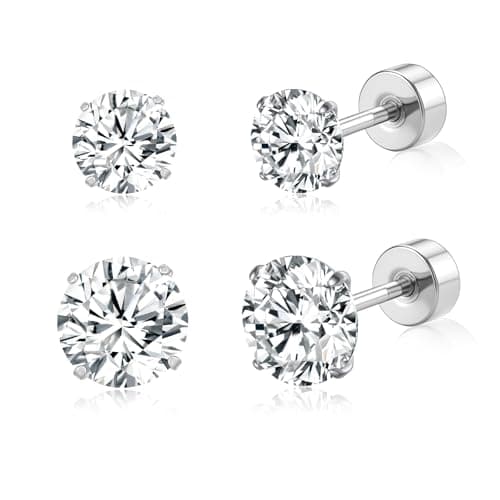
Limerencia F136 Titanium Screw-Back Flat-Back CZ Studs (20G)The clearest material claim in this whole category: the standard number, the gauge and the fastening are all in the title before you have clicked anything.
G23 Titanium Flat-Back CZ Studs, 20G (plated finish)An implant-grade post with a plated decorative front — the right way round, and the title is unusually clear about which part is which.
G23 Implant-Grade Titanium CZ Studs, 4-8mm (5 pairs)Runs up to 8mm while still putting the grade designation in the title, which larger stones usually stop doing — and it is the rare listing that names its own back.
“Score” is a disclosure score, not a test result. It rates how completely the seller states the post metal, the back metal and the nickel claim, and how that metal holds up for reactive skin. The full rubric is published on our methodology page.
The clearest material claim in this whole category: the standard number, the gauge and the fastening are all in the title before you have clicked anything.
Post material
F136 implant-grade titanium, 20 gauge
From the seller’s own product title: “Limerencia Hypoallergenic G23 Implant Grade Titanium Screw Back Earrings | 20G F136 Pure Titanium Flat Back CZ Studs”
Back material
Screw-on flat back; the same titanium is implied but the metal is not separately named
Not named in the seller’s product title — the headline nearly every buyer reads. That omission is the finding, not a gap in our notes.
Nickel claim
Says hypoallergenic, not nickel-free. The seller’s own words: “Hypoallergenic G23 Implant Grade Titanium”
Two numbers do all the work here. F136 is the ASTM specification for the Ti-6Al-4V ELI alloy used in surgical implants, and G23 is the grade designation for that same alloy. A seller putting both in the title is pointing at a published document rather than reaching for an adjective, and that is rarer than it should be.
The flat back matters as much as the metal. A flat disc sits against the back of the lobe instead of a butterfly clip pressing a small area, which is why piercers use this shape for anything that has to be slept in. Combined with a screw thread rather than a friction push-fit, it is about as low-drama as an earring gets.
What the title does not do is name the back separately. In practice a screw-back on a titanium post is almost always the same titanium, and the design leaves little room for it to be anything else — but the seller has not committed to it in the headline, and we score what is stated rather than what is likely.
Who it’s for
Anyone who has reacted to something before and wants to stop running experiments. Also the sensible default for a piercing you intend to sleep in.
Skip it if
Skip this if you want a decorative statement earring. A 20-gauge flat-back CZ stud is deliberately unobtrusive, and if you want to be seen wearing something, this is not it.
An implant-grade post with a plated decorative front — the right way round, and the title is unusually clear about which part is which.
Post material
G23 / F136 implant-grade titanium, 20 gauge
From the seller’s own product title: “20G G23 Implant Grade Titanium Flat Back Stud Earrings for Women Men, Gold/White Gold Plated Tragus Labret Cartilage Helix F136 Piercing Jewelry for Sensitive Ears”
Back material
Flat back; metal not separately named
Not named in the seller’s product title — the headline nearly every buyer reads. That omission is the finding, not a gap in our notes.
Nickel claim
Names a metal, makes no nickel claim. The seller’s own words: “G23 Implant Grade Titanium ... F136”
This is the plating arrangement to look for. The gold appears in the title attached to the decorative end — 'Gold/White Gold Plated' — while the structural claim, G23 and F136, attaches to the post. A plated front over a titanium post is a completely different proposition from a plated post, because the plating is nowhere near your piercing.
Most listings do not draw that distinction, which is why plated jewelry has a bad reputation it only half deserves. Plating is not the problem; plating on the wrong component is.
Twenty gauge is the standard for a healed lobe or a cartilage piercing done at that size. If your piercing was done at 18 gauge, a 20-gauge post will fit but will move around in the channel more than you want.
Who it’s for
Helix, tragus and conch piercings where you want a gold look and cannot risk the metal that goes through the hole.
Skip it if
Skip this if your piercing is 18 gauge or larger. A thinner post in a wider channel migrates and irritates, and the fix is the right gauge rather than a better metal.
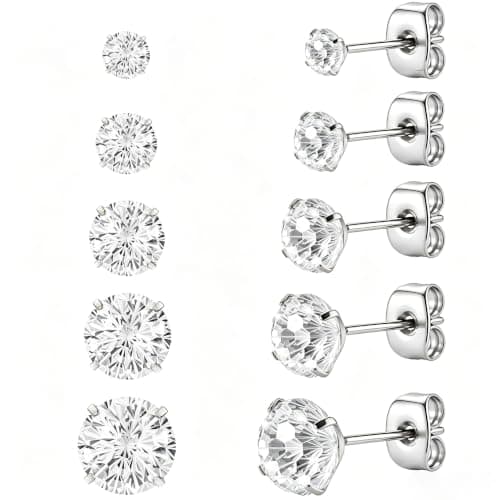
Runs up to 8mm while still putting the grade designation in the title, which larger stones usually stop doing — and it is the rare listing that names its own back.
Post material
G23 implant-grade titanium
From the seller’s own product title: “5 Pairs G23 Titanium Stud Earrings Set for Women Men- Hypoallergenic Implant Grade Titanium Fireworks Cut Cubic Zirconia CZ Studs with Butterfly Back for Sensitive Ears Safe Jewelry Gifts 4-8mm”
Back material
Butterfly back, stated in the title — material of the clutch itself not named
From the seller’s own product title: “with Butterfly Back”
Nickel claim
Says hypoallergenic, not nickel-free. The seller’s own words: “Hypoallergenic Implant Grade Titanium”
Size is the interesting thing here. Safe-metal earrings cluster at 3mm to 5mm because small is cheap to make in a hard metal. A range running to 8mm on a titanium post is a genuinely different look, and the grade claim survives the size increase.
This is one of the few listings on the site that names its back at all. That is worth real credit — and it is also the catch, because a butterfly clutch is the fitting this site likes least: it has a fold that traps debris, and the title stops short of saying what the clutch is made of. A stated butterfly is still better than an unstated nothing.
An 8mm stud is heavier, which is the thing to weigh against the metal being lighter. Titanium's density advantage does not fully offset a stone four times the volume.
Five pairs across the range means you are buying a set rather than one earring, so check which size you actually intend to wear before the whole box arrives in sizes you do not.
Who it’s for
Anyone who wants a visible stud rather than a discreet one and has been stuck with tiny safe options.
Skip it if
Skip this if your lobe piercing is stretched, thin or sore. Weight is the second most common cause of earlobe irritation after metal, and an 8mm stone is not light. If the butterfly clutch is the part that has bothered you before, take a flat-back pick instead.
What is the difference between implant grade titanium and titanium?+
Implant grade points at ASTM F-136, a published standard for a Ti-6Al-4V ELI alloy used in surgical implants. Plain titanium may mean the same alloy, commercially pure titanium, or a titanium-colored coating over a base metal. The standard number is what distinguishes them.
Is G23 titanium the same as F136?+
Nearly. G23 is Grade 23 titanium, the Ti-6Al-4V ELI alloy. F-136 is the ASTM specification that a Grade 23 alloy must meet to be sold for surgical implants. Every F-136 part is Grade 23; not every part described as G23 has been certified to F-136.
Does ASTM F136 mean nickel-free?+
It means no nickel is a deliberate alloying element, which in practice is what people mean by nickel-free. Strictly, F-136 is a composition standard rather than a nickel-release standard; the release test is EN 1811 and it is a separate document.
Is titanium plated jewelry safe for sensitive ears?+
Treat it as unsafe until the listing names the base metal. A titanium-colored coating over an unnamed core wears through fastest at the post, which is exactly the point of contact you were trying to protect.
Is titanium steel a type of titanium?+
No. “Titanium steel” is a marketing phrase for stainless steel and is not a recognized material designation. If a listing uses it, judge the product as steel.