Gentle Carat earns a commission when you buy through the links on this page, at no extra cost to you. It never decides what we recommend or how we rank it — here is the full disclosure.
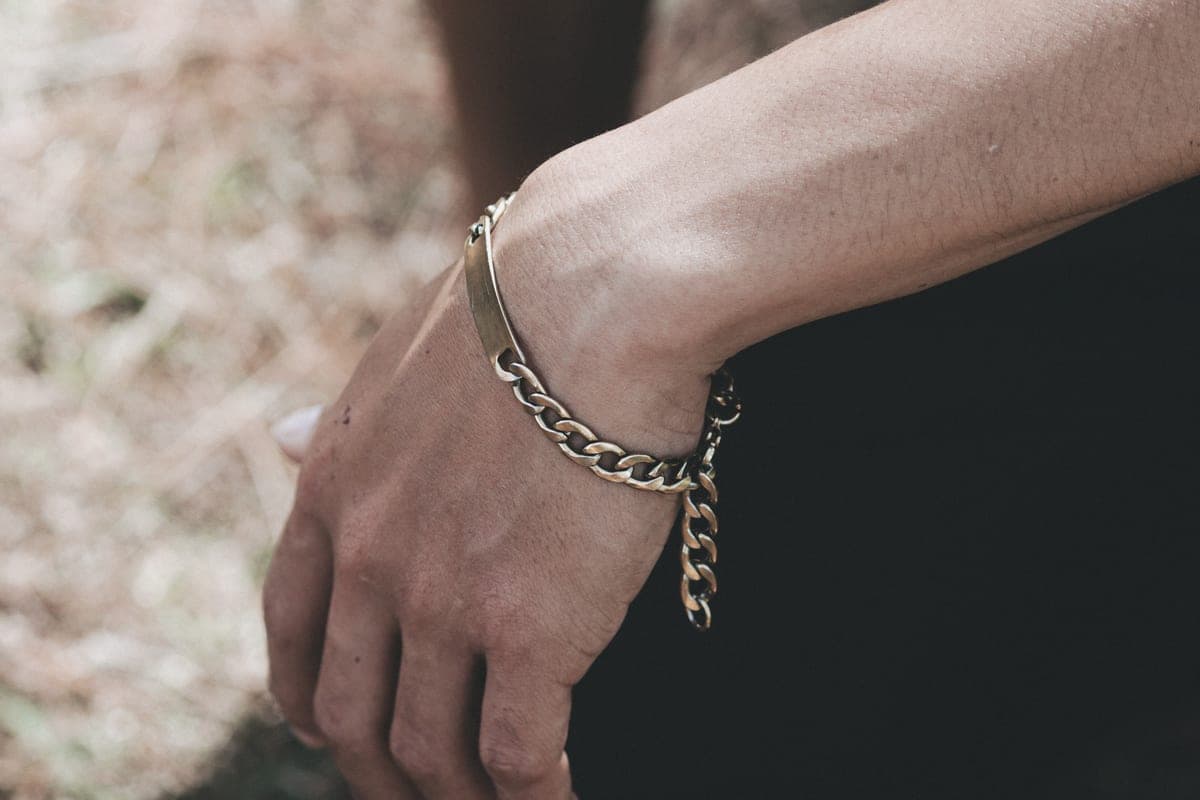
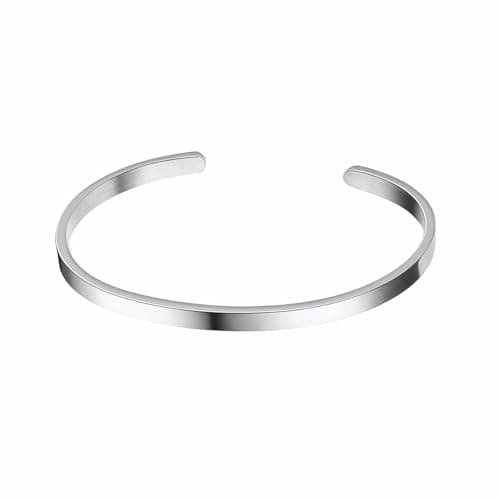
For reactive skin, an open cuff is structurally the best bracelet: there is no clasp, so there is no separately manufactured component that could be a different alloy, and the metal you read about in the listing is the metal that touches you along the whole length. Chain bracelets have a clasp, and the clasp is almost never named.
The pattern by now should be familiar
It is the same argument as earring backs and necklace clasps. Jewelry reactions cluster around the bought-in fastening rather than the main body of the piece, because fastenings are separately sourced, rarely specified, and sit against skin for the same duration as everything else.
A cuff sidesteps it entirely. One piece of metal, one material claim, no gap.
Bracelet constructions, counted by how many separately made metal parts touch you.
Bracelet type
Separate components
Fit
Best for
Open cuff
None
Adjusted by gently bending
Reactive skin, and anyone who finds clasps fiddly
Solid bangle
None
Fixed — has to pass over the hand
Set-and-forget wear
Flexible cable cuff
One (the cable)
Some give, fits a range
Comfort across a wider size range
Chain with lobster clasp
Two or more
Adjustable
Style, if the clasp metal is known
Magnetic clasp bracelet
Two, plus a plated magnet
Easy one-handed
Dexterity, not for reactive skin
Bracelet constructions, counted by how many separately made metal parts touch you.
The wrist is a demanding place for jewelry
A bracelet gets more mechanical abuse than anything else you wear. It knocks against desks and doorframes, it slides up and down the forearm, it goes into every sink you use, and it sits over the underside of the wrist where skin is thin and blood vessels are close to the surface.
That last point is why watch bands and bracelets produce reactions in people who wear earrings without trouble — and why the same question applies to a watch strap, which is worn even longer.
Fit, since a cuff cannot be adjusted infinitely
Cuffs are sized by the internal circumference plus the gap. They are adjusted by carefully bending them, and every bend work-hardens the metal a little. Titanium in particular does not enjoy repeated flexing.
Practically: adjust it once to fit, then leave it. If you need something that goes on and off several times a day, a flexible cable cuff or a properly specified clasp bracelet will last longer than a rigid cuff you keep opening.
Quick picks
Ranked on what the seller actually discloses. Tap a row for the full write-up, or go straight to the listing.
#
Product
Best for
Score
Price
1
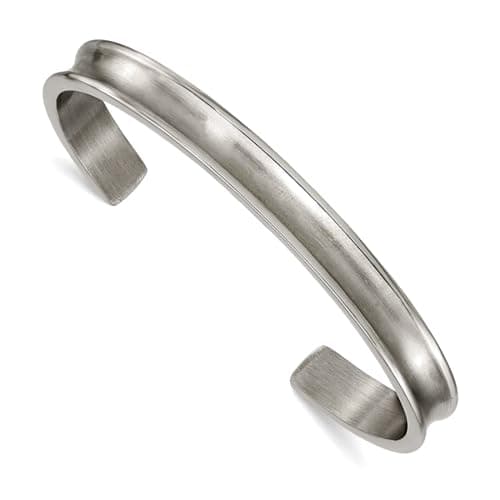
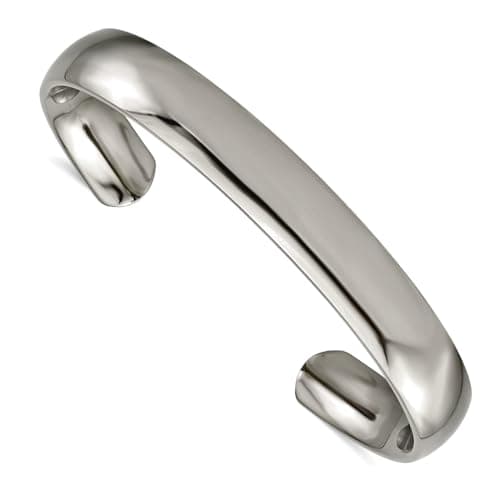
JewelryWeb Polished Titanium Cuff Bangle, 10mmA solid titanium cuff. No clasp, no hinge, no second component — the simplest possible construction for reactive skin.
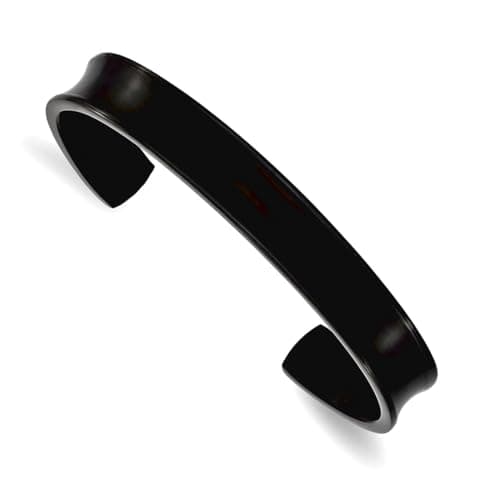
JewelryWeb Black IP-Plated Titanium Cuff Bangle, 10mmThe same titanium cuff with a black ion-plated finish — and ion plating is a coating, which is the whole caveat.
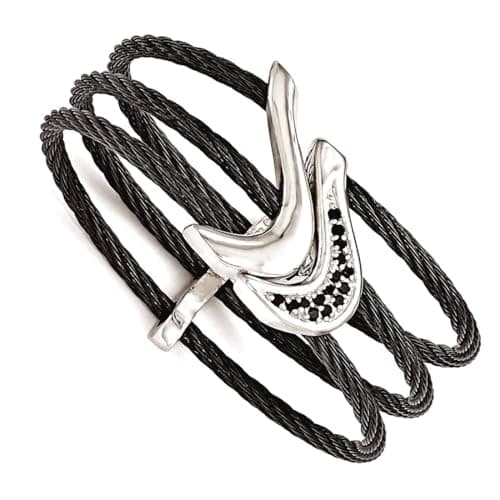
JewelryWeb Titanium and Sterling Silver Flexible Cable CuffTitanium and sterling silver together with a spinel stone — more decorative, and one more alloy in the mix.
“Score” is a disclosure score, not a test result. It rates how completely the seller states the post metal, the back metal and the nickel claim, and how that metal holds up for reactive skin. The full rubric is published on our methodology page.
#1 · A wide cuff with no clasp
JewelryWeb Polished Titanium Cuff Bangle, 10mm
A solid titanium cuff. No clasp, no hinge, no second component — the simplest possible construction for reactive skin.
Post material
Titanium, 10mm wide
From the seller’s own product title: “JewelryWeb Titanium Polished Cuff Stackable Bangle Bracelet 10mm Wide Cuff Bracelet for Women”
Back material
Open cuff — no clasp or fastening component at all
From the seller’s own product title: “Cuff Stackable Bangle Bracelet”
Nickel claim
Names a metal, makes no nickel claim. The seller’s own words: “Titanium Polished Cuff Stackable Bangle Bracelet”
The clasp is the weak point of almost every bracelet: it is a separate part, often a different alloy, and it sits against the underside of the wrist where skin is thin. An open cuff has no clasp at all, so what you read about is what touches you, everywhere.
That single structural fact is why cuffs are worth recommending for reactive skin over chain bracelets, more or less regardless of the metal.
The title makes no hypoallergenic claim, only a material one, which is the honest way round. Titanium is doing the work; no adjective is needed.
Who it’s for
Anyone who has reacted to a bracelet and suspects the clasp, and anyone who finds fastening a chain one-handed annoying.
Skip it if
Skip this if you need an exact fit. A cuff is adjusted by gently bending it, and repeated adjustment eventually fatigues any metal.
A narrower version of the same idea, which is what you want if the plan is to wear more than one.
Post material
Titanium, 6.5mm wide, brushed with a polished edge
From the seller’s own product title: “JewelryWeb Titanium Brushed With Polished Edge 6.5mm Cuff Stackable Bangle Bracelet Cuff Bracelet for Women”
Back material
Open cuff — no clasp
From the seller’s own product title: “Cuff Stackable Bangle Bracelet”
Nickel claim
Names a metal, makes no nickel claim. The seller’s own words: “Titanium Brushed With Polished Edge”
Six and a half millimeters is roughly two-thirds the width of the cuff above, which is the difference between one statement piece and two or three that sit together without dominating the wrist.
The brushed face with a polished edge is a finish detail that reads more expensive than a uniform polish and hides day-to-day scratching better. On a bracelet, which knocks against desks and doorframes constantly, that is a practical benefit rather than a cosmetic one.
Same clasp-free construction, same single stated metal.
Who it’s for
Stacking, or a first cuff for someone who does not want a wide band on a smaller wrist.
Skip it if
Skip this if you want one substantial piece rather than several. A narrow cuff worn alone can look slight.
JewelryWeb Black IP-Plated Titanium Cuff Bangle, 10mm
The same titanium cuff with a black ion-plated finish — and ion plating is a coating, which is the whole caveat.
Post material
Titanium base with black ion plating (IP)
From the seller’s own product title: “JewelryWeb Titanium Brushed With Polished Edge Black Ip Plated 10mm Cuff Stackable Bangle Bracelet Cuff Bracelet for Women”
Back material
Open cuff — no clasp
From the seller’s own product title: “Cuff Stackable Bangle Bracelet”
Nickel claim
Names a metal, makes no nickel claim. The seller’s own words: “Titanium ... Black Ip Plated”
Ion plating is a vacuum deposition process and produces a genuinely tough coating — far harder than electroplated gold, and the same technique used on watch cases. It is not a flimsy finish.
It is still a finish. On a bracelet the wear points are the underside of the wrist and wherever the cuff rubs a sleeve, and over years the coating will thin there before anywhere else. The good news, and the reason this is still a recommendation, is that what you are left with underneath is titanium.
That is the whole test for any coated jewelry: assume the surface eventually goes, and ask what is under it. Here the answer is fine.
Who it’s for
Anyone who wants a black cuff and understands they are buying a coating over a metal they would have been happy to wear bare.
Skip it if
Skip this if you want the color to be permanent. Sandblasted or bare titanium will look the same in ten years; a plated finish will not.
JewelryWeb Titanium and Sterling Silver Flexible Cable Cuff
Titanium and sterling silver together with a spinel stone — more decorative, and one more alloy in the mix.
Post material
Titanium and 925 sterling silver, on a flexible cable
From the seller’s own product title: “JewelryWeb 27mm Titanium Black Titanium 925 Sterling Silver Polished Spinel Cable Flexible Cuff 6 Inch Cuff Bracelet for Women”
Back material
Flexible cable cuff — no clasp, but the cable is a separate component
From the seller’s own product title: “Cable Flexible Cuff 6 Inch Cuff Bracelet”
Nickel claim
Names a metal, makes no nickel claim. The seller’s own words: “Titanium Black Titanium 925 Sterling Silver”
Two metals rather than one. Titanium is nickel-free; sterling silver is usually nickel-free but the 925 standard only fixes the silver content and says nothing about the remaining 7.5 percent. So this carries slightly more uncertainty than a plain titanium cuff, and the title does not resolve it.
The flexible cable construction is a different animal from a rigid cuff: it has some give, so it fits a wider range of wrists without bending, and there is no clasp to introduce a third metal.
Spinel is a hard natural stone and is inert against skin. It is a styling element, not a variable.
Who it’s for
A dressier option for someone who tolerates sterling silver and wants something less severe than a plain metal band.
Skip it if
Skip this if you have reacted to sterling silver before. There is titanium in it, but there is also silver, and the title does not tell you which sits against your skin where.
A slim stackable bangle in 'titanium steel', which is stainless steel — judge it on that.
Post material
Stainless steel — 'titanium steel' in the title is a trade term for stainless
From the seller’s own product title: “YIJINJER Hypoallergenic Bangle Bracelets for Men Women 1 Pcs Black Cuff Metal Bracelet Stack Wrist Bangles Titanium Steel Men's Jewelry Width 6 mm”
Back material
Open cuff — no clasp
From the seller’s own product title: “Black Cuff Metal Bracelet Stack Wrist Bangles”
Nickel claim
Says hypoallergenic, not nickel-free. The seller’s own words: “Hypoallergenic Bangle Bracelets”
Third appearance of 'titanium steel' on this page, and the same answer each time: it is stainless steel, it is not a titanium alloy, and it is a perfectly reasonable metal as long as you know which one you bought.
The clasp-free cuff construction still applies and is still the main structural advantage. Whatever the alloy is, there is only one of it.
A black finish on steel is almost certainly ion plating, and the title does not say. Treat it as a coating with a service life.
Who it’s for
Stacking on a budget, for someone who wears stainless steel without trouble.
Skip it if
Skip this if you bought it thinking it was titanium. It is not, and the real titanium cuffs on this page cost more for a reason.
What is the best bracelet material for sensitive skin?+
Titanium, in a cuff or bangle form with no clasp. Niobium if titanium fails. Surgical steel is fine for most people. Avoid plated base metal for daily wear, because a bracelet abrades more than any other jewelry.
Why do bracelets irritate my wrist when earrings do not?+
The underside of the wrist has thin skin, it is a high-sweat area, and a bracelet moves and abrades constantly. Plus the clasp is usually an unstated component. All three factors are worse than for an earring in a healed lobe.
Are cuff bracelets better than chain bracelets for allergies?+
Structurally, yes. A cuff has no clasp, so there is no separately sourced component of unknown alloy. Whatever the listing says the cuff is made of is what touches you along its whole length.
Can I adjust a titanium cuff to fit?+
Gently, once. Titanium work-hardens with repeated bending, so adjust it to fit and then leave it. If you need frequent adjustment, a flexible cable design suits better.
Is black ion plating safe for sensitive skin?+
While it lasts, yes — it is a hard vacuum-deposited coating, the same technique used on watch cases. Like any coating it eventually wears at contact points, and the question then is what is underneath. On a titanium cuff the answer is fine.
Worn 24/7 against a sweating wrist, steel is the worst case and the category default. The titanium and silicone options, and the clasp nobody discloses.