
Skip to content
Gentle CaratGentle Carat home

Titanium vs surgical steel earrings

The short answer is titanium, and the useful answer is that surgical steel is fine for most people and half the price.

By Scooter M. · Verified on

Two lengths of metal side by side on a plain, brightly lit surface

Gentle Carat earns a commission when you buy through the links on this page, at no extra cost to you. It never decides what we recommend or how we rank it — here is the full disclosure.

Titanium is the safer metal: implant-grade titanium contains no deliberately added nickel, so there is none to release. Surgical stainless steel — usually 316L — contains 8 to 12 percent nickel by weight, but it is locked into the alloy and released so slowly that most people wear it without any trouble at all. If your ears react to everything, buy titanium. If they mostly behave, steel is half the price and will probably be fine.

Implant-grade titanium versus 316L surgical stainless steel, on the properties that decide whether your ear reacts.
Implant-grade titanium316L surgical stainless steel
Nickel contentNone deliberately added. ASTM F-136 specifies a Ti-6Al-4V ELI alloy: titanium, aluminum, vanadium.8 to 12 percent by weight, as an intentional alloying element.
Nickel released onto skinEffectively none.Very low. Well-made 316L generally passes the EU release limits, which is why it is used for surgical instruments.
WeightAbout 45 percent lighter than steel for the same shape. Noticeable in a healing lobe.Heavier. Fine in a stud, more noticeable in a large hoop.
CorrosionExcellent. Forms its own oxide layer instantly and does not care about sweat, chlorine or seawater.Very good. Can pit in prolonged salt or chlorine exposure.
Typical priceLow, and lower than most people expect. Multipacks are commonplace.Lowest in the category, especially in multipacks.
Color optionsAnodizes to a range of colors without any coating or plating.Silver tone, or plated — and plating on a post is the weak link.
Best forHealing piercings, ears that react to steel, anyone who wants to stop thinking about it.Everyday wear at low cost for the majority who tolerate it.
Implant-grade titanium versus 316L surgical stainless steel, on the properties that decide whether your ear reacts.

Why steel works for most people despite the nickel

This is the part that sounds contradictory and is not. Nickel in 316L is dissolved into the steel’s crystal structure, and the chromium in the alloy forms a passive oxide film on the surface that keeps the nickel from migrating out. The metal is not inert — it releases a tiny amount — but the rate is low enough that the majority of people never notice.

Which is exactly why “surgical steel” and “hypoallergenic” got welded together in marketing copy, and also exactly why some people read that, buy steel, and react anyway. If you are sensitized enough, a low release rate is still a release rate. That is not you being dramatic, and it is not the seller lying. It is a threshold effect.

Where titanium wins outright

  • A piercing that is still healing. A healing channel is an open wound, and wounds are far less forgiving of a trace release than intact skin. This is why piercers reach for implant-grade titanium. More on new piercings.
  • Ears that have already reacted to steel. If you have a track record, stop running the experiment.
  • Heavier or larger styles. The weight difference is real and a lighter earring drags less on the lobe over a long day.
  • Swimming and long-term wear. Titanium does not pit in chlorine. Swimming and showering in jewelry.

Where steel is genuinely the better buy

  • You already wear steel without trouble. There is no upgrade here. Buying titanium to fix a problem you do not have is just spending money.
  • You want a lot of pairs. Steel multipacks are the cheapest safe-ish way to own fifteen pairs of studs, and for most ears that is a fine trade.
  • Rigidity matters. Steel is stiffer, which suits some fastenings and thin hoop profiles better.

The verdict, split by situation

Your situationBuy
Piercing is new or still healingImplant-grade titanium
You have reacted to surgical steel beforeImplant-grade titanium
You react to almost everythingTitanium, then niobium if titanium also fails
Steel has always been fine for you316L steel, and save the difference
You want a large set of everyday studs cheaply316L steel multipack
Heavy or large hoopsTitanium, for the weight

Both metals appear in the picks below, with the titanium options first. That ordering is about material safety, not about which is better value — the steel multipacks at the bottom are excellent value and the right answer for a lot of readers.

Quick picks

Ranked on what the seller actually discloses. Tap a row for the full write-up, or go straight to the listing.

#ProductBest forScorePrice
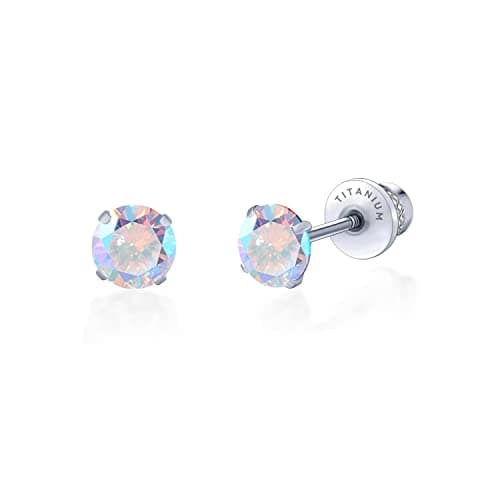
1Limerencia F136 Titanium Screw-Back Flat-Back CZ Studs (20G)Limerencia F136 Titanium Screw-Back Flat-Back CZ Studs (20G)The clearest material claim in this whole category: the standard number, the gauge and the fastening are all in the title before you have clicked anything.The default safe stud8.2disclosureCheck price
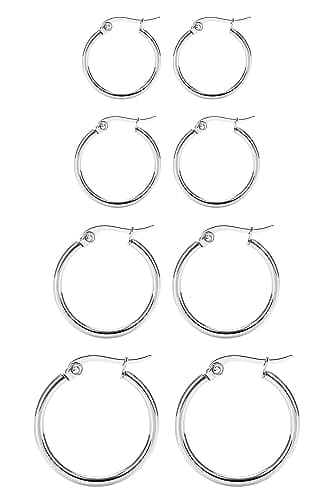
2Titanium Huggie Hoops, 4 pairs (12–25mm)Titanium Huggie Hoops, 4 pairs (12–25mm)Four diameters in one purchase, which is the practical way to work out what size hoop you actually wear before committing to one.A range of hoop sizes at once8disclosureCheck price
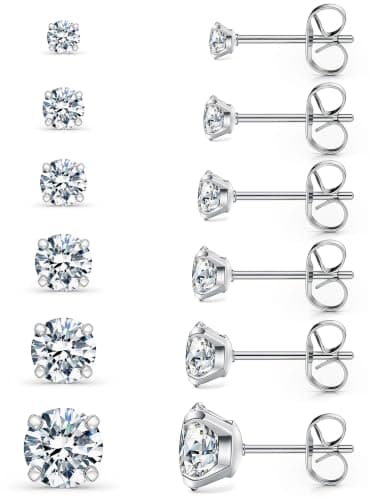
3316L Stainless Steel CZ Studs, 6 pairs (3–8mm)316L Stainless Steel CZ Studs, 6 pairs (3–8mm)The grade number is in the title, which is the single thing that separates a useful steel listing from a decorative one.The cheap everyday set6.2disclosureCheck price
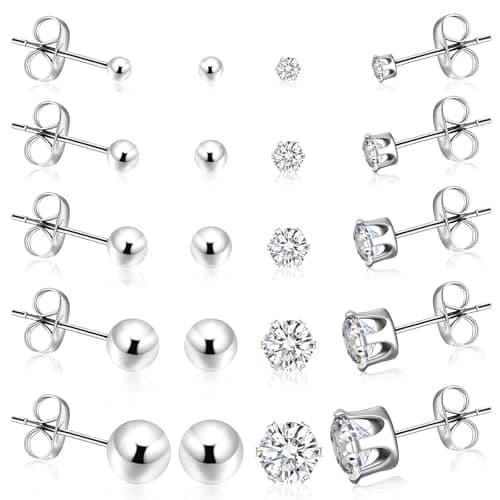
4Surgical Stainless Steel Studs, 10 pairsSurgical Stainless Steel Studs, 10 pairsA large steel set with a title that says 'surgical' but never says which grade, which is the common shape of this category.Ten pairs, one purchase5.4disclosureCheck price

“Score” is a disclosure score, not a test result. It rates how completely the seller states the post metal, the back metal and the nickel claim, and how that metal holds up for reactive skin. The full rubric is published on our methodology page.

Limerencia F136 Titanium Screw-Back Flat-Back CZ Studs (20G)

#1 · The default safe stud

Limerencia F136 Titanium Screw-Back Flat-Back CZ Studs (20G)

The clearest material claim in this whole category: the standard number, the gauge and the fastening are all in the title before you have clicked anything.

Post material
F136 implant-grade titanium, 20 gauge
From the seller’s own product title: “Limerencia Hypoallergenic G23 Implant Grade Titanium Screw Back Earrings | 20G F136 Pure Titanium Flat Back CZ Studs
Back material
Screw-on flat back; the same titanium is implied but the metal is not separately named
Not named in the seller’s product title — the headline nearly every buyer reads. That omission is the finding, not a gap in our notes.
Nickel claim
Says hypoallergenic, not nickel-free. The seller’s own words: “Hypoallergenic G23 Implant Grade Titanium

Two numbers do all the work here. F136 is the ASTM specification for the Ti-6Al-4V ELI alloy used in surgical implants, and G23 is the grade designation for that same alloy. A seller putting both in the title is pointing at a published document rather than reaching for an adjective, and that is rarer than it should be.

The flat back matters as much as the metal. A flat disc sits against the back of the lobe instead of a butterfly clip pressing a small area, which is why piercers use this shape for anything that has to be slept in. Combined with a screw thread rather than a friction push-fit, it is about as low-drama as an earring gets.

What the title does not do is name the back separately. In practice a screw-back on a titanium post is almost always the same titanium, and the design leaves little room for it to be anything else — but the seller has not committed to it in the headline, and we score what is stated rather than what is likely.

Who it’s for

Anyone who has reacted to something before and wants to stop running experiments. Also the sensible default for a piercing you intend to sleep in.

Skip it if

Skip this if you want a decorative statement earring. A 20-gauge flat-back CZ stud is deliberately unobtrusive, and if you want to be seen wearing something, this is not it.

Disclosure score

8.2

  • Post metal stated10
  • Back metal stated5
  • Strength of nickel claim7
  • Material for reactive skin10
  • Everyday wearability9

A disclosure score, not a test result. Nobody here wore these. Read how the rubric works.

Titanium Huggie Hoops, 4 pairs (12–25mm)

#2 · A range of hoop sizes at once

Titanium Huggie Hoops, 4 pairs (12–25mm)

Four diameters in one purchase, which is the practical way to work out what size hoop you actually wear before committing to one.

Post material
Pure titanium, G23
From the seller’s own product title: “4 Pairs Titanium Hoop Earrings for Sensitive Ears Hypoallergenic Pure Titanium Earrings for Women Men G23 Lightweight Small Huggie Hoop Earrings Set 12MM 15MM 20MM 25MM
Back material
Hinged huggie closure across all four sizes
From the seller’s own product title: “Huggie Hoop Earrings Set
Nickel claim
Says hypoallergenic, not nickel-free. The seller’s own words: “Hypoallergenic Pure Titanium

Hoop diameter is far more personal than people expect and is almost impossible to judge from a product photo. Twelve millimeters reads as a huggie that sits tight to the lobe; twenty-five is a visible hoop that swings. Buying the range solves a problem no amount of reading solves.

The title carries both 'Pure Titanium' and 'G23', which are technically different things — G23 is the Ti-6Al-4V alloy, pure titanium is unalloyed. Sellers are loose about this. Either is nickel-free, so for allergy purposes the ambiguity does not cost you anything, but it is the kind of imprecision worth noticing.

Weight is the reason to buy titanium in hoops specifically. At 25mm the difference against a steel hoop is something you feel by the end of a day.

Who it’s for

Someone building an everyday rotation who does not yet know which hoop size they will actually reach for.

Skip it if

Skip this if you only ever wear one size. A four-pack is only good value if you use more than one of them, and a single well-chosen pair will be better made.

Disclosure score

8

  • Post metal stated8
  • Back metal stated8
  • Strength of nickel claim6
  • Material for reactive skin9
  • Everyday wearability9

A disclosure score, not a test result. Nobody here wore these. Read how the rubric works.

316L Stainless Steel CZ Studs, 6 pairs (3–8mm)

#3 · The cheap everyday set

316L Stainless Steel CZ Studs, 6 pairs (3–8mm)

The grade number is in the title, which is the single thing that separates a useful steel listing from a decorative one.

Post material
316L stainless steel
From the seller’s own product title: “6 Pairs Stud Earrings Set, Hypoallergenic Cubic Zirconia 316L Earrings Stainless Steel CZ Earrings 3-8mm (Steel color)
Back material
Not named in the title
Not named in the seller’s product title — the headline nearly every buyer reads. That omission is the finding, not a gap in our notes.
Nickel claim
Says hypoallergenic, not nickel-free. The seller’s own words: “Hypoallergenic Cubic Zirconia 316L

'316L' is doing all the work in this title. Most steel jewelry is sold as 'surgical steel', which has no legal definition for jewelry and could be 304, 430 or something unnumbered. A specific alloy designation is a claim you can go and read about, and 316L is the good one — the molybdenum in it is what resists pitting in sweat.

Six sizes from 3mm to 8mm covers most of what anyone actually wears, and cubic zirconia at this price is exactly what you would expect: bright when new, gradually less so.

For the large majority of people, including many with a mild nickel sensitivity, this is the correct everyday answer and titanium is an upgrade they do not need.

Who it’s for

Anyone who wears steel without trouble and wants a full size range for the price of one titanium pair.

Skip it if

Skip this if you have reacted to surgical steel before. 316L contains eight to twelve percent nickel by weight even though it releases very little, and if you are past that threshold no grade number will help.

Disclosure score

6.2

  • Post metal stated8
  • Back metal stated2
  • Strength of nickel claim6
  • Material for reactive skin7
  • Everyday wearability8

A disclosure score, not a test result. Nobody here wore these. Read how the rubric works.

Surgical Stainless Steel Studs, 10 pairs

#4 · Ten pairs, one purchase

Surgical Stainless Steel Studs, 10 pairs

A large steel set with a title that says 'surgical' but never says which grade, which is the common shape of this category.

Post material
Surgical stainless steel — no grade number stated
From the seller’s own product title: “Hypoallergenic Surgical Stainless Steel Stud Earrings for Women,10 Pairs
Back material
Not named in the title
Not named in the seller’s product title — the headline nearly every buyer reads. That omission is the finding, not a gap in our notes.
Nickel claim
Says hypoallergenic, not nickel-free. The seller’s own words: “Hypoallergenic Surgical Stainless Steel

The word missing here is a number. 'Surgical stainless steel' is a marketing phrase; 316L, 304 and 430 are alloys, and they behave differently in sweat and contain very different amounts of nickel. A listing that will not commit to one has left the most useful fact out.

That is not a reason to assume the worst. Most jewelry sold this way is 316L or 304 and most people wear both without incident. It is a reason to score the disclosure below the listing above it, which names its alloy for the same money.

Ten pairs is a genuinely useful quantity if steel agrees with you and you lose earrings, which most people do.

Who it’s for

Steel-tolerant buyers who want quantity and are not trying to solve a specific reaction.

Skip it if

Skip this if you need to know exactly what alloy is going through your ear. The title does not say and no amount of hoping will change that.

Disclosure score

5.4

  • Post metal stated5
  • Back metal stated2
  • Strength of nickel claim5
  • Material for reactive skin7
  • Everyday wearability8

A disclosure score, not a test result. Nobody here wore these. Read how the rubric works.

Questions people actually ask

Is titanium better than surgical steel for sensitive ears?

For sensitive ears, yes. Implant-grade titanium contains no deliberately added nickel, while 316L surgical steel contains 8 to 12 percent by weight even though it releases very little of it. If you have reacted to steel before, titanium is the straightforward fix.

Does surgical steel contain nickel?

Yes. 316L stainless steel is roughly 10 to 14 percent nickel by weight depending on the exact composition. The nickel is bound into the alloy and released very slowly, which is why most people wear it comfortably and a minority do not.

Is implant grade titanium the same as regular titanium?

Not quite. “Implant grade” normally points at ASTM F-136, a specific Ti-6Al-4V ELI alloy. Plain “titanium” on a listing may mean commercially pure titanium, a different alloy, or occasionally just a titanium-colored coating. The distinction, in detail.

Why do my ears react to surgical steel if it is hypoallergenic?

Because “hypoallergenic” means less likely, not impossible, and steel does release a small amount of nickel. If you are strongly sensitized, a small amount is enough. The other common explanation is that the earring is steel and the back is not.

Is titanium heavier or lighter than steel?

Lighter, by roughly 45 percent for the same volume. For a small stud you will not notice; for a larger hoop worn all day, you will.

Which lasts longer?

Both outlast the styles they are made into. Titanium resists corrosion slightly better, particularly in chlorinated water; steel is harder and resists scratching slightly better. Neither will tarnish the way silver does.

Sources

Read next