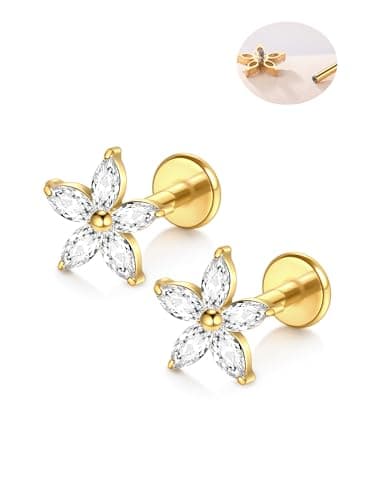
Helix, tragus, conch and forward helix. Cartilage has a poor blood supply, heals over months, and punishes the wrong bar length as readily as the wrong metal.
Gentle Carat earns a commission when you buy through the links on this page, at no extra cost to you. It never decides what we recommend or how we rank it — here is the full disclosure.
For cartilage the answer is a flat-back stud in implant-grade titanium (ASTM F-136), internally threaded or threadless, at the gauge you were pierced at and a bar length that sits flush without pressing. Cartilage has a poorer blood supply than a lobe, heals over six to twelve months rather than six weeks, and is far less tolerant of a trace metal release or a rough thread.
How we judged these
Criteria before ranking. Every pick was scored on the five things this site always scores — stated post metal, stated back metal, strength of the nickel claim, how the metal suits reactive skin, and everyday wearability — with two cartilage-specific weightings applied on top:
Threading is scored inside "back metal". A listing that states internally threaded is telling you something that materially affects a healing piercing, and it gets credit for it.
Stated gauge and bar length count toward wearability. A stud that does not fit produces symptoms indistinguishable from a metal reaction, and no alloy fixes it.
Why cartilage is a different problem
An earlobe is soft, well-supplied with blood, and heals in six to eight weeks. Cartilage is avascular — it has no direct blood supply of its own and is fed by diffusion from the tissue around it. That single fact explains most of what follows: slower healing, less capacity to clear an irritant, and a much longer window in which the wrong jewelry can cause trouble.
It is also structurally unforgiving. A lobe will accommodate a slightly wrong post length by flexing. Cartilage will not; it presses back, and sustained pressure on cartilage produces the bumps that people spend months trying to treat.
The threading question, which decides more than the metal does
Cartilage jewelry threading. This is the difference between a jewelry change that passes unnoticed and one that sets healing back weeks.
Type
Where the thread sits
Through a healing piercing
Verdict
Threadless / push-pin
No thread — a bent pin grips inside a hollow post.
Nothing sharp passes through.
The piercer standard. Best choice.
Internally threaded
Inside the decorative end; the post is smooth.
Nothing sharp passes through.
Equally good, slightly fiddlier.
Externally threaded
Cut into the post itself.
A spiral of sharp edges is dragged through the channel.
Avoid for cartilage at any stage.
Cartilage jewelry threading. This is the difference between a jewelry change that passes unnoticed and one that sets healing back weeks.
Cheap cartilage jewelry is overwhelmingly externally threaded because it costs less to make, and most listings do not say. When a title states "internally threaded", that is a seller volunteering the thing the cheap competition is hiding.
Gauge and bar length
16G (1.2mm) — common for conch, some helix, and most tragus work.
18G (1.0mm) — the other common cartilage size.
6mm bar — a settled, thin cartilage placement.
8mm bar — the safe default, and what most sets ship.
10mm bar — a thicker conch, or a piercing that is still settling.
Piercers commonly fit a longer bar initially to allow for swelling and downsize later. If your stud has started to sit tight, downsizing is often the whole fix — and it is cheaper than a new metal.
The boundary
Nothing here is aftercare and nothing here tells you when to change jewelry in a healing cartilage piercing — that comes from your piercer, who can see it. An irritation bump that will not settle, or anything hot, swollen or discharging, is a clinical question.
Quick picks
Ranked on what the seller actually discloses. Tap a row for the full write-up, or go straight to the listing.
#
Product
Best for
Score
Price
1
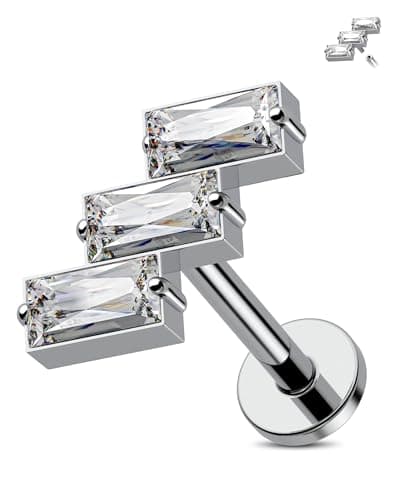
Xpircn ASTM F136 Titanium Flat-Back Cartilage Studs, 16G 8mm (2 pack)The full specification in one title: the standard number, the gauge, the bar length and the placements it is cut for.
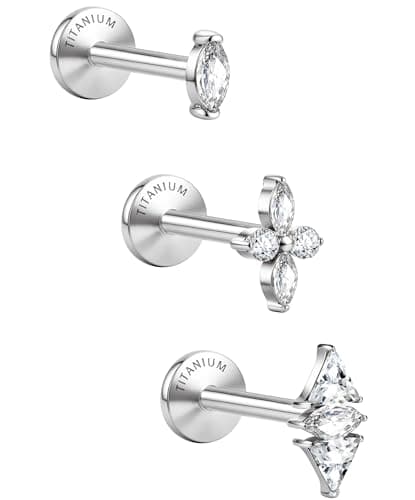
Jewseen G23 Titanium Internally Threaded Flat-Back Studs, 16G (6/8/10mm)Internally threaded and offered in three bar lengths — the two specifications that decide whether a cartilage stud is comfortable.
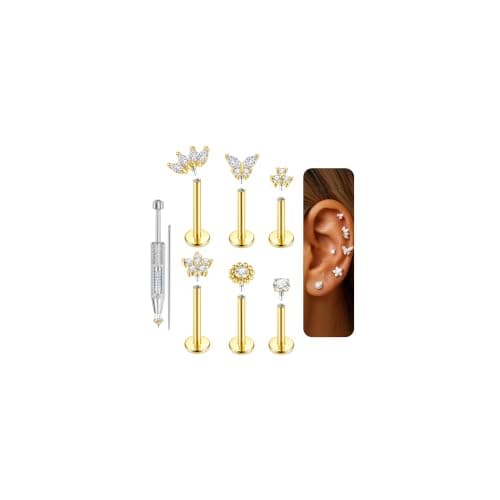
AFSITNIG G23 Titanium Flat-Back Studs, 16G, gold finish (6 pack)G23 titanium stated for the stud and a gold finish on top of it — the right way round, though this listing names the color without ever naming the coating.
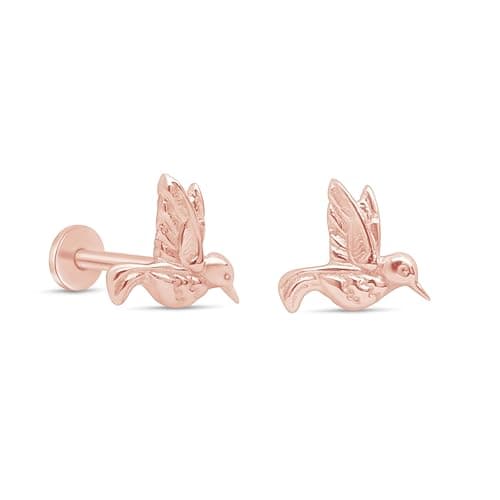
Estella Collection 14K Solid Yellow Gold Hummingbird Flat-Back Stud, 18GSolid 14K gold with an internally threaded flat back — the two things that make gold genuinely safe for a piercing, both stated in the title.
“Score” is a disclosure score, not a test result. It rates how completely the seller states the post metal, the back metal and the nickel claim, and how that metal holds up for reactive skin. The full rubric is published on our methodology page.
The full specification in one title: the standard number, the gauge, the bar length and the placements it is cut for.
Post material
ASTM F136 titanium, 16 gauge, 8mm
From the seller’s own product title: “Xpircn 2PCS ASTM F136 Titanium Flat Back Earrings for Women Helix Tragus Conch Piercing Jewelry Hypoallergenic Cartilage Earring Stud 16G 8mm”
Back material
Flat back, described as part of the same titanium stud
From the seller’s own product title: “Flat Back Earrings ... Cartilage Earring Stud”
Nickel claim
Says hypoallergenic, not nickel-free. The seller’s own words: “Hypoallergenic Cartilage Earring Stud 16G 8mm”
Cartilage is a harder problem than a lobe and it is worth being blunt about why. It has a poor blood supply, it heals over months rather than weeks, and it is unforgiving of a trace metal release, a rough thread or an earring that moves. Everything this site says about implant-grade titanium applies here with more force.
This title states ASTM F136 — the specification itself, not just the grade nickname — plus 16 gauge and an 8mm bar. Those three numbers are exactly what you need to know a stud will fit a helix or a conch without pressing or dangling.
Two pieces per pack, which suits stacking, or simply having a spare when one goes down a sink.
Who it’s for
Helix, tragus or conch piercings that are healed, where you want the specification stated rather than implied.
Skip it if
Skip this if your piercing is at 18 gauge. A 16G post will not pass through an 18G channel without stretching it, and stretching cartilage is not something to do by accident.
From the seller’s own product title: “Jewseen 16G Flat Back Earrings G23 Titanium Cartilage Earring Internally Threaded Lip Piercing Jewelry 6/8/10mm Cartilage Stud Helix Tragus Conch Earrings Stud for Women Men”
Back material
Internally threaded flat back — the thread is in the decorative end, not on the post
From the seller’s own product title: “Internally Threaded”
Nickel claim
Names a metal, makes no nickel claim. The seller’s own words: “G23 Titanium Cartilage Earring Internally Threaded”
Bar length on a cartilage stud is not cosmetic. Cartilage swells, and a bar chosen to sit flush on a settled piercing will press if that piercing flares up. Piercers commonly fit a longer bar initially and downsize later, which is why a listing offering 6, 8 and 10mm is more useful than one offering a single length.
Internally threaded, stated in the title, means no sharp thread passes through the channel on insertion. On cartilage that is worth more than it is anywhere else on the body.
The claim is material-only — a grade and no adjective — which on this site reads as honest rather than thin.
Who it’s for
Anyone downsizing a settled cartilage piercing, or who has bought a stud that turned out to sit too tight.
Skip it if
Skip this if you do not know your bar length. Three options only help if you pick the right one, and a piercer will measure it in seconds.
The 18-gauge counterpart to the pick above, in a three-piece set for a stacked ear.
Post material
G23 implant-grade titanium, 18 gauge
From the seller’s own product title: “GEMQUEEN 3 Pcs G23 Implant Grade Titanium Flat Back Earrings for Women Men”
Back material
Flat back; metal not separately named
Not named in the seller’s product title — the headline nearly every buyer reads. That omission is the finding, not a gap in our notes.
Nickel claim
Names a metal, makes no nickel claim. The seller’s own words: “G23 Implant Grade Titanium Flat Back Earrings”
Eighteen gauge is roughly 1.0mm and is the other common cartilage size. Whether you need 16G or 18G is decided by how you were pierced rather than by preference, and it is the first thing to check before ordering anything on this page.
Three pieces at one gauge is the right shape for a curated ear: a helix, a forward helix and a conch, all matching.
The title names the grade and makes no allergy claim, which is the honest ordering. It does not break out the back metal, which is the one thing we would add.
Who it’s for
A stacked ear at 18 gauge where you want the pieces to match and the metal stated.
Skip it if
Skip this if you were pierced at 16 gauge, which is common for conch and for some helix placements.
G23 titanium stated for the stud and a gold finish on top of it — the right way round, though this listing names the color without ever naming the coating.
Post material
G23 titanium, 16 gauge
From the seller’s own product title: “AFSITNIG 16G G23 Titanium Flat Back Earrings Studs for Women,Gold,6pcs”
Back material
Flat back; metal not separately named
Not named in the seller’s product title — the headline nearly every buyer reads. That omission is the finding, not a gap in our notes.
Nickel claim
Names a metal, makes no nickel claim. The seller’s own words: “16G G23 Titanium Flat Back Earrings Studs”
Gold-toned cartilage jewelry has a bad reputation it only half deserves. The problem is never the coating as such — it is a coating on the part that sits inside the piercing, where friction and moisture wear it through fastest. A toned finish over a stated titanium stud keeps the question away from the channel.
What this title does not do is characterize that finish. It says "Gold", which is a color, and it does not say plated, PVD, ion-plated or gold-filled, nor which parts of the stud carry it. Treat it as a gold-colored titanium stud rather than as a disclosed two-layer construction, and score it accordingly.
Six pieces is the practical part. Cartilage flat-backs are small, they get lost, and 16G is the common cartilage gauge, so a multipack is the honest way to buy them.
The back metal is not broken out, which is the standard gap across this whole shelf.
Who it’s for
A healed helix, conch or tragus piercing where you want a gold tone on a post whose metal is actually stated.
Skip it if
Skip this if you want the finish characterized or guaranteed. The listing names a color and not a process, and any coating wears eventually even when it is nowhere near the piercing. The solid gold pick on this page is the version with nothing to wear through.
One pair, one gauge, one length, one standard number. Nothing to sort through on arrival.
Post material
ASTM F136 titanium, 18 gauge, 8mm
Stated by the manufacturer: the listing's "Implant-Grade Titanium Material" bullet — "SGS-certified ASTM F136 implant titanium construction, nickel-free and hypoallergenic"
Back material
Flat labret disc; metal not separately named
Not named in the seller’s product title — the headline nearly every buyer reads. That omission is the finding, not a gap in our notes.
Nickel claim
Explicitly nickel-free. The seller’s own words: “SGS-certified ASTM F136 implant titanium construction, nickel-free and hypoallergenic”
A labret is the flat-disc-and-post design that most cartilage jewelry now uses, named after the lip piercing it was originally made for. The disc sits flush behind the piercing and nothing protrudes to press into a pillow or catch on a hairbrush.
Buying one properly specified pair rather than an assortment is the right call for a piercing that has given you trouble, because it isolates the variable. If it works, you know exactly what worked.
The F136 number is real and, as of October 2026, the seller has moved it into the title: the headline now reads "ASTM F136 Titanium Flatback Stud" where it previously gave a gauge and a length and nothing about the metal. The fuller claim still sits in the implant-grade titanium bullet, which adds SGS certification and an explicit nickel-free statement. Both halves now say the same thing, which is the right way round and more than most of this shelf manages.
Who it’s for
One cartilage piercing, healed, where you want the exact specification and nothing else.
Skip it if
Skip this if you are stacking several placements. Buying five single pairs costs more than one properly sized set.
From the seller’s own product title: “14K Solid Yellow Gold Hummingbird Flat Back Stud Earrings Pair | 18G Internally Threaded - Cartilage Helix Tragus Conch Daith | Hypoallergenic Piercing Minimalist Bird Jewelry”
Back material
Flat back, internally threaded — the thread sits in the decorative end, not on the post
From the seller’s own product title: “18G Internally Threaded”
Nickel claim
Says hypoallergenic, not nickel-free. The seller’s own words: “Hypoallergenic Piercing Minimalist Bird Jewelry”
Solid gold means there is no plating to wear through, which removes the single most common failure mode in this category. What it does not automatically remove is the alloy question: gold is alloyed with other metals for hardness, and in white gold that whitening metal is sometimes nickel. Yellow gold, as here, is normally alloyed with copper and silver and is very well tolerated.
The internally threaded detail is why this sits at the top of the gold list rather than in the middle. On externally threaded jewelry the screw thread is cut into the post, so sharp edges pass through the piercing on every insertion. Internally threaded leaves the post smooth. For the cartilage placements this is explicitly sold for, that matters a great deal.
It is priced as fine jewelry rather than fashion jewelry, and the listing offers a single stud as well as a pair. Read which one you are adding to the basket.
Who it’s for
A cartilage or lobe piercing you intend to keep, where you want real gold and no surface to lose.
Skip it if
Skip this if you want a matched pair on a budget. This is fine-jewelry pricing, and the single-stud option exists because people buy it one at a time.
What is the best material for cartilage earrings?+
Implant-grade titanium (ASTM F-136), internally threaded or threadless. Niobium is the fallback if titanium still bothers you. Solid high-karat gold is a good alternative if it is internally threaded.
Do you need special earrings for a helix piercing?+
Yes, in practice. Cartilage placements need a flat back rather than a butterfly clip, a gauge that matches the piercing, and a bar length that suits the tissue thickness — none of which a standard lobe earring provides.
Can you put normal earrings in a cartilage piercing?+
Often the post will physically fit, and it is still a bad idea. Standard lobe studs are usually 20G with a short post and a butterfly back, all three of which are wrong for cartilage.
Why does my cartilage piercing have a bump?+
Common causes are pressure from jewelry that is too short, knocks, and irritation from a butterfly back or a rough thread. It is a physical-irritation problem far more often than a metal one — and a persistent bump is worth showing to a piercer or clinician rather than treating from a website.
How long does a cartilage piercing take to heal?+
Commonly six to twelve months, against six to eight weeks for a lobe. Cartilage has no direct blood supply, which is the reason for the difference and the reason the jewelry specification matters for so much longer.
Is surgical steel okay for cartilage?+
For a long-healed cartilage piercing many people wear it without trouble. For anything healing, implant-grade titanium is the standard for good reason — a healing channel is far less tolerant of the small nickel release steel produces.