The arguments usually turn on how much it hurts, which is the least important difference. The ones that matter are what can be sterilized, and what jewelry each method is physically able to put in your ear.
Gentle Carat earns a commission when you buy through the links on this page, at no extra cost to you. It never decides what we recommend or how we rank it — here is the full disclosure.
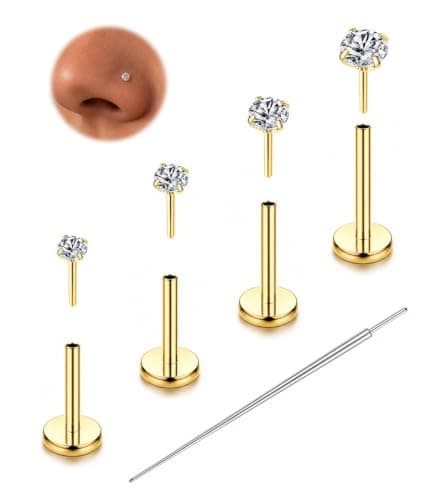
A needle, at a studio, with implant-grade titanium jewelry fitted — and the internally-threaded GEMQUEEN set is the kind of thing to ask for. The usual debate is about pain, which is the least important difference between the two. The ones that matter are that a spring-loaded gun has plastic parts that cannot be autoclaved, and that a gun can only fire the pre-mounted stud it is loaded with — so the method you choose decides what metal ends up in your ear. If your skin reacts, that second point is the whole argument.
What each method actually does
A piercing needle is a hollow, single-use, very sharp tube. It cuts a clean channel and removes the small core of tissue, and the jewelry is threaded in behind it. The needle goes in a sharps bin afterwards. Because the jewelry is fitted separately, it can be anything the studio stocks.
A piercing gun is a spring-loaded device that drives a pre-mounted stud through the lobe using the stud itself as the point. Earring studs are not sharp — they are blunt-ended posts — so the tissue is forced apart rather than cut. The stud and its butterfly back are usually supplied in a sealed sterile cartridge, which is a real and worthwhile thing, but the device that fires them is reused.
The differences that actually bear on sensitive skin
Needle
Gun
How the hole is made
Cut, tissue removed
Forced apart by a blunt post
Device reused
No, single use, sharps bin
Yes, the instrument is reused
Can it be autoclaved
Not applicable, disposed of
Plastic housing cannot be
Choice of jewelry
Anything the studio stocks
Only the loaded stud
Usual metal fitted
Implant-grade titanium if you ask
Whatever that brand supplies
Usual back fitted
Flat disc, internally threaded or threadless
Butterfly clutch
Post length
Chosen for your lobe
One fixed length
Suitable for cartilage
Yes
No, the standard professional position
The differences that actually bear on sensitive skin
The sterilization argument, stated fairly
It is worth being precise here rather than alarming, because the gun case is routinely overstated in both directions.
The studs themselves usually arrive in sealed sterile cartridges, and reputable operators handle them without touching the business end. That part is fine. The issue is the instrument: a spring-loaded plastic device is reused across customers and cannot be put through an autoclave, because an autoclave would destroy it. It is wiped down instead. MedlinePlus, listing the risks of piercing generally, says plainly that “Proper sterilization of the equipment is important” and that you should “make sure that the facility is clean, safe and has a good reputation”. A device that cannot be autoclaved cannot fully satisfy the first of those.
We are not telling you that everyone pierced with a gun gets an infection. Enormous numbers of people have been gun-pierced and are completely fine, and if that is you, nothing here needs acting on. We are saying that if you are choosing today, one method has a sterilization answer and the other has a mitigation.
The part this site actually cares about: what goes in
Here is the argument you will not usually find in a gun-versus-needle piece, and it is the one that matters most if your skin reacts.
A gun can only fit the stud it is loaded with. The post is the projectile. So the jewelry is not a separate decision you get to make — it is determined by which cartridge the operator has, in whatever alloy that brand supplies, at whatever single post length the system uses, with a butterfly clutch on the back. If that alloy happens to be something you react to, you now have it sitting in an open wound for the entire healing period, and healing is exactly when sensitisation is most likely to develop.
A needle piercing separates the two decisions. The piercer makes the hole, then fits whatever jewelry you have chosen: a flat-back labret in stated ASTM F136 titanium, internally threaded or threadless, in the post length that suits your lobe. Every one of those words is a variable a gun cannot give you.
Butterfly backs, and the fixed length problem
Gun systems fit a butterfly clutch at a single post length, and both halves of that are problems this site writes about constantly.
The butterfly clutch is a separately manufactured part, frequently a different alloy from the stud, and the most common explanation on this site for a reaction to an earring that should have been fine. The fixed length is the quieter issue: lobes vary in thickness by several millimeters, and a single post length cannot suit all of them. Too short and the back is pulled tight against swelling tissue, trapping moisture against a healing wound. That is a fit problem rather than a metal problem, and no amount of good alloy fixes it — it is why this site now has a separate page on gauge and post length.
Cartilage: the one place this is not a preference
Everything above is a weighing of trade-offs. Cartilage is not. The consistent position among professional piercers is that a gun should not be used on cartilage at all: cartilage does not have the blood supply that a lobe does, it heals over many months rather than weeks, and shattering or crushing it with a blunt post is a materially worse outcome than anything that happens to an earlobe. If someone offers to gun-pierce a helix or a tragus, that is the point to leave.
For cartilage you also need a different gauge. Lobes are usually pierced at 20G and cartilage at 16G or 18G, and the picks on this page include one at 16G for exactly that reason.
What to ask for
If you take one script from this page, take this one. At the studio, ask: is it a needle, is the jewelry implant-grade titanium to ASTM F136, is it internally threaded or threadless, and what post length are you fitting for my lobe? Four questions. A good piercer will answer all four without blinking and will probably be pleased you asked. If any of them produces a blank look, that in itself is the answer.
Quick picks
Ranked on what the seller actually discloses. Tap a row for the full write-up, or go straight to the listing.
#
Product
Best for
Score
Price
1
GEMQUEEN Internally Threaded Titanium Flat-Backs, 20G, 3 PairsGauge, grade, standard and threading type all stated. The one number it leaves out is the one this page cares about most, which is post length.
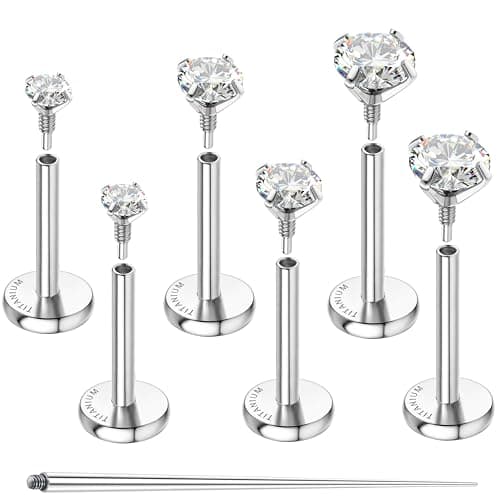
Purbeaut Threadless Titanium Flat-Backs, 20G, 6/7/8mm, 4 PiecesThe only listing on this site that sells you more than one post length at once, which is the single most useful thing a seller can do for someone who does not know their own measurement.
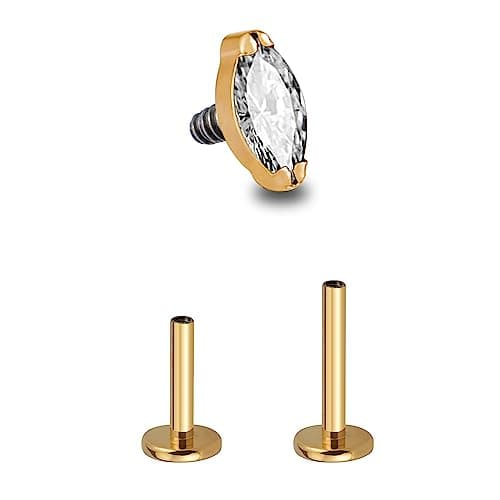
FINE4U Internally Threaded Titanium Flat-Back, 16G, 6mm and 8mmThe only pick here at 16 gauge rather than 20, which matters because a cartilage piercing is usually a thicker hole and a 20G post in it will not sit right.
G23 Titanium Flat-Back CZ Studs, 20G (plated finish)An implant-grade post with a plated decorative front — the right way round, and the title is unusually clear about which part is which.
“Score” is a disclosure score, not a test result. It rates how completely the seller states the post metal, the back metal and the nickel claim, and how that metal holds up for reactive skin. The full rubric is published on our methodology page.
Gauge, grade, standard and threading type all stated. The one number it leaves out is the one this page cares about most, which is post length.
Post material
G23 titanium, cited against ASTM F136, 20 gauge. Post length is not stated
From the seller’s own product title: “GEMQUEEN G23 Implant Grade Titanium Flat Back Earrings Hypoallergernic 20G | 3 Pairs Astm F136 Hypoallergenic Flatback Earrings Internally Threaded Studs for Nose, Helix, Tragus, Conch, Labret Piercing”
Back material
Flat back, internally threaded, in the same titanium
From the seller’s own product title: “Flatback Earrings Internally Threaded Studs”
Nickel claim
Names a metal, makes no nickel claim. The seller’s own words: “G23 Implant Grade Titanium Flat Back Earrings Hypoallergernic”
This listing does four of the five things right. It gives the gauge, it names the grade, it cites ASTM F136, and it tells you the studs are internally threaded. For a healing or recently-healed piercing that is a strong specification.
What is absent is post length, and on a flat-back that is the measurement that decides comfort. A flat disc sitting against the back of the lobe is only comfortable if the post is long enough to clear the tissue. Without the number you are buying on hope, which is why this sits below the picks that publish it.
Quoted verbatim above, typo included: the title really does read "Hypoallergernic". That is the seller's own spelling, and a quote that has been tidied up is no longer a quote. It is a small thing, but a listing proofread this loosely is a listing to read the rest of twice.
Three pairs on a named standard with internal threading is still a good buy. It is the fit information, not the metal, that is missing here.
Who it’s for
Someone who already knows their post length, wants internal threading, and wants the standard cited rather than just the grade.
Skip it if
Skip this if you are new to flat-backs. Start with a set that publishes several post lengths, learn yours, then come back.
The only listing on this site that sells you more than one post length at once, which is the single most useful thing a seller can do for someone who does not know their own measurement.
Post material
Implant-grade G23 titanium, 20 gauge, in three stated post lengths — 6mm, 7mm and 8mm
From the seller’s own product title: “4PCS Implant Grade G23 Titanium Threadless Flat Back Earrings Stud Set, 20G Gold Push In Nose Studs Lip Cartilage Helix Tragus Medusa Conch Body Piercing Jewelry for Women and Men, 6mm 7mm 8mm Labret Posts with 2mm 2.5mm 3mm 4mm Four-prong CZ”
Back material
Flat disc in the same titanium as the post, push-in threadless fitting
From the seller’s own product title: “Titanium Threadless Flat Back Earrings Stud Set”
Nickel claim
Names a metal, makes no nickel claim. The seller’s own words: “Implant Grade G23 Titanium Threadless Flat Back Earrings”
Post length is the measurement nobody knows about themselves and nobody can look up. It has to clear the thickness of your lobe plus a little room, and lobes differ by several millimeters between people and between the front and back of the same ear. Too short and the back digs in and traps fluid; too long and the earring rocks and catches. This listing solves that by giving you 6mm, 7mm and 8mm and letting your ear decide.
It states the gauge too, at 20G, which is the common lobe size. And it states four stone sizes from 2mm to 4mm. That is gauge, length and decoration all published on one listing, and it is close to unheard of on this shelf.
Threadless is the other reason it leads. A threadless post has no screw thread at all: a pin on the decorative end springs into a hollow post. There is no spiral of sharp thread to drag through the channel, which is the detail the site's new-piercing page calls out as the one most people have never heard of.
The limit of what we can say: G23 is a trade designation used loosely across this market, and it is not the same thing as a listing citing ASTM F136 and meaning it. Two other picks on this page name the standard explicitly. This one names the grade.
Who it’s for
Anyone who has never measured a post length, anyone whose current backs press into the lobe, and anyone setting up a first set of flat-backs without knowing their own size.
Skip it if
Skip this if you already know your length and want a matched pair rather than an assortment of four single pieces.
FINE4U Internally Threaded Titanium Flat-Back, 16G, 6mm and 8mm
The only pick here at 16 gauge rather than 20, which matters because a cartilage piercing is usually a thicker hole and a 20G post in it will not sit right.
Post material
ASTM F136 titanium, 16 gauge, offered in 6mm and 8mm post lengths
From the seller’s own product title: “FINE4U Gold Tragus Conch Helix Flat Labret Piercing Jewelry 16G 6mm 8mm - ASTM F136 Titanium Cartilage Earring Flatback Stud, Implant Grade Internally Threaded Hypoallergenic Body Jewelry”
Back material
Flat labret disc, internally threaded, same titanium as the post
From the seller’s own product title: “Titanium Cartilage Earring Flatback Stud, Implant Grade Internally Threaded”
Nickel claim
Names a metal, makes no nickel claim. The seller’s own words: “ASTM F136 Titanium Cartilage Earring Flatback Stud, Implant Grade”
Gauge is not a preference, it is a measurement of your piercing, and this listing is the one that makes the point. 16G is thicker than 20G. Most lobes are pierced at 20G and most cartilage at 16G or 18G, so buying by look rather than by number is how people end up with a post that will not pass through or one that leaves the hole loose around it.
It also names ASTM F136 and states internal threading. Internally threaded means the thread is cut inside the post and the decorative end screws into it, so no thread passes through your piercing. Externally threaded jewelry drags a spiral of sharp edges through the channel on the way in, which is the thing to avoid in anything that is still healing.
Two post lengths published, 6mm and 8mm, which is more than most and less than the three-length set above.
The honest caveat is the finish. This is the gold-tone option, and a gold tone on titanium is a surface treatment rather than solid gold. The title does not say how it was applied, and a colored surface on a post is a surface that can wear. If the color matters less to you than the metal does, the plain versions elsewhere on this page have one fewer unknown.
Who it’s for
Anyone buying for a helix, tragus or conch rather than a lobe, who needs the thicker gauge and wants the standard named.
Skip it if
Skip this for a standard lobe piercing — 16G is likely thicker than your hole. And skip the gold tone if you wear it daily and want no coating anywhere on the post.
An implant-grade post with a plated decorative front — the right way round, and the title is unusually clear about which part is which.
Post material
G23 / F136 implant-grade titanium, 20 gauge
From the seller’s own product title: “20G G23 Implant Grade Titanium Flat Back Stud Earrings for Women Men, Gold/White Gold Plated Tragus Labret Cartilage Helix F136 Piercing Jewelry for Sensitive Ears”
Back material
Flat back; metal not separately named
Not named in the seller’s product title — the headline nearly every buyer reads. That omission is the finding, not a gap in our notes.
Nickel claim
Names a metal, makes no nickel claim. The seller’s own words: “G23 Implant Grade Titanium ... F136”
This is the plating arrangement to look for. The gold appears in the title attached to the decorative end — 'Gold/White Gold Plated' — while the structural claim, G23 and F136, attaches to the post. A plated front over a titanium post is a completely different proposition from a plated post, because the plating is nowhere near your piercing.
Most listings do not draw that distinction, which is why plated jewelry has a bad reputation it only half deserves. Plating is not the problem; plating on the wrong component is.
Twenty gauge is the standard for a healed lobe or a cartilage piercing done at that size. If your piercing was done at 18 gauge, a 20-gauge post will fit but will move around in the channel more than you want.
Who it’s for
Helix, tragus and conch piercings where you want a gold look and cannot risk the metal that goes through the hole.
Skip it if
Skip this if your piercing is 18 gauge or larger. A thinner post in a wider channel migrates and irritates, and the fix is the right gauge rather than a better metal.
A needle, for two reasons that have nothing to do with pain. A gun is a reusable device with plastic parts that cannot be autoclaved, and it can only fit the stud it is loaded with — so you do not get to choose the metal, the back type or the post length. A needle piercing separates making the hole from choosing the jewelry, which is the whole decision if your skin reacts.
Are piercing guns safe?+
Very large numbers of people have been gun-pierced without incident, so this is not a scare story. The specific concern is that the instrument is reused and cannot go through an autoclave, while MedlinePlus says of piercing generally that proper sterilization of the equipment is important. The studs usually arrive sterile in sealed cartridges; the device firing them does not.
Does a gun or a needle hurt more?+
Reports go both ways and it is the least useful thing to choose on. A needle cuts and a gun forces tissue apart, so a gun tends to leave more swelling afterwards even when the moment itself is quick. Base the decision on sterilization and on what jewelry each method can fit, not on a second and a half of sensation.
Can you use a piercing gun on cartilage?+
It should not be done, and this is the one point on this page that is not a trade-off. Cartilage has a poorer blood supply than a lobe, heals over months rather than weeks, and can be crushed rather than cleanly pierced by a blunt post. If a shop offers to gun-pierce a helix, conch or tragus, go elsewhere.
What earrings should be used for a new piercing?+
A flat-back stud in stated implant-grade titanium to ASTM F136, internally threaded or threadless, in a post length chosen for your lobe. That combination removes the unnamed alloy, the separate butterfly clutch and the fixed length all at once. Our new piercing page covers what to wear while it heals.
Are mall and pharmacy piercings done with a gun?+
Traditionally yes, though some chains have moved to other systems, so ask rather than assume. If you are going that route anyway, the question worth asking is what alloy the studs are, and whether there is a titanium option. Our review of the Studex Sensitive line goes through what one of the big piercing-stud brands does and does not state about its own metals.
Sources
MedlinePlus (US National Library of Medicine) — piercing and tattoos — Lists the health risks as allergic reactions, keloids and infections. On choosing where to get pierced: 'make sure that the facility is clean, safe and has a good reputation', and 'Proper sterilization of the equipment is important.'
The pharmacy-counter brand, judged on its own labels. It names the post metal — and then says nickel safe on three listings and nickel free on a fourth.