Three numbers decide whether an earring fits the ear it is going into, and almost no listing publishes all three. Get them wrong and you get symptoms that look exactly like a metal reaction.
Gentle Carat earns a commission when you buy through the links on this page, at no extra cost to you. It never decides what we recommend or how we rank it — here is the full disclosure.
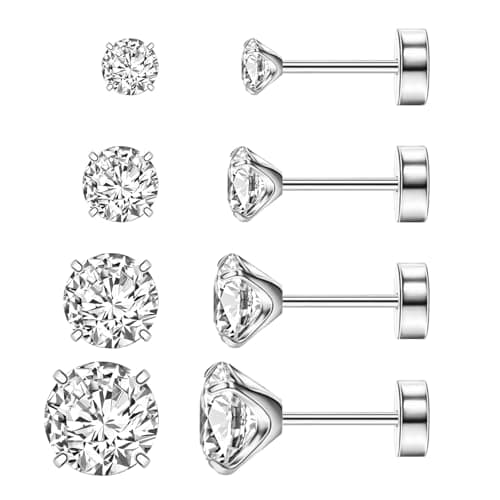
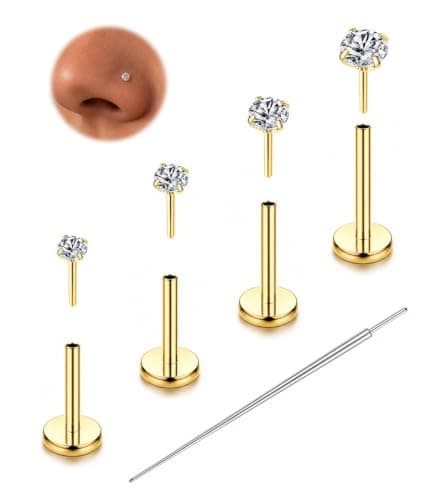
Three numbers decide whether an earring fits: gauge, post length and back type — and the Purbeaut threadless set is the pick because it ships three post lengths so your own ear can settle the question. Most lobes are 20 gauge and most cartilage is 16 or 18. Post length has to clear the thickness of your lobe with a little room. Get the length wrong and you get a tight, sore, weeping piercing that looks exactly like an allergy — which is why people replace perfectly good titanium earrings and stay sore.
Why this page exists
This site spends most of its time on a single question: what metal goes through the hole, and does the seller say so. That question assumes the earring fits. A startling number do not, and the symptoms of a badly fitted earring — soreness, tenderness, weeping, a piercing that never quite settles — are close enough to the symptoms of a contact reaction that people spend a great deal of money solving the wrong problem.
You can buy the best-documented implant-grade titanium on the market and still be uncomfortable every day if the post is two millimeters too short for your lobe. No alloy fixes a fit problem.
Number one: gauge
Gauge is the thickness of the post, and the scale runs backwards: a bigger number means a thinner post. 20G is thinner than 18G, which is thinner than 16G.
It is not a style choice. It is a measurement of the hole you already have. Standard earlobe piercings are usually 20G; cartilage — helix, tragus, conch — is usually pierced at 16G or 18G because the thicker post is more stable in tissue that heals slowly. Put a 20G post in a 16G cartilage hole and it rattles around in a channel too big for it; try to put a 16G post through a 20G lobe and it will not go.
The gauges you will actually meet, and where they belong
Gauge
Roughly
Normally used for
20G
0.8 mm
Standard earlobe piercings, most stud earrings
18G
1.0 mm
Some lobes, some cartilage, many nose piercings
16G
1.2 mm
Helix, tragus, conch and most cartilage
14G
1.6 mm
Industrial, some navel; rare in a lobe
The gauges you will actually meet, and where they belong
Number two: post length
This is the one almost nobody states and the one that causes the most trouble. Post length is how far the post stands off the front of your ear before the back goes on, and it has to clear the thickness of your lobe plus a little room.
Lobes are not all the same thickness. They differ between people by several millimeters, they differ between the front and back of the same ear, and they change — a lobe swells slightly when a piercing is new or irritated. So “the standard length” is a fiction, and the common lengths you will see are 6mm, 7mm and 8mm.
Too short is the damaging direction. The back is pulled tight against the skin, which presses on the tissue, traps moisture and sweat against the back of the lobe, and gives a healing or irritated piercing nowhere to drain. That produces soreness, a damp smell and sometimes weeping — a combination most people read as an infection or an allergy. Too long is merely annoying: the earring rocks forward, the post catches on clothing, and the front does not sit flush.
Number three: back type
The back is a separate decision and it is the component this site rates as the most common cause of a reaction to an earring that should have been fine, because it is separately manufactured, often a cheaper alloy, and almost never named. That page covers the metal question. What matters here is the mechanics.
Flat back (labret). A smooth disc flush against the lobe. Spreads pressure, nothing to catch on a pillow, the piercer default and the right choice for anything worn overnight.
Butterfly clutch. The folding wire clip everyone has. Easy, cheap, works loose over a day, and concentrates pressure on a small area.
Screw back. Threads on and stays. The right answer when losing the earring would be a problem — a long event, travel, a wedding.
Threadless or internally threaded. Describes how the front attaches rather than the back shape. Both avoid dragging a screw thread through the channel, which matters in anything healing.
How to find your own numbers
You do not need a tool. The practical method is to buy a set that includes several post lengths, wear each for a day, and keep the one that sits flush without pressing. That is precisely why the multi-length set is ranked first on this page rather than the best-specified single pair — it answers a question about your ear that no listing can answer for you.
For gauge, the reliable answer is to ask whoever pierced you, or to ask a piercer, who can tell at a glance. If you were gun-pierced at a pharmacy or a mall, you were almost certainly done at 20G in the lobe. If you have had cartilage done at a studio, ask — and if you bought jewelry that simply would not go in, you now know why.
When fit is not the answer
If you have the right gauge, a flat back and a post length that sits flush, and the piercing is still angry, then you have ruled out fit and learned something worth knowing. At that point the variables left are the metal — move to stated implant-grade titanium if you have not — and, if that fails too, a conversation with a dermatologist who can patch test. Working through it in that order saves replacing an entire jewelry collection to solve a two-millimeter problem.
Quick picks
Ranked on what the seller actually discloses. Tap a row for the full write-up, or go straight to the listing.
#
Product
Best for
Score
Price
1
Purbeaut Threadless Titanium Flat-Backs, 20G, 6/7/8mm, 4 PiecesThe only listing on this site that sells you more than one post length at once, which is the single most useful thing a seller can do for someone who does not know their own measurement.
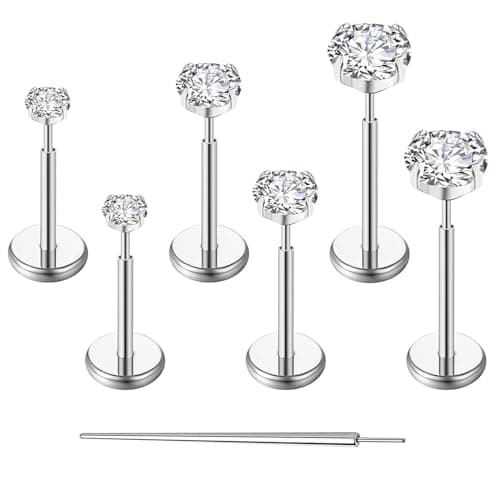
XUU Titanium Flat-Back Studs, 20G, 8mm Post, 4 PairsStates the gauge, the post length and ASTM F136 by name in a single title. On the question this page is about, nothing else here is as complete.
Gauge, post length and the standard, all on one line
FINE4U Internally Threaded Titanium Flat-Back, 16G, 6mm and 8mmThe only pick here at 16 gauge rather than 20, which matters because a cartilage piercing is usually a thicker hole and a 20G post in it will not sit right.
GEMQUEEN Internally Threaded Titanium Flat-Backs, 20G, 3 PairsGauge, grade, standard and threading type all stated. The one number it leaves out is the one this page cares about most, which is post length.
Gotumo Threadless Titanium Flat-Back Stud, 20GGauge and threading type stated, nothing else. It is the baseline this page is measuring the others against, and it is ranked last on information rather than on quality.
Limerencia Pure Titanium Replacement Earring Backs (2 pairs)The cheapest fix in this whole category: keep the earrings, replace the part that is actually touching you.
“Score” is a disclosure score, not a test result. It rates how completely the seller states the post metal, the back metal and the nickel claim, and how that metal holds up for reactive skin. The full rubric is published on our methodology page.
The only listing on this site that sells you more than one post length at once, which is the single most useful thing a seller can do for someone who does not know their own measurement.
Post material
Implant-grade G23 titanium, 20 gauge, in three stated post lengths — 6mm, 7mm and 8mm
From the seller’s own product title: “4PCS Implant Grade G23 Titanium Threadless Flat Back Earrings Stud Set, 20G Gold Push In Nose Studs Lip Cartilage Helix Tragus Medusa Conch Body Piercing Jewelry for Women and Men, 6mm 7mm 8mm Labret Posts with 2mm 2.5mm 3mm 4mm Four-prong CZ”
Back material
Flat disc in the same titanium as the post, push-in threadless fitting
From the seller’s own product title: “Titanium Threadless Flat Back Earrings Stud Set”
Nickel claim
Names a metal, makes no nickel claim. The seller’s own words: “Implant Grade G23 Titanium Threadless Flat Back Earrings”
Post length is the measurement nobody knows about themselves and nobody can look up. It has to clear the thickness of your lobe plus a little room, and lobes differ by several millimeters between people and between the front and back of the same ear. Too short and the back digs in and traps fluid; too long and the earring rocks and catches. This listing solves that by giving you 6mm, 7mm and 8mm and letting your ear decide.
It states the gauge too, at 20G, which is the common lobe size. And it states four stone sizes from 2mm to 4mm. That is gauge, length and decoration all published on one listing, and it is close to unheard of on this shelf.
Threadless is the other reason it leads. A threadless post has no screw thread at all: a pin on the decorative end springs into a hollow post. There is no spiral of sharp thread to drag through the channel, which is the detail the site's new-piercing page calls out as the one most people have never heard of.
The limit of what we can say: G23 is a trade designation used loosely across this market, and it is not the same thing as a listing citing ASTM F136 and meaning it. Two other picks on this page name the standard explicitly. This one names the grade.
Who it’s for
Anyone who has never measured a post length, anyone whose current backs press into the lobe, and anyone setting up a first set of flat-backs without knowing their own size.
Skip it if
Skip this if you already know your length and want a matched pair rather than an assortment of four single pieces.
#2 · Gauge, post length and the standard, all on one line
XUU Titanium Flat-Back Studs, 20G, 8mm Post, 4 Pairs
States the gauge, the post length and ASTM F136 by name in a single title. On the question this page is about, nothing else here is as complete.
Post material
ASTM F136 implant-grade titanium, 20 gauge, 8mm post length
From the seller’s own product title: “XUU 20G Titanium Flat Back Earrings 3-6mm 4 Pair Set for Sensitive Ears | ASTM F136 implant-grade titanium & hypoallergenic, Spark CZ gemstones. 8mm length stud earrings, Post silver.”
Back material
Flat back in the same stated titanium as the post
From the seller’s own product title: “Titanium Flat Back Earrings”
Nickel claim
Names a metal, makes no nickel claim. The seller’s own words: “ASTM F136 implant-grade titanium & hypoallergenic”
Read the title carefully and it answers all three fit questions. 20G is the gauge. 8mm is the post length. Flat back is the back type. The "3-6mm" is the stone diameter across the four pairs, which is a style spec rather than a fit one, and it is easy to misread as a length — a reminder that two different millimeter figures appear on these listings and they mean completely different things.
Naming ASTM F136 is worth more than naming G23. F136 is a published specification for the Ti-6Al-4V ELI alloy used in surgical implants; it governs what is in the metal. A grade label does not point at a document you can look up. This title does both, which is why it scores where it does.
One honest limitation on the fit question: it sells one post length, 8mm, across all four pairs. 8mm suits a lot of lobes and is a sensible default, but if yours is thinner it will rock, and there is no shorter option in the box.
It sits at the upper end of this shelf's price bracket, and four pairs of stated-F136 titanium is a reasonable reason for that.
Who it’s for
Someone who wants a set of everyday flat-backs on a named standard, and who already knows 8mm works for them or is willing to find out.
Skip it if
Skip this if you do not know your post length. The three-length set above is the better way to find out, and then you can buy a matched set with confidence.
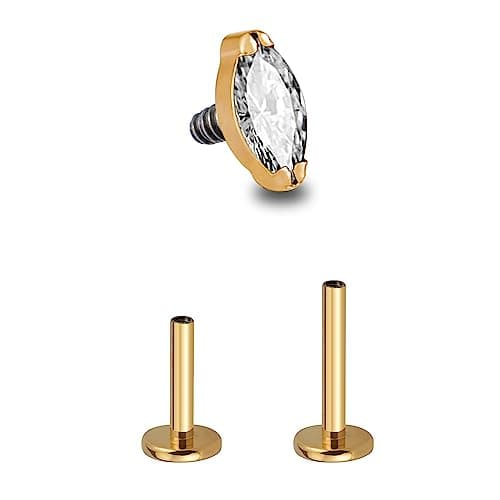
FINE4U Internally Threaded Titanium Flat-Back, 16G, 6mm and 8mm
The only pick here at 16 gauge rather than 20, which matters because a cartilage piercing is usually a thicker hole and a 20G post in it will not sit right.
Post material
ASTM F136 titanium, 16 gauge, offered in 6mm and 8mm post lengths
From the seller’s own product title: “FINE4U Gold Tragus Conch Helix Flat Labret Piercing Jewelry 16G 6mm 8mm - ASTM F136 Titanium Cartilage Earring Flatback Stud, Implant Grade Internally Threaded Hypoallergenic Body Jewelry”
Back material
Flat labret disc, internally threaded, same titanium as the post
From the seller’s own product title: “Titanium Cartilage Earring Flatback Stud, Implant Grade Internally Threaded”
Nickel claim
Names a metal, makes no nickel claim. The seller’s own words: “ASTM F136 Titanium Cartilage Earring Flatback Stud, Implant Grade”
Gauge is not a preference, it is a measurement of your piercing, and this listing is the one that makes the point. 16G is thicker than 20G. Most lobes are pierced at 20G and most cartilage at 16G or 18G, so buying by look rather than by number is how people end up with a post that will not pass through or one that leaves the hole loose around it.
It also names ASTM F136 and states internal threading. Internally threaded means the thread is cut inside the post and the decorative end screws into it, so no thread passes through your piercing. Externally threaded jewelry drags a spiral of sharp edges through the channel on the way in, which is the thing to avoid in anything that is still healing.
Two post lengths published, 6mm and 8mm, which is more than most and less than the three-length set above.
The honest caveat is the finish. This is the gold-tone option, and a gold tone on titanium is a surface treatment rather than solid gold. The title does not say how it was applied, and a colored surface on a post is a surface that can wear. If the color matters less to you than the metal does, the plain versions elsewhere on this page have one fewer unknown.
Who it’s for
Anyone buying for a helix, tragus or conch rather than a lobe, who needs the thicker gauge and wants the standard named.
Skip it if
Skip this for a standard lobe piercing — 16G is likely thicker than your hole. And skip the gold tone if you wear it daily and want no coating anywhere on the post.
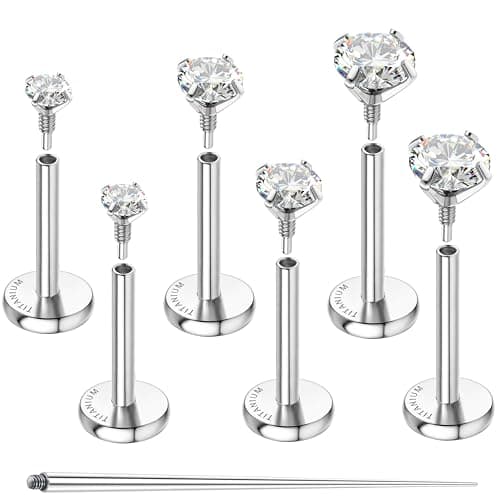
Gauge, grade, standard and threading type all stated. The one number it leaves out is the one this page cares about most, which is post length.
Post material
G23 titanium, cited against ASTM F136, 20 gauge. Post length is not stated
From the seller’s own product title: “GEMQUEEN G23 Implant Grade Titanium Flat Back Earrings Hypoallergernic 20G | 3 Pairs Astm F136 Hypoallergenic Flatback Earrings Internally Threaded Studs for Nose, Helix, Tragus, Conch, Labret Piercing”
Back material
Flat back, internally threaded, in the same titanium
From the seller’s own product title: “Flatback Earrings Internally Threaded Studs”
Nickel claim
Names a metal, makes no nickel claim. The seller’s own words: “G23 Implant Grade Titanium Flat Back Earrings Hypoallergernic”
This listing does four of the five things right. It gives the gauge, it names the grade, it cites ASTM F136, and it tells you the studs are internally threaded. For a healing or recently-healed piercing that is a strong specification.
What is absent is post length, and on a flat-back that is the measurement that decides comfort. A flat disc sitting against the back of the lobe is only comfortable if the post is long enough to clear the tissue. Without the number you are buying on hope, which is why this sits below the picks that publish it.
Quoted verbatim above, typo included: the title really does read "Hypoallergernic". That is the seller's own spelling, and a quote that has been tidied up is no longer a quote. It is a small thing, but a listing proofread this loosely is a listing to read the rest of twice.
Three pairs on a named standard with internal threading is still a good buy. It is the fit information, not the metal, that is missing here.
Who it’s for
Someone who already knows their post length, wants internal threading, and wants the standard cited rather than just the grade.
Skip it if
Skip this if you are new to flat-backs. Start with a set that publishes several post lengths, learn yours, then come back.
#5 · A single plain threadless piece at a stated gauge
Gotumo Threadless Titanium Flat-Back Stud, 20G
Gauge and threading type stated, nothing else. It is the baseline this page is measuring the others against, and it is ranked last on information rather than on quality.
Post material
G23 titanium, 20 gauge. No post length and no standard cited
From the seller’s own product title: “Gotumo 20G Flat Back Earrings Stud G23 Titanium Threadless Tragus Labret Cartilage Lip Medusa Conch Body Piercing Jewelry for Women Men Silver”
Back material
Flat back in the same titanium, threadless push-in fitting
From the seller’s own product title: “Flat Back Earrings Stud G23 Titanium Threadless”
Nickel claim
Names a metal, makes no nickel claim. The seller’s own words: “G23 Titanium Threadless”
There is nothing wrong with this listing. It names a gauge, it names a grade, it says threadless, and it is honest about being a single plain piece. If you want one unobtrusive flat-back and you know your size, it does the job.
It is last here because this page ranks on fit disclosure, and it publishes one of the three numbers. No post length, no back disc diameter, and G23 rather than a cited standard.
A note that applies across the whole shelf: these pieces are sold with body-jewelry vocabulary — labret, tragus, conch, medusa — because that is the manufacturing category they come from. A "labret" post is simply a flat-backed post, and it works in a lobe perfectly well. Do not be put off by a title listing piercings you do not have.
Who it’s for
Someone replacing one piece, who knows their gauge and length and wants the plainest possible titanium flat-back.
Skip it if
Skip this if you want the specification spelled out. Everything else on this page tells you more for a similar outlay.
Limerencia Pure Titanium Replacement Earring Backs (2 pairs)
The cheapest fix in this whole category: keep the earrings, replace the part that is actually touching you.
Post material
Not applicable — this is the back component
From the seller’s own product title: “Limerencia Pure Titanium Earring Backs Replacements”
Back material
Pure titanium
From the seller’s own product title: “Limerencia Pure Titanium Earring Backs Replacements, Hypoallergenic for Sensitive Ears, Secure Ear Locking for Stud Earrings for Posts”
Nickel claim
Says hypoallergenic, not nickel-free. The seller’s own words: “Pure Titanium Earring Backs ... Hypoallergenic”
This is the pick that most often solves the problem for the least money, and almost nobody writing about sensitive ears mentions it. A butterfly back is a separately manufactured part, frequently a cheaper alloy than the earring it holds on, and it sits against the back of your lobe for exactly as long as the earring does.
So if you have earrings you love that started irritating you, or one ear reacts and the other does not, changing the backs is the first thing to try. It costs a fraction of a new pair and it isolates the variable.
Titanium backs also grip differently from steel butterflies — generally more securely, which is a side benefit if you lose earrings.
Who it’s for
Anyone with a drawer of earrings they cannot wear. Try this before replacing any of them.
Skip it if
Skip this if the post itself is the problem. A titanium back on a plated brass post fixes half of a two-part contact and the half it does not fix is inside the piercing.
Standard earlobe piercings are usually 20 gauge, which is about 0.8mm. Cartilage — helix, tragus, conch — is normally pierced at 16G or 18G, which are thicker. The scale runs backwards, so a bigger number means a thinner post. Gauge is a measurement of the hole you already have, not a preference.
What post length should earrings be?+
Long enough to clear the thickness of your lobe with a little room, which for most people means 6mm, 7mm or 8mm. There is no standard, because lobes differ by several millimeters between people and even between ears. The practical way to find yours is to buy a set with several lengths and keep the one that sits flush without pressing.
What happens if an earring post is too short?+
The back gets pulled tight against the lobe. That presses on the tissue, traps moisture and sweat behind the ear, and leaves a healing or irritated piercing nowhere to drain. The result is soreness, sometimes a damp smell and sometimes weeping — which looks very like an infection or an allergy and is neither. It is the most commonly misdiagnosed problem in this whole category.
How tight should earring backs be?+
Snug enough that the earring does not slide, loose enough that the back is not compressing the lobe. If a butterfly clutch is leaving a mark, it is too tight or the post is too short. A flat back solves this more reliably than adjusting a clutch does, because the disc spreads pressure instead of concentrating it.
Can I use a 20G earring in a 16G piercing?+
It will physically go in, because it is thinner, but it will sit loose in a channel sized for something bigger — it moves around, it can migrate, and in cartilage that is not ideal. The other direction does not work at all: a 16G post will not pass through a 20G hole without stretching it. Match the gauge to the piercing.
Are wooden or resin earrings metal free?+
Usually not. The decorative front is wood or resin and the post is almost always metal, commonly stainless steel, and the listing typically describes the wood in detail and the post not at all. If you need a post with no metal in it, look at plastic-post studs and retainers instead.