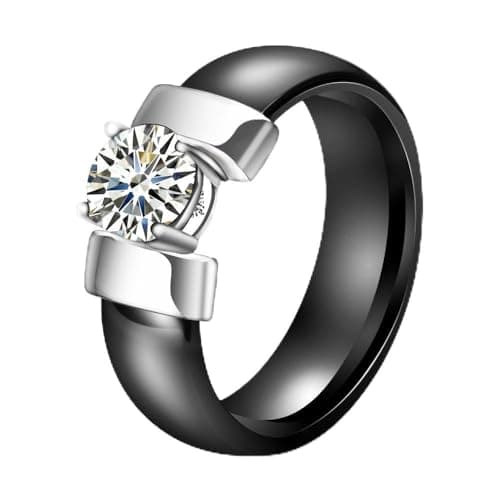
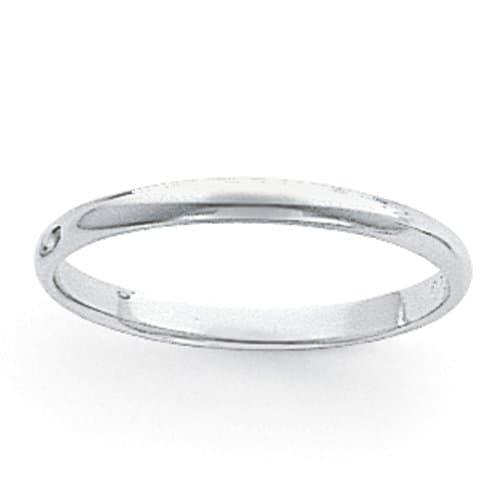
They look almost identical on the hand and they are not the same purchase. One is a single dense metal that never needed a coating; the other is an alloy whose recipe the seller usually will not tell you.
Gentle Carat earns a commission when you buy through the links on this page, at no extra cost to you. It never decides what we recommend or how we rank it — here is the full disclosure.
Platinum is the safe one. It is a single dense metal, alloyed only lightly, never whitened with nickel and never plated — what you see on the day you buy it is what touches your skin in fifteen years. White gold is a recipe, not a metal: yellow gold bleached pale with either nickel or palladium, then almost always coated in rhodium. If the whitening metal is nickel, the rhodium is the only thing between it and your finger, and rhodium wears.
How we judged these
Criteria first, ranking second. Nobody here has worn any of these rings, so the scores rate what each seller discloses and how well the named metal suits reactive skin — never a test result. What we looked for, in order:
Is the metal stated as a fineness? “950 platinum” is a number you can check against a hallmark. “Platinum” on its own could be plating.
Is the alloying metal named? Nobody on this shelf names it. We say so on every entry rather than assuming it is benign.
How much skin does it occlude? Width and interior profile, because a ring traps moisture in a way no other jewelry does.
Can it be resized and repaired? Over a lifetime this matters as much as the alloy.
Honest downsides. Every pick carries a “skip it if”, including the platinum.
What white gold actually is
Pure gold is yellow and too soft to hold a stone, so every gold ring is an alloy. The karat number tells you how much of it is gold: 14K is 58.3 percent, 18K is 75 percent. What the karat number does not tell you is what the rest is — and in white gold, the rest is the whole question.
To make gold look white you have to bleach the yellow out of it with a paler metal. The two traditional choices are nickel, which is cheap and makes a hard, bright alloy, and palladium, which is a platinum-group metal, more expensive, and nickel-free. Europe’s nickel restrictions pushed much European white gold toward palladium. The United States has no equivalent federal limit for jewelry, so an American listing can be either, and the title almost never says which.
Then the ring is usually plated in rhodium — a hard, bright, platinum-group metal that hides the faintly gray or yellow cast even whitened gold has. Rhodium itself is inert and people rarely react to it. The trouble is that it is a coating a few microns thick on a ring you wear through washing up, gardening and hand sanitizer, and it wears fastest on the underside of the band. That is why a white gold ring can be perfectly comfortable for a year and then begin to itch with nothing visibly changed.
What platinum actually is
Jewelry platinum is typically 950 — 95 percent platinum, with the balance ruthenium, iridium or cobalt. It is white all the way through, so it is not plated, so there is no coating to wear off and no second metal waiting underneath. The platinum-group metals are among the least reactive things you can put against skin.
Two practical differences people notice immediately. Platinum is dense: a platinum band feels substantially heavier than the same ring in gold, which some people love and some cannot get used to. And platinum scratches — but the scratches push metal aside rather than removing it, which is why old platinum develops a soft patina instead of thinning. A jeweler can polish it back.
Side by side
Platinum and white gold compared on the things that decide a ring you will wear for decades.
Platinum (950)
White gold (14K/18K)
Nickel
None as an alloying metal
Depends entirely on the recipe — nickel or palladium, and the listing rarely says
Coating
None — white all the way through
Almost always rhodium-plated
Maintenance
Polish occasionally if you dislike the patina
Replating every year or two to stay bright
Weight
Noticeably heavy
Lighter, closer to what people expect from a ring
Wear
Scratches displace metal; very little is lost
Plating thins; the alloy underneath becomes the contact surface
Resizing
Yes, by a jeweler
Yes, by a jeweler
Price
The highest on this page
Typically less than platinum, more than titanium
Platinum and white gold compared on the things that decide a ring you will wear for decades.
Is white gold ever the right answer?
Yes — if you can get the alloy named. A jeweler who will confirm in writing that a ring is palladium white gold is selling you a nickel-free white metal, and it will be lighter on the hand than platinum and cost less. The problem is not white gold as a material. It is white gold as it is sold online, where the word appears with no recipe attached and the buyer is expected to assume.
It is the same failure this site documents everywhere else: a conclusion offered in place of the fact that would support it. The listing-reading method applies exactly here — find the specific claim, and if there is not one, treat the question as open.
If platinum is out of reach
Most people arriving at this question are not choosing between two thousand-dollar rings. They are trying to avoid buying the wrong one. Three answers cost far less and settle the metal completely:
Solid yellow gold at 14K or above. Conventionally alloyed with silver and copper, so no whitening metal and no plating. See the engagement ring picks.
Titanium. No nickel as an alloying element, very light, a fraction of the price. The trade-off is that it cannot realistically be resized.
Ceramic. Not a metal at all, so the alloy question does not arise. Very scratch-resistant and brittle in the same breath.
All three appear in the picks below alongside the platinum, because the honest ranking on this page is not “platinum, then worse platinum”. It is: buy the metal whose composition you can state.
Ranked on what the seller actually discloses. Tap a row for the full write-up, or go straight to the listing.
#
Product
Best for
Score
Price
1
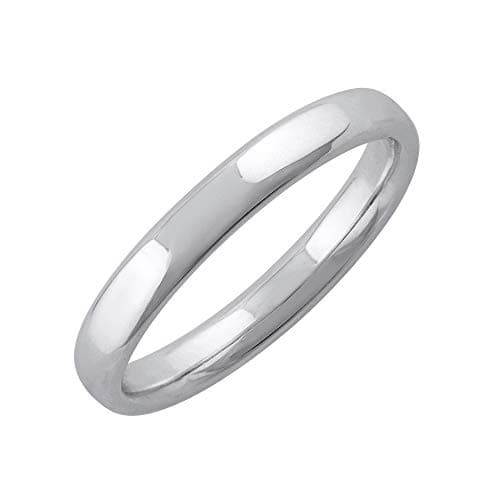
Jewelry Stores Network Solid 950 Platinum Comfort-Fit Band, 3mmSolid 950 platinum with a comfort-fit interior, which is the detail that decides whether a dense ring is pleasant after twelve hours.
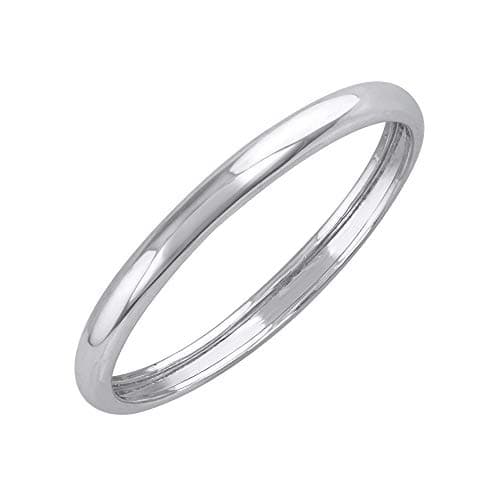
FINEROCK 950 Platinum Plain Band, 2mmA stated 950 platinum alloy in the narrowest width, which is the least expensive honest platinum band on this shelf.
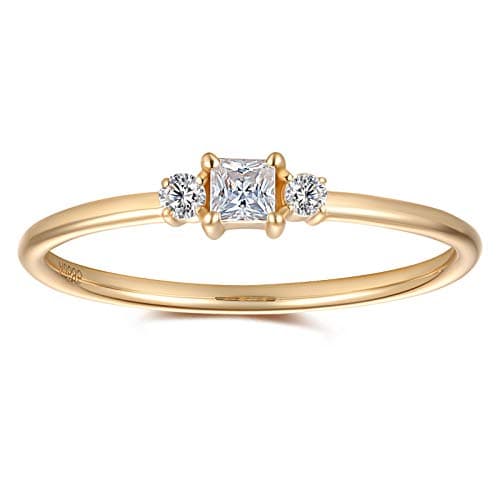
espere Solid 14K Yellow Gold Three-Stone Moissanite RingThe title commits to both of the words that matter on a gold ring — "solid" and "yellow" — which is precisely the combination that rules out plating and the white-gold nickel question at once.
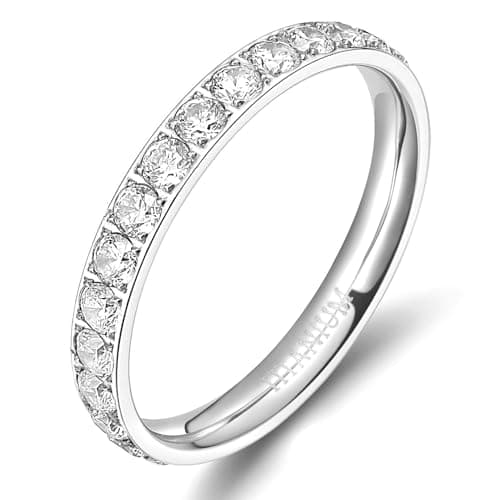
TIGRADE 3mm Titanium Engagement Ring, CZ EternityTitanium band, stones set all the way round, a genuinely wide size range — and a price that makes it the right ring for travel, the gym, or the months before the real one is ready.
The metal question solved for the price of a lunch
MYNENEY 6mm Ceramic Engagement Band with CZA ceramic band removes the metal question entirely rather than answering it — which, for someone who has reacted to everything, is the point.
“Score” is a disclosure score, not a test result. It rates how completely the seller states the post metal, the back metal and the nickel claim, and how that metal holds up for reactive skin. The full rubric is published on our methodology page.
Solid 950 platinum with a comfort-fit interior, which is the detail that decides whether a dense ring is pleasant after twelve hours.
Post material
Solid 950 platinum, 3mm, comfort fit
From the seller’s own product title: “Jewelry Stores Network Solid Platinum Wedding Bands for Women - 3mm Comfort Fit Rounded 950 Platinum Wedding Ring, Size 5, Classic Engagement, Polished Rings for Women and Couples”
Back material
Domed interior — less of the band actually touches the finger
From the seller’s own product title: “Comfort Fit Rounded”
Nickel claim
Names a metal, makes no nickel claim. The seller’s own words: “Solid Platinum”
Comfort fit means the inside of the band is domed rather than flat, so it rolls over the knuckle and rests on a narrower line of skin. On a site preoccupied with occlusion that is not a comfort detail, it is a contact-area detail: less flat metal pressed against damp skin.
The title uses both words that matter — "solid" and "950" — which is more than most platinum listings manage. Platinum this fine is soft enough to scratch, but the scratches displace metal rather than remove it, which is why old platinum develops a patina instead of wearing thin the way plating does.
Three millimeters is the width most people end up wearing daily. It reads as a real ring without the weight of a wide platinum band, which at this density is a genuine consideration.
Who it’s for
A daily wedding band for someone whose skin has already ruled out white gold and who wants the metal settled for life.
Skip it if
Skip this if the budget is the constraint. A titanium band solves the same medical problem for a fraction of the price, and nobody will know from across the room.
A stated 950 platinum alloy in the narrowest width, which is the least expensive honest platinum band on this shelf.
Post material
950 platinum — 95% platinum by weight
From the seller’s own product title: “950 Platinum 2 mm Plain Wedding Band (Ring Size 5)”
Back material
Solid throughout; the remaining 5% alloy metal is not named
Not named in the seller’s product title — the headline nearly every buyer reads. That omission is the finding, not a gap in our notes.
Nickel claim
Names a metal, makes no nickel claim. The seller’s own words: “950 Platinum”
"950" is the part that matters. It is a stated fineness — 95 percent platinum by weight — rather than the word "platinum" floating free of a number, and it is the difference between a platinum ring and a platinum-plated one.
Platinum is the rare case where a precious metal is also the conservative medical choice. It is not alloyed with nickel, and the platinum-group metals are among the least reactive things you can put against skin. It is also dense: a platinum band feels noticeably heavier than the same ring in gold, which people either love or cannot get used to.
The remaining five percent is usually ruthenium, iridium or cobalt, and the listing does not say which. For almost everyone that is academic. If you have a diagnosed cobalt allergy as well as nickel, it is the one question worth asking the seller before ordering.
Who it’s for
Someone who wants a precious-metal band, cannot risk white gold, and would rather spend the money on the metal than on width.
Skip it if
Skip this if you want presence on the hand. Two millimeters is a fine line, and platinum's weight is spent on very little visible ring.
The same stated 950 alloy in a wider profile, for a hand that carries it and a budget that stretches.
Post material
950 platinum — 95% platinum by weight
From the seller’s own product title: “950 Platinum 3.2 mm Plain Wedding Band (Ring Size 9.5)”
Back material
Solid throughout; interior profile not named
Not named in the seller’s product title — the headline nearly every buyer reads. That omission is the finding, not a gap in our notes.
Nickel claim
Names a metal, makes no nickel claim. The seller’s own words: “950 Platinum”
Width changes two things on a reactive finger: how much skin is covered, and how much moisture and soap get trapped under the band. A wider ring is not a worse metal, but it is a larger occluded patch, and it is worth knowing that before choosing a width for the sake of looks.
Platinum's weight scales with width, and at 3.2mm this is a substantial ring on the hand. People who move to platinum from titanium consistently notice the difference for the first week.
As with the narrow band, the alloying five percent goes unnamed. Platinum sellers rarely state it and it rarely matters.
Who it’s for
Someone who wants the presence of a wider band without moving back into the gold alloy question.
Skip it if
Skip this if your hands swell in heat or your work involves gloves. A wide, heavy band is the least forgiving thing to wear when a finger changes size.
espere Solid 14K Yellow Gold Three-Stone Moissanite Ring
The title commits to both of the words that matter on a gold ring — "solid" and "yellow" — which is precisely the combination that rules out plating and the white-gold nickel question at once.
Post material
Solid 14K yellow gold band
From the seller’s own product title: “espere 14K Yellow Gold Moissanite Engagement Ring for Women | Solid Gold Three-Stone Promise Ring | 0.2 Carat Moissanite Dainty Stacking Rings Size 8”
Back material
Setting metal not named separately — assume it matches the band, and ask
Not named in the seller’s product title — the headline nearly every buyer reads. That omission is the finding, not a gap in our notes.
Nickel claim
Names a metal, makes no nickel claim. The seller’s own words: “14K Yellow Gold Moissanite Engagement Ring”
Fourteen-karat gold is 58.3 percent gold by weight; the rest is the alloy, and in yellow gold that alloy is conventionally silver and copper. That is the reason yellow gold at 14K and above is this site's standing answer for people who want a precious-metal ring and cannot wear nickel. The listing says yellow, and it says solid, so there is no plating layer waiting to wear through.
Moissanite is silicon carbide, a different mineral from diamond, and it is hard — around 9.25 on the Mohs scale against diamond's 10 — which is why it holds a polish on a ring worn every day. A total of 0.2 carat across three stones is a dainty ring, sold explicitly as stackable, and that is the honest framing: this is a delicate engagement ring rather than a statement one.
The one open question is the setting. Some yellow gold rings are made with white gold prongs so the stone reads whiter, and white gold is where nickel turns up. The title does not say, so ask the seller before ordering if a nickel reaction is the reason you are here.
Who it’s for
Someone buying a genuine gold proposal ring for a partner whose skin rules out white gold, on a budget that stops well short of a diamond.
Skip it if
Skip this if you want a visible center stone. Three small stones totaling 0.2 carat read as a delicate band, not a solitaire.
#5 · The metal question solved for the price of a lunch
TIGRADE 3mm Titanium Engagement Ring, CZ Eternity
Titanium band, stones set all the way round, a genuinely wide size range — and a price that makes it the right ring for travel, the gym, or the months before the real one is ready.
Post material
Titanium band, 3mm
From the seller’s own product title: “TIGRADE 3mm Women Titanium Engagement Ring Cubic Zirconia Eternity Wedding Band Size 3-13.5, Silver, Size 6”
Back material
Stones set into the band; no separate setting metal named
Not named in the seller’s product title — the headline nearly every buyer reads. That omission is the finding, not a gap in our notes.
Nickel claim
Names a metal, makes no nickel claim. The seller’s own words: “Women Titanium Engagement Ring”
Titanium contains no nickel as an alloying element, so the band — the part under occluded skin all day — is settled. That is the entire medical question for most people with a nickel allergy, and this ring answers it for very little money.
Cubic zirconia is a synthetic stone and it is inert against skin. It is also softer than moissanite or diamond and will lose its edge over years of daily wear, which is an honest reason to think of this as a ring for a period of time rather than for life.
One practical warning that applies to every titanium ring on this page: titanium cannot realistically be resized. It is too hard to cut and rejoin the way gold is. Sizes run from 3 to 13.5 here, so measure properly rather than guessing — and remember knuckles swell in heat.
Who it’s for
A travel or work ring, a placeholder while the real one is made, or a genuine engagement ring for a couple who would rather spend the money elsewhere.
Skip it if
Skip this if the ring has to last decades unchanged. Cubic zirconia clouds and loses its edge with years of wear, and titanium cannot be resized if fingers change.
A ceramic band removes the metal question entirely rather than answering it — which, for someone who has reacted to everything, is the point.
Post material
Ceramic band, 6mm, comfort fit
From the seller’s own product title: “MYNENEY 6mm White/Black Ceramic Rings Plus Cubic Zirconia For Women Comfort Fit Engagement Wedding Band Size 5-12”
Back material
Cubic zirconia inlaid in the ceramic; no metal setting named
From the seller’s own product title: “Ceramic Rings Plus Cubic Zirconia”
Nickel claim
Names a metal, makes no nickel claim. The seller’s own words: “Ceramic Rings Plus Cubic Zirconia”
Jewelry ceramic is a hard, non-metallic material, usually zirconium oxide, and it contains no nickel because it contains no metal alloy at all. For someone who has reacted to titanium as well as steel — a small group, but a real one — that is a genuinely different answer rather than a better grade of the same one.
The trade-off is how ceramic fails. It is very scratch-resistant, much more so than titanium, but it is brittle: a hard knock that would dent a gold ring can crack a ceramic one. It also cannot be resized, and in an emergency it has to be cracked off rather than cut.
Six millimeters is a wide band for an engagement ring. Wider bands occlude more skin, which matters more to a reactive finger than the material does once the material is inert.
Who it’s for
Someone who has reacted even to titanium, or who simply wants a band that will not scratch.
Skip it if
Skip this if you work with your hands. Ceramic shrugs off scratches and does not shrug off impacts, and a cracked band cannot be repaired.
As close as jewelry metal gets. Jewelry platinum is typically 95 percent platinum, and the platinum-group metals very rarely cause contact allergy. The remaining five percent is usually ruthenium, iridium or cobalt — worth asking about only if you have a diagnosed cobalt allergy as well.
Does white gold contain nickel?+
Sometimes. White gold is yellow gold alloyed with a whitening metal, and the two traditional choices are nickel and palladium. Palladium white gold is nickel-free. US listings rarely say which recipe they used, so treat an unspecified white gold ring as an open question rather than a safe one.
Why did my white gold ring start irritating me after a year?+
Most likely the rhodium plating wore through. White gold is coated in rhodium to keep it bright, the coating thins fastest on the underside of the band, and once it does the alloy underneath becomes the surface touching your finger. Replating restores both the color and the barrier.
Is platinum worth the extra money over white gold?+
For a reactive finger, the argument is strong: no whitening metal, no coating to wear through, and no replating appointments. For anyone else it is a question of weight and taste. If the budget is the obstacle, titanium and solid yellow gold both settle the metal for far less.
Can platinum rings be resized?+
Yes. Platinum is worked by any competent jeweler, which is one advantage it has over titanium and ceramic — both of which effectively cannot be resized at all.