Gentle Carat earns a commission when you buy through the links on this page, at no extra cost to you. It never decides what we recommend or how we rank it — here is the full disclosure.
No, they are not the same. Nickel-free is a specific claim that a named metal is absent from the piece. Hypoallergenic is a general claim that a reaction is less likely, with no standard behind it in the United States and no obligation to name any metal at all. A product can honestly call itself hypoallergenic while containing nickel. It cannot honestly call itself nickel-free.
What each phrase commits the seller to
What each phrase on a jewelry listing actually commits the seller to.
Phrase on the listing
What it commits to
Can you check it?
Nickel-free
That the piece contains no nickel. A definite, checkable statement about composition.
Yes, in principle — and the seller has put themselves on the hook by saying it.
Nickel-safe
That nickel is present but releases below a threshold, usually the EU limit.
Only if the seller names the standard. Some do, most do not.
Hypoallergenic
Nothing specific. Less likely to cause a reaction, in the seller's opinion.
No. There is nothing to check.
Lead-free / cadmium-free
Real claims about real metals — but neither is what causes contact dermatitis in ears.
Yes, and they are often used to pad a listing that says nothing about nickel.
Surgical steel
A material family, usually 316L. It contains nickel and releases very little.
Partly. The grade number is the useful part; 'surgical' alone is decorative.
Implant grade
Usually a pointer at ASTM F-136 titanium. The strongest routine claim in this category.
Yes, if the standard number appears alongside it.
What each phrase on a jewelry listing actually commits the seller to.
Why the weaker word is the more common one
Not because sellers are all cynics. It is because “hypoallergenic” is the safer thing to write. If you print “nickel-free” on a product that turns out to contain nickel, you have made a false statement of fact about your goods. If you print “hypoallergenic”, you have expressed an opinion. Legal departments have views about which of those to prefer, and they are not wrong.
The practical consequence for you is simple and slightly bleak: the more careful a company is, the vaguer its label tends to be, unless it genuinely knows its supply chain well enough to make the specific claim. Which is why a small seller writing “F136 implant-grade titanium post, surgical steel back” is telling you more than a large one writing “hypoallergenic fine jewelry”.
The nickel-free claim has one real gap
Even a truthful nickel-free claim usually covers the piece as sold. It does not always cover the back, which may be sourced separately, and it does not cover the replacement back you bought in a multipack two years later. If you have ever had one earring irritate you and not the other, an odd back is a very likely culprit. Backs and posts, in detail.
It also says nothing about cobalt or chromium, both of which are recognized contact allergens and both of which appear in jewelry alloys. If titanium and niobium are fine for you and steel is not, nickel may not be the whole story — but working that out is a patch-test question for a clinician rather than something to solve by reading listings.
What to do with this at the checkout
Search for the metal, not the adjective. “Titanium studs” will get you closer than “hypoallergenic earrings” every time.
Read the listing for the word post. If it is not there, the product is telling you about its front.
Treat “hypoallergenic” on its own as a null result. Not a red flag — plenty of good products use it — just no information.
Prefer a listing that names a standard. “ASTM F-136” or “316L” beats an adjective, because you can go and read what the number means.
Three products, three different strengths of claim
The picks below are deliberately not all the same. One makes the strongest claim available in this category, one makes a good claim about a genuinely nickel-free metal, and one is a popular plated option whose claim is weaker than its marketing suggests — included so you can see the difference on a real listing rather than in the abstract.
Quick picks
Ranked on what the seller actually discloses. Tap a row for the full write-up, or go straight to the listing.
#
Product
Best for
Score
Price
1
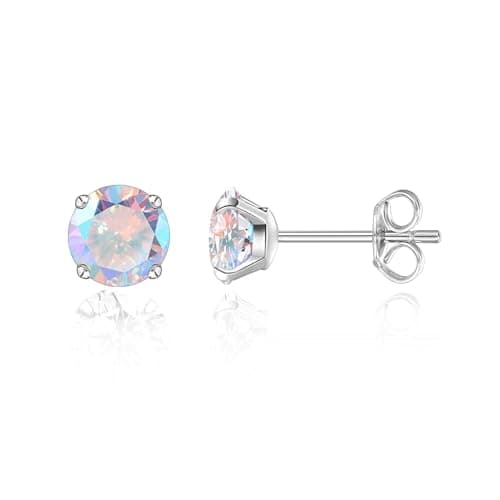
Limerencia F136 Titanium Birthstone CZ StudsColored stones on an implant-grade post — a way to get something other than plain silver-tone without introducing a plated surface.
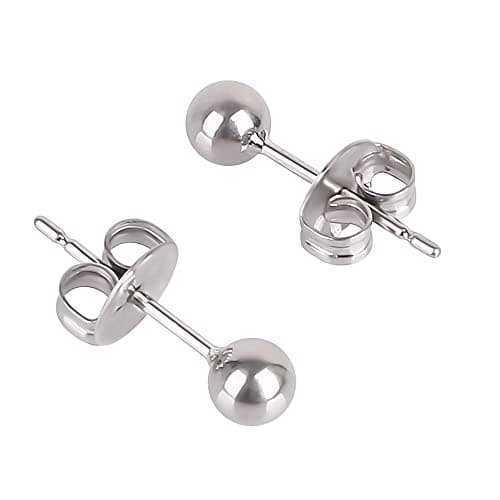
VGACETI Pure Titanium Ball Post Studs, 3mm and 4mmThe rare listing that says nickel-free rather than hypoallergenic, and names the post specifically rather than the earring generally.
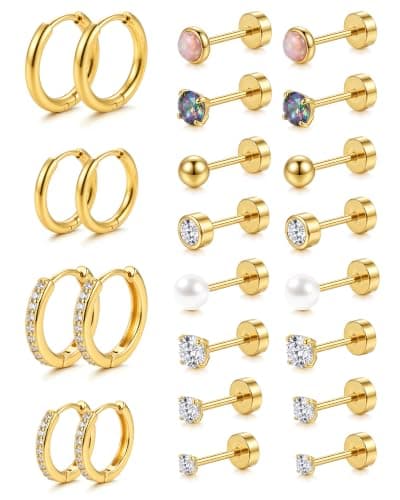
18K Gold-Plated Surgical Steel Flat-Back and Screw-Back Stack SetA plated set that names its base metal and says nickel-free rather than hypoallergenic — both unusual, both the right way round.
“Score” is a disclosure score, not a test result. It rates how completely the seller states the post metal, the back metal and the nickel claim, and how that metal holds up for reactive skin. The full rubric is published on our methodology page.
#1 · Color without plating
Limerencia F136 Titanium Birthstone CZ Studs
Colored stones on an implant-grade post — a way to get something other than plain silver-tone without introducing a plated surface.
Post material
F136 implant-grade titanium
From the seller’s own product title: “Limerencia Hypoallergenic G23 Titanium Earrings | F136 Implant Grade Pure Titanium, Suitable for Sensitive Ears with Birthstone Crystals CZ Simulated Diamonds”
Back material
Not named in the title
Not named in the seller’s product title — the headline nearly every buyer reads. That omission is the finding, not a gap in our notes.
Nickel claim
Says hypoallergenic, not nickel-free. The seller’s own words: “Hypoallergenic G23 Titanium”
The reason this pick exists is a specific trap: the usual way to get colored earrings at this price is a plated finish, and plating on a post is the thing that fails first. Colored stones on a bare titanium post sidesteps that entirely — the color is in the stone, not on the metal.
'Simulated diamonds' and 'CZ' are the same thing said twice, and neither is a claim about the metal. Read past them to the F136 designation, which is the part that decides whether your ear minds.
The title is silent on the back, which is worth a small mark down. On a set sold as twelve colors, the backs are the component most likely to have been bought in bulk from somewhere else.
Who it’s for
Someone who wants a bit of color, has reacted to plated jewelry before, and would rather solve that by changing the stone than by hoping the plating lasts.
Skip it if
Skip this if you were hoping for real gemstones. Cubic zirconia is a synthetic and the listing says so; if that matters to you, this is the wrong price bracket entirely.
VGACETI Pure Titanium Ball Post Studs, 3mm and 4mm
The rare listing that says nickel-free rather than hypoallergenic, and names the post specifically rather than the earring generally.
Post material
Pure titanium, ball post construction
From the seller’s own product title: “Ball Stud Titanium Earrings,Hypoallergenic for Women High Polished Colored for Sensitive Ears, 3mm and 4mm Pure Titanium Nickel-Free Lead-Free”
Back material
Not named in the title
Not named in the seller’s product title — the headline nearly every buyer reads. That omission is the finding, not a gap in our notes.
Nickel claim
Explicitly nickel-free. The seller’s own words: “Pure Titanium Nickel-Free Lead-Free”
This is the strongest nickel language on this page and the reason the pick is here. 'Nickel-free' is a definite factual claim about composition that the seller can be held to. 'Hypoallergenic' is not. Almost every competing listing chooses the second and this one chose the first.
Commercially pure titanium rather than the F136 alloy: no aluminum, no vanadium, one element. Slightly softer, which is why you see it as balls and discs rather than as thin structural parts, and completely fine for a healed lobe.
A 3mm or 4mm ball is the smallest sensible everyday earring. It is what you put in when you want the piercing to stay open and otherwise want to forget it exists, and at this price there is no reason to compromise on the metal to get it.
Who it’s for
First purchase for someone who has just worked out that nickel is the problem. Cheap enough to be a low-stakes test of whether titanium fixes it.
Skip it if
Skip this if you want the earring to be visible from more than a foot away. A polished 3mm ball is jewelry in the technical sense only.
18K Gold-Plated Surgical Steel Flat-Back and Screw-Back Stack Set
A plated set that names its base metal and says nickel-free rather than hypoallergenic — both unusual, both the right way round.
Post material
Surgical steel, 18K gold plated
From the seller’s own product title: “18K Gold Plated Hypoallergenic Earring Stack Set, Surgical Steel Flat Back & Screw Back Studs, Multi-Size Small Huggie Hoops, Nickel-Free CZ Pearl Opal Cartilage Earrings”
Back material
Flat backs and screw backs; both named as part of the surgical steel construction
From the seller’s own product title: “Surgical Steel Flat Back & Screw Back Studs”
Nickel claim
Explicitly nickel-free. The seller’s own words: “Nickel-Free CZ Pearl Opal Cartilage Earrings”
Two things make this the pick of the plated options. It names the base metal — surgical steel, not an unnamed alloy — and it says nickel-free explicitly rather than hedging with hypoallergenic. The plating is a finish over a metal you would have been willing to wear anyway.
That is the whole test for plated jewelry. Plating wears through at the post first, because the post is the highest-friction, highest-moisture part of the piece. When it eventually does, the question is what you are left standing on. Here, it is steel.
Both fastening types appear in the title and both are attributed to the steel construction, which is why this scores highest on back disclosure of anything on this page.
Who it’s for
Anyone who wants a warm gold-tone stacked ear and has been avoiding plated jewelry because of the base-metal question.
Skip it if
Skip this if surgical steel is what you react to. Plating buys you time, not immunity, and eventually you are wearing the base.
Are nickel-free earrings the same as hypoallergenic?+
No. Nickel-free is a claim that a specific metal is absent. Hypoallergenic is a claim that a reaction is unlikely, with no standard behind it in the US. Something can be labeled hypoallergenic and still contain nickel.
What is the difference between nickel-safe and nickel-free?+
Nickel-free means none is present. Nickel-safe usually means some is present but the piece releases less than a threshold — typically the EU limit of 0.2 micrograms per square centimeter per week for post assemblies. Nickel-safe is a more honest label for surgical steel than nickel-free would be.
Are hypoallergenic earrings real, or is it all marketing?+
Both, depending on the seller. Implant-grade titanium and niobium genuinely do not release nickel, and jewelry made from them genuinely is less likely to cause a reaction. The word on the label is doing no work; the metal is doing all of it. So the answer is to buy the metal rather than the word.
If a listing says nickel-free, can I trust it?+
More than you can trust hypoallergenic, because it is a specific factual claim someone can be held to. It is still worth checking that it covers the post and the back rather than just the decorative part, since those are separate components and a claim about “the earring” does not always reach the fastening.
Why do some sellers say lead-free and cadmium-free instead?+
Because those are real claims that are easy to make and are required for children’s products in several US states. They are not irrelevant, but neither lead nor cadmium is what causes the itchy red earlobe. A listing leading with those two and silent on nickel has answered a question you did not ask.