Gentle Carat earns a commission when you buy through the links on this page, at no extra cost to you. It never decides what we recommend or how we rank it — here is the full disclosure.
Nickel allergy is a form of allergic contact dermatitis: the immune system learns to recognize nickel ions released from metal into sweat, and reacts on subsequent exposure with itching, redness and sometimes blistering where the metal touched. It develops through exposure rather than being present from birth, and it generally persists once established.
The mechanism, briefly
Metal does not have to dissolve for this to happen. What matters is ion release— a small number of nickel ions coming off the surface into sweat, which is slightly acidic and salty and is an effective solvent for the purpose. Those ions cross into the skin and bind to proteins there, and the immune system responds to the combination.
Three consequences follow, and they explain most of what is otherwise confusing about this:
Nickel content is not the same as nickel release. Surgical steel is roughly a tenth nickel by weight and releases almost none, because the alloy holds onto it. A cheap plated earring may contain far less and give you a much worse week.
Sweat makes everything worse. Hot weather, exercise and occlusion all increase release and increase uptake. The same earring can be fine in January and a problem in July.
Duration matters. Which is why the worst offenders are the things worn longest against skin: piercings, watch bands, belt buckles and rings.
What the law requires, and where
The European Union regulates this and the United States does not, which is the single most useful fact on this page.
Why the same product can be sold as hypoallergenic in the US and would need to pass a measured test to be sold in the EU.
Jurisdiction
What is regulated
The number
European Union
Nickel release from items in prolonged skin contact, under REACH Annex XVII entry 27
0.2 µg/cm²/week for post assemblies in pierced ears; 0.5 µg/cm²/week for prolonged skin contact
European Union
The test method for the above
EN 1811 — artificial sweat for one week, then measured by AAS or ICP-MS
United States
Nickel release from consumer jewelry
Nothing. There is no federal limit.
United States
The word “hypoallergenic”
No legal definition for jewelry. The FDA has said it means whatever the company wants it to.
Why the same product can be sold as hypoallergenic in the US and would need to pass a measured test to be sold in the EU.
If you have identified a nickel sensitivity and jewelry changes have only partly helped, these are the everyday contacts people miss. All of them satisfy the same conditions: metal, skin, time, moisture.
Belt buckles — the classic, and the most misdiagnosed. The navel rash.
Jeans rivets and studs, sitting at the same spot as a buckle.
Watch cases and bracelets — the longest daily contact most people have. More here.
Eyeglass frames, especially monel, a nickel-copper alloy that is the standard cheap frame material. More here.
Bra hooks and underwires.
Keys, coins and phones in a front pocket, against the thigh.
Zips and snap fasteners on clothing.
Where the evidence stops
Two things we deliberately do not tell you, because we could not trace them to a primary source.
Prevalence figures. Several numbers for how common nickel allergy is circulate widely across retailer blogs, quoted without attribution and often citing each other. We are not repeating them. If you want a figure, it should come from a clinical source, not from a jewelry shop.
Whether a specific product passes the EU limit. Unless a manufacturer publishes a test result, nobody knows — including us. We cite the thresholds to explain what a real claim would look like, and we have never measured a product against them.
What to do with all this
Get it confirmed if it matters to you. Patch testing is the only way to know what you actually react to, and cobalt and chromium are worth ruling in or out at the same time.
Deal with the longest contacts first: piercings, watch, belt, ring. That is where the exposure is.
Buy metals with no nickel in them rather than products with the word hypoallergenic on them. Which metals those are.
Do not expect it to fade. Contact allergies generally persist, and exposure tends to intensify rather than desensitize.
Quick picks
Ranked on what the seller actually discloses. Tap a row for the full write-up, or go straight to the listing.
#
Product
Best for
Score
Price
1
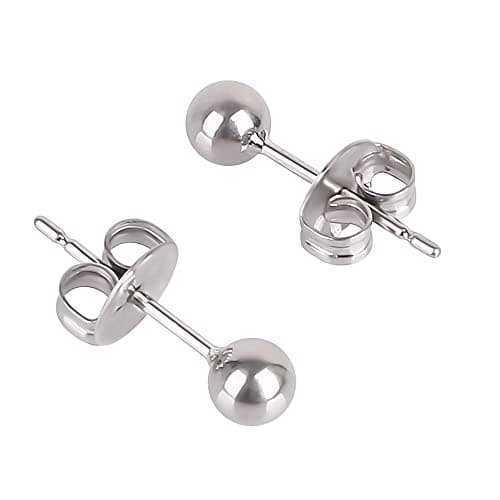
VGACETI Pure Titanium Ball Post Studs, 3mm and 4mmThe rare listing that says nickel-free rather than hypoallergenic, and names the post specifically rather than the earring generally.
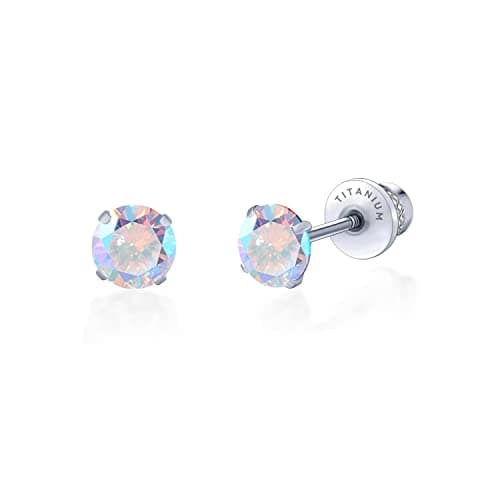
Limerencia F136 Titanium Screw-Back Flat-Back CZ Studs (20G)The clearest material claim in this whole category: the standard number, the gauge and the fastening are all in the title before you have clicked anything.
“Score” is a disclosure score, not a test result. It rates how completely the seller states the post metal, the back metal and the nickel claim, and how that metal holds up for reactive skin. The full rubric is published on our methodology page.
#1 · The cheapest genuine nickel-free claim
VGACETI Pure Titanium Ball Post Studs, 3mm and 4mm
The rare listing that says nickel-free rather than hypoallergenic, and names the post specifically rather than the earring generally.
Post material
Pure titanium, ball post construction
From the seller’s own product title: “Ball Stud Titanium Earrings,Hypoallergenic for Women High Polished Colored for Sensitive Ears, 3mm and 4mm Pure Titanium Nickel-Free Lead-Free”
Back material
Not named in the title
Not named in the seller’s product title — the headline nearly every buyer reads. That omission is the finding, not a gap in our notes.
Nickel claim
Explicitly nickel-free. The seller’s own words: “Pure Titanium Nickel-Free Lead-Free”
This is the strongest nickel language on this page and the reason the pick is here. 'Nickel-free' is a definite factual claim about composition that the seller can be held to. 'Hypoallergenic' is not. Almost every competing listing chooses the second and this one chose the first.
Commercially pure titanium rather than the F136 alloy: no aluminum, no vanadium, one element. Slightly softer, which is why you see it as balls and discs rather than as thin structural parts, and completely fine for a healed lobe.
A 3mm or 4mm ball is the smallest sensible everyday earring. It is what you put in when you want the piercing to stay open and otherwise want to forget it exists, and at this price there is no reason to compromise on the metal to get it.
Who it’s for
First purchase for someone who has just worked out that nickel is the problem. Cheap enough to be a low-stakes test of whether titanium fixes it.
Skip it if
Skip this if you want the earring to be visible from more than a foot away. A polished 3mm ball is jewelry in the technical sense only.
The clearest material claim in this whole category: the standard number, the gauge and the fastening are all in the title before you have clicked anything.
Post material
F136 implant-grade titanium, 20 gauge
From the seller’s own product title: “Limerencia Hypoallergenic G23 Implant Grade Titanium Screw Back Earrings | 20G F136 Pure Titanium Flat Back CZ Studs”
Back material
Screw-on flat back; the same titanium is implied but the metal is not separately named
Not named in the seller’s product title — the headline nearly every buyer reads. That omission is the finding, not a gap in our notes.
Nickel claim
Says hypoallergenic, not nickel-free. The seller’s own words: “Hypoallergenic G23 Implant Grade Titanium”
Two numbers do all the work here. F136 is the ASTM specification for the Ti-6Al-4V ELI alloy used in surgical implants, and G23 is the grade designation for that same alloy. A seller putting both in the title is pointing at a published document rather than reaching for an adjective, and that is rarer than it should be.
The flat back matters as much as the metal. A flat disc sits against the back of the lobe instead of a butterfly clip pressing a small area, which is why piercers use this shape for anything that has to be slept in. Combined with a screw thread rather than a friction push-fit, it is about as low-drama as an earring gets.
What the title does not do is name the back separately. In practice a screw-back on a titanium post is almost always the same titanium, and the design leaves little room for it to be anything else — but the seller has not committed to it in the headline, and we score what is stated rather than what is likely.
Who it’s for
Anyone who has reacted to something before and wants to stop running experiments. Also the sensible default for a piercing you intend to sleep in.
Skip it if
Skip this if you want a decorative statement earring. A 20-gauge flat-back CZ stud is deliberately unobtrusive, and if you want to be seen wearing something, this is not it.
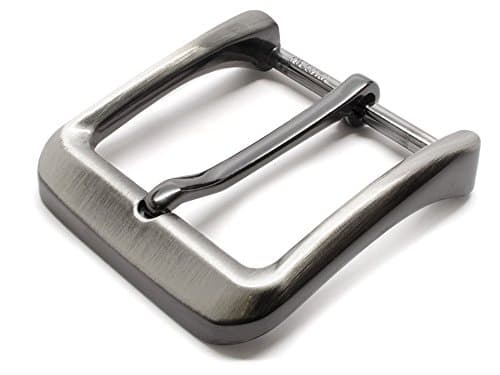
A buckle on its own, which is the cheapest fix if the strap is fine and the metal is not.
Post material
Zinc alloy, stated nickel-free
From the seller’s own product title: “Casual 1.5" Belt Buckle - Nickel-Free and Hypoallergenic (Zinc, Black)”
Back material
Buckle only — the strap is whatever you already own
From the seller’s own product title: “Casual 1.5" Belt Buckle”
Nickel claim
Explicitly nickel-free. The seller’s own words: “Nickel-Free and Hypoallergenic (Zinc, Black)”
This is the belt equivalent of replacing your earring backs: keep the thing you like, change the part that touches you. If you have a good leather belt with a removable buckle, a nickel-free replacement is a fraction of the cost of a new belt.
Naming the alloy — zinc — alongside the nickel-free claim is better disclosure than most. Zinc alloy buckles are common, cast easily, and do not contain nickel unless it is deliberately added.
Check that your belt has a snap or screw buckle attachment before ordering. Many belts have the buckle stitched in permanently, and then this is not an option.
Who it’s for
Anyone with a belt they like and a rash they do not, where the strap is not the problem.
Skip it if
Skip this if your belt's buckle is sewn in. The buckle has to be removable for this to be a fix rather than an ornament.
A form of allergic contact dermatitis in which the immune system reacts to nickel ions released from metal into sweat. It produces itching, redness and sometimes blistering where the metal touched, and it develops through exposure rather than being present from birth.
Can a nickel allergy go away?+
Contact allergies generally persist once established, and repeated exposure tends to intensify rather than reduce the response. Whether that is true in an individual case is a clinical question.
How much nickel is allowed in jewelry?+
In the European Union: 0.2 micrograms per square centimeter per week for post assemblies inserted into pierced ears, and 0.5 for jewelry in prolonged skin contact, under REACH Annex XVII entry 27. In the United States there is no federal limit at all.
Where else does nickel show up besides jewelry?+
Belt buckles, jeans rivets, watch cases and bracelets, eyeglass frames (especially monel), bra hooks, zips, and keys or coins in a pocket. Anything metal held against skin for hours in a place that sweats.
How do I get tested for a nickel allergy?+
Patch testing, done by a dermatologist or allergy clinic. It is the only way to identify what you actually react to, and it can distinguish nickel from cobalt and chromium, which produce similar reactions.
Does stainless steel contain nickel?+
Yes, 316L is roughly eight to twelve percent nickel by weight. It releases very little of it because the alloy holds onto it, which is why most people with a nickel allergy wear surgical steel without trouble. More on steel.