Gentle Carat earns a commission when you buy through the links on this page, at no extra cost to you. It never decides what we recommend or how we rank it — here is the full disclosure.
Rings are the worst case for reactive skin, because the skin underneath a band is occluded — permanently warm, damp and never exposed to air — and because a wedding band is worn continuously for years. Solid single-metal titanium is the construction that removes every variable: no plating to wear, no second component, no alloy question.
What occlusion actually changes
A necklace or an earring gets air. The skin under a ring does not. Soap and water get underneath and stay there, sweat has nowhere to evaporate, and the tissue is softened by constant moisture. Dermatologists have a name for the resulting irritation — ring dermatitis — and a meaningful share of it is not an allergy at all but soap trapped against macerated skin.
Which is genuinely useful to know, because the fix for that is not a different metal. It is taking the ring off to wash your hands, drying underneath it, and rinsing it occasionally. If your ring rash improves within days of doing that, you have solved it for free.
The white gold problem
This is the single most common way people with a nickel allergy end up with a reaction to an expensive ring. Gold is naturally yellow. White gold is gold alloyed with a white metal to change its color, and one of the traditional whitening metals is nickel.
Modern white gold frequently uses palladium instead, which is fine. But nickel-white-gold is still sold, and both kinds are usually rhodium-plated on top to get the bright white finish people expect. That plating wears — on a ring, faster than anywhere else — and when it does, whatever is underneath is against your finger.
If you react to nickel and want gold, yellow gold at 14k or above is the simple answer. If you specifically want white, ask whether the alloy is palladium-based, or buy platinum, or buy titanium.
What to know before buying titanium
Ring metals compared on the things that matter over a decade of daily wear.
Titanium
Gold
Stainless steel
Nickel
None as an alloying element
None in yellow; possibly in white
8–12% by weight, low release
Resizable
No
Yes
Rarely
Weight
Very light
Heavy
Heavy
Scratches
Yes, and it patinates
Yes, and it can be polished out
Less readily
Cost
Low
High
Low
Removable in an emergency
Cut with a diamond wheel
Cut easily
Cut with difficulty
Ring metals compared on the things that matter over a decade of daily wear.
Emergency removal, since nobody mentions it
A ring that has to come off in a hurry — a swollen finger, an injury, an emergency room — is a real consideration with hard metals. Titanium can be cut; it takes a diamond wheel rather than the standard ring cutter, and any emergency department that has seen a titanium band before will manage it. It is not the barrier internet folklore suggests, but it is slower than cutting gold.
If that worries you, silicone rings exist for exactly this reason and are worn by a lot of people in manual trades. They are also, incidentally, entirely metal-free.
Quick picks
Ranked on what the seller actually discloses. Tap a row for the full write-up, or go straight to the listing.
#
Product
Best for
Score
Price
1
TIGRADE Matte Titanium Band, 4-10mmSolid titanium in a matte finish across four widths and a genuinely wide size range, which is the practical choice for a ring that will get knocked about.
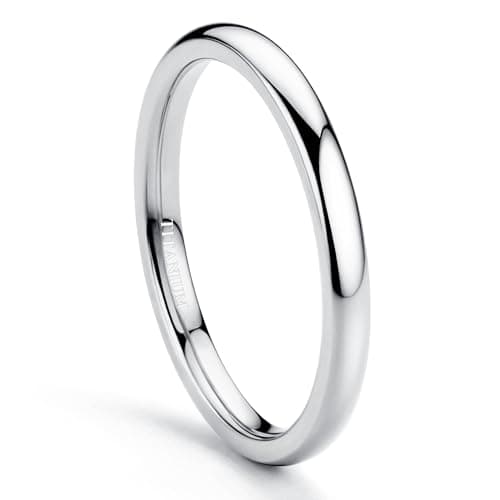
Jstyle 2mm Titanium Band, Comfort FitTwo millimeters of solid titanium and nothing else — the narrowest way to test whether a ring is the thing that has been bothering you.
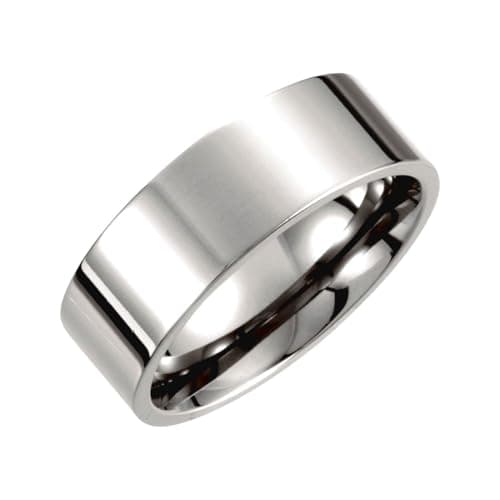
JewelryWeb 8mm Polished Flat Titanium BandEight millimeters is a substantial ring, and titanium is the metal that makes that width wearable rather than heavy.
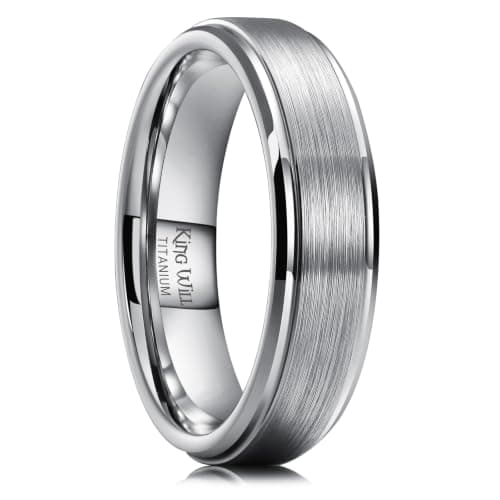
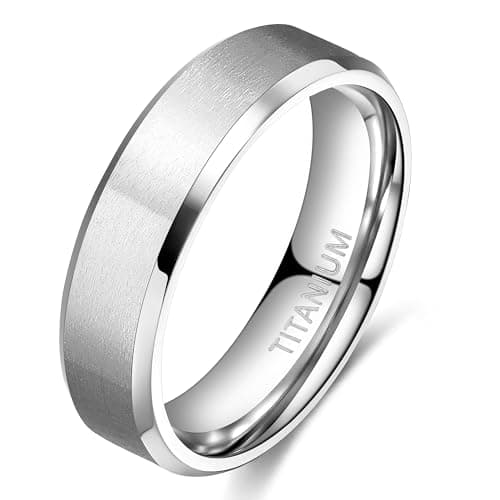
King Will Brushed Titanium Band, 6mm, Stepped EdgeA brushed rather than polished surface, achieved by texturing the titanium instead of putting anything on top of it — which is the distinction that matters.
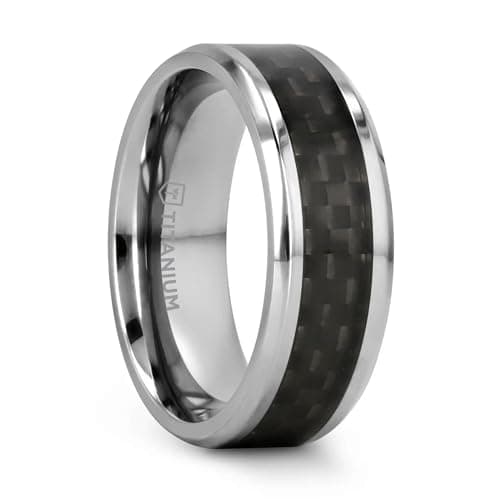
Thorsten Carbon Fiber Inlay Titanium Band, 8mmTitanium with a carbon fiber inlay — two materials, neither of which contains nickel, and the most expensive ring on this page by a wide margin.
“Score” is a disclosure score, not a test result. It rates how completely the seller states the post metal, the back metal and the nickel claim, and how that metal holds up for reactive skin. The full rubric is published on our methodology page.
#1 · A finish that hides scratches
TIGRADE Matte Titanium Band, 4-10mm
Solid titanium in a matte finish across four widths and a genuinely wide size range, which is the practical choice for a ring that will get knocked about.
Post material
Titanium, matte finish, 4 to 10mm
From the seller’s own product title: “TIGRADE Titanium Rings 4MM 6MM 8MM 10MM Wedding Band in Comfort Fit Matte for Men Women Size 3-15, Silver 6mm, Size 10.5”
Back material
Solid throughout
From the seller’s own product title: “Wedding Band in Comfort Fit Matte”
Nickel claim
Names a metal, makes no nickel claim. The seller’s own words: “TIGRADE Titanium Rings 4MM 6MM 8MM 10MM Wedding Band in Comfort Fit Matte”
Titanium is hard but it is not scratch-proof, and a high polish shows every mark. A matte finish absorbs the same wear without looking damaged, which across ten years of daily wear is the difference between a ring that ages and one that looks battered.
The metal question is identical to the polished bands: solid, single alloy, nothing plated, nothing bonded. The finish is cosmetic and does not change what touches your skin.
Sizes 3 to 15 in four widths is unusually complete for this shelf. Titanium cannot practically be resized — it is too hard to cut and rejoin the way gold is — so ordering the right size first time matters more here than with any other ring metal.
Who it’s for
Everyday wear, manual work, and anyone who has already scratched a polished band and regretted it.
Skip it if
Skip this if you want a mirror shine. Matte is the point of this listing, and a brushed surface will never look like polished metal.
Two millimeters of solid titanium and nothing else — the narrowest way to test whether a ring is the thing that has been bothering you.
Post material
Titanium, 2mm wide
From the seller’s own product title: “Jstyle 2mm Silver Titanium Wedding Band for Women Men, Comfort Fit Size 7”
Back material
Solid throughout — a band has no second component
From the seller’s own product title: “Titanium Wedding Band”
Nickel claim
Names a metal, makes no nickel claim. The seller’s own words: “2mm Silver Titanium Wedding Band”
Rings are the hardest case on this site because the skin under a band is occluded — permanently warm, damp and never exposed to air — and because a band is worn continuously for years rather than taken off at night.
A narrow band is the sensible first purchase for exactly that reason: less metal, less occluded skin, and a smaller loss if the shape turns out not to suit you. Two millimeters is about as slim as a wedding band is made.
"Comfort fit" describes the inside of the band, which is domed rather than flat so it rolls over the knuckle. It also means the ring sits on a narrower line of skin than its width suggests.
Who it’s for
A first titanium ring, a stacking band, or anyone with smaller hands who finds a 6mm band overbearing.
Skip it if
Skip this if you want presence. At 2mm this reads as a thin line on the hand, and a wedding band you wanted to notice will disappoint you.
Eight millimeters is a substantial ring, and titanium is the metal that makes that width wearable rather than heavy.
Post material
Titanium
From the seller’s own product title: “Titanium Size 11.5 8mm Polished Flat Band Ring Ring for Women and Men”
Back material
Solid throughout
From the seller’s own product title: “8mm Polished Flat Band Ring”
Nickel claim
Names a metal, makes no nickel claim. The seller’s own words: “Titanium ... 8mm Polished Flat Band Ring”
Width is where titanium's density advantage becomes the whole argument. An 8mm band in stainless steel or gold is a genuinely heavy object to wear all day; the same ring in titanium weighs a little over half as much.
The title makes no allergy claim at all — it names the metal, the width and the finish and stops. On this site that scores as an honest material-only listing rather than as a weak one.
Check the size in the listing before ordering. This particular product page is size-specific, and titanium cannot be resized afterwards.
Who it’s for
Anyone who wants a wide band and has found equivalents in steel or gold too heavy to wear daily.
Skip it if
Skip this if you work with your hands in tight spaces. A wide band catches and pinches in a way a 4mm one does not, regardless of what it is made of.
King Will Brushed Titanium Band, 6mm, Stepped Edge
A brushed rather than polished surface, achieved by texturing the titanium instead of putting anything on top of it — which is the distinction that matters.
Post material
Titanium, brushed finish, 6mm
From the seller’s own product title: “King Will BASIC 6mm Mens Womens Titanium Wedding Ring Brushed Finished Wedding Band Comfort Fit Stepped Edge 11”
Back material
Solid throughout
From the seller’s own product title: “Titanium Wedding Ring Brushed Finished”
Nickel claim
Names a metal, makes no nickel claim. The seller’s own words: “Titanium Wedding Ring Brushed Finished”
A darker or more muted ring usually means a coating — ion plating, DLC, black rhodium — and a coating on a ring wears through at the contact points and eventually exposes whatever is beneath. Brushing is different: it abrades the surface of the metal itself so it scatters light instead of reflecting it, and there is nothing on top to come off.
That makes this the right way to get a softer-looking titanium ring if you are avoiding applied surfaces entirely. The tone is a muted gray rather than the near-black a coated ring would give you.
The stepped edge is a bevel around the rim. It is a styling choice with one practical effect: a beveled edge catches less on gloves and pockets than a square one.
Who it’s for
Someone who wants the look of a coated ring and has already been burned by plating wearing through.
Skip it if
Skip this if you actually want black. Brushing mutes titanium, it does not darken it, and if black is the requirement then a coating is the only way there — with the wear that implies.
Titanium with a carbon fiber inlay — two materials, neither of which contains nickel, and the most expensive ring on this page by a wide margin.
Post material
Titanium with a black carbon fiber inlay
From the seller’s own product title: “Thorsten Colosseum Black Carbon Fiber Inlay Titanium Wedding Size 10, 8mm”
Back material
Inlay is bonded into the titanium; the inner surface is not separately named
Not named in the seller’s product title — the headline nearly every buyer reads. That omission is the finding, not a gap in our notes.
Nickel claim
Names a metal, makes no nickel claim. The seller’s own words: “Black Carbon Fiber Inlay Titanium Wedding”
Carbon fiber is a polymer composite rather than a metal, so it introduces no new nickel question at all. What it does introduce is a bonded joint between two different materials, and bonded joints are where mixed-material rings fail.
In practice that failure is cosmetic and slow — an inlay lifting at an edge after years — rather than sudden. It is worth knowing because it is the one way this ring is less permanent than a plain titanium band.
The price is the honest objection. This costs several times what the plain titanium bands on this page cost, and it buys you an appearance rather than a better answer to the nickel question. The metal against your finger is the same titanium either way.
Who it’s for
Someone who wants a ring that does not look like a plain metal band and is willing to pay several times the price for it.
Skip it if
Skip this on price alone if the nickel question is what brought you here. A 2mm or 6mm plain titanium band solves the same medical problem for a tenth of the money.
Yes. Titanium contains no nickel as an alloying element and forms a stable inert oxide layer, so there is nothing to release into skin. It is the standard recommendation for people who react to conventional ring metals.
Is white gold safe if I am allergic to nickel?+
Not automatically. White gold is gold alloyed with a whitening metal, and nickel is one of the traditional choices. Palladium white gold and platinum avoid the issue, and yellow gold at 14k and above is the simplest safe answer.
Why does my finger get irritated under my ring?+
Very often soap and moisture trapped against skin rather than a metal allergy. The skin under a band never dries out. Try removing the ring to wash your hands and drying underneath it for a couple of weeks; if it clears, that was it.
Can titanium rings be resized?+
No. Titanium work-hardens and does not take solder like gold, so a titanium band cannot be sized up or down. Get measured properly before buying, at the end of a warm day when fingers are largest.
Can a titanium ring be cut off in an emergency?+
Yes. It needs a diamond-wheel cutter rather than the standard manual ring cutter, and it takes longer than gold, but it is routinely done. The idea that titanium rings cannot be removed is folklore.
Are stainless steel rings a good alternative?+
For people who tolerate steel, yes — cheap, durable and non-tarnishing. It contains nickel and releases very little, so it is the wrong choice if steel has bothered you elsewhere. Under a ring, where skin is occluded all day, a marginal tolerance is more likely to be exceeded.