A healing piercing is an open channel through your body. It is far less tolerant than a healed one, and the metal matters more here than anywhere else.
Gentle Carat earns a commission when you buy through the links on this page, at no extra cost to you. It never decides what we recommend or how we rank it — here is the full disclosure.
While a piercing is healing, the safest thing you can do is leave in whatever your piercer fitted, for as long as they told you. When it is time to change, the answer is a flat-back stud in stated implant-grade titanium (ASTM F-136), internally threaded or threadless, in the gauge you were pierced at. This page is about metal, not aftercare — aftercare comes from your piercer.
Why a healing piercing is a different problem
A healed lobe is lined with skin. A healing one is not: it is a channel of raw tissue, in contact with lymph, actively rebuilding. Two consequences follow.
First, a trace metal release that intact skin would ignore is a much bigger deal against open tissue. This is exactly why piercers use implant-grade titanium rather than surgical steel, even though most people wear steel without any trouble at all once healed.
Second, this is the moment a nickel allergy is most likely to be created. Sensitization develops through exposure, and a new piercing is the most permissive exposure route most people ever have. Wearing nickel-releasing jewelry through a healing piercing is how a lifelong sensitivity gets established.
What to change to, when the time comes
What to move to when your piercer says you can change. The threading detail is the one most people have never heard of.
Choose
Not
Why
Implant-grade titanium (ASTM F-136 / G23)
Surgical steel, plated anything
No nickel as an alloying element. What piercers fit as standard.
Flat back
Butterfly back
Sits flush, spreads pressure, nothing to catch on a pillow, no separate clip of unknown metal.
Threadless or internally threaded
Externally threaded
External threads drag a spiral of sharp metal edges through the healing channel.
The gauge you were pierced at
Whatever is on the shelf
A thinner post moves in the channel and abrades it. A thicker one will not go in.
Small and light
Hoops, drops, anything that swings
Movement is the enemy of a healing piercing. Weight compounds it.
What to move to when your piercer says you can change. The threading detail is the one most people have never heard of.
The threading detail, because it genuinely matters
On externally threaded jewelry, the screw thread is cut into the post itself. Every time you insert it, a spiral of sharp metal edges is dragged through the inside of your piercing. In a long-healed lobe that is a non-event; in a healing channel it is genuinely damaging.
Internally threaded jewelry puts the thread on the decorative end and leaves the post smooth. Threadless uses a friction pin instead of a thread at all. Both are what the piercing trade moved to, and it is the reason professional jewelry costs more than a mall multipack.
A lobe is soft tissue with a good blood supply. Cartilage has neither, which is why helix, conch and tragus piercings heal over many months rather than weeks and are far less tolerant of a bad decision along the way.
Everything on this page applies more strongly to cartilage: the titanium is less optional, the threading matters more, and the temptation to change jewelry early should be resisted harder.
When you are healed
Once a piercing is fully settled, your options open up considerably — steel, gold, hoops, heavier styles. The one thing worth carrying forward is the habit of knowing what your backs are made of, because that is where a solved problem quietly comes back.
Quick picks
Ranked on what the seller actually discloses. Tap a row for the full write-up, or go straight to the listing.
#
Product
Best for
Score
Price
1
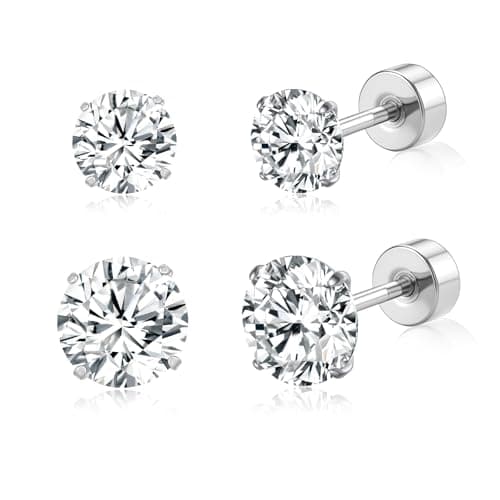
Limerencia F136 Titanium Screw-Back Flat-Back CZ Studs (20G)The clearest material claim in this whole category: the standard number, the gauge and the fastening are all in the title before you have clicked anything.
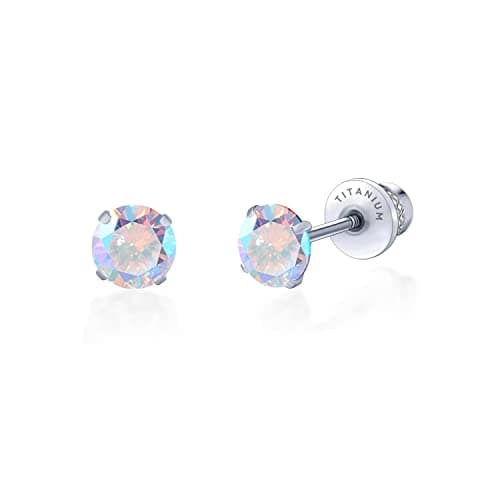
G23 Titanium Flat-Back CZ Studs, 20G (plated finish)An implant-grade post with a plated decorative front — the right way round, and the title is unusually clear about which part is which.
Titanium Screw-Back Flat-Back Dot StudsA plain dot on a screw-thread flat back. Nothing to snag, nothing to fall out, and a title that at least names the metal.
“Score” is a disclosure score, not a test result. It rates how completely the seller states the post metal, the back metal and the nickel claim, and how that metal holds up for reactive skin. The full rubric is published on our methodology page.
The clearest material claim in this whole category: the standard number, the gauge and the fastening are all in the title before you have clicked anything.
Post material
F136 implant-grade titanium, 20 gauge
From the seller’s own product title: “Limerencia Hypoallergenic G23 Implant Grade Titanium Screw Back Earrings | 20G F136 Pure Titanium Flat Back CZ Studs”
Back material
Screw-on flat back; the same titanium is implied but the metal is not separately named
Not named in the seller’s product title — the headline nearly every buyer reads. That omission is the finding, not a gap in our notes.
Nickel claim
Says hypoallergenic, not nickel-free. The seller’s own words: “Hypoallergenic G23 Implant Grade Titanium”
Two numbers do all the work here. F136 is the ASTM specification for the Ti-6Al-4V ELI alloy used in surgical implants, and G23 is the grade designation for that same alloy. A seller putting both in the title is pointing at a published document rather than reaching for an adjective, and that is rarer than it should be.
The flat back matters as much as the metal. A flat disc sits against the back of the lobe instead of a butterfly clip pressing a small area, which is why piercers use this shape for anything that has to be slept in. Combined with a screw thread rather than a friction push-fit, it is about as low-drama as an earring gets.
What the title does not do is name the back separately. In practice a screw-back on a titanium post is almost always the same titanium, and the design leaves little room for it to be anything else — but the seller has not committed to it in the headline, and we score what is stated rather than what is likely.
Who it’s for
Anyone who has reacted to something before and wants to stop running experiments. Also the sensible default for a piercing you intend to sleep in.
Skip it if
Skip this if you want a decorative statement earring. A 20-gauge flat-back CZ stud is deliberately unobtrusive, and if you want to be seen wearing something, this is not it.
An implant-grade post with a plated decorative front — the right way round, and the title is unusually clear about which part is which.
Post material
G23 / F136 implant-grade titanium, 20 gauge
From the seller’s own product title: “20G G23 Implant Grade Titanium Flat Back Stud Earrings for Women Men, Gold/White Gold Plated Tragus Labret Cartilage Helix F136 Piercing Jewelry for Sensitive Ears”
Back material
Flat back; metal not separately named
Not named in the seller’s product title — the headline nearly every buyer reads. That omission is the finding, not a gap in our notes.
Nickel claim
Names a metal, makes no nickel claim. The seller’s own words: “G23 Implant Grade Titanium ... F136”
This is the plating arrangement to look for. The gold appears in the title attached to the decorative end — 'Gold/White Gold Plated' — while the structural claim, G23 and F136, attaches to the post. A plated front over a titanium post is a completely different proposition from a plated post, because the plating is nowhere near your piercing.
Most listings do not draw that distinction, which is why plated jewelry has a bad reputation it only half deserves. Plating is not the problem; plating on the wrong component is.
Twenty gauge is the standard for a healed lobe or a cartilage piercing done at that size. If your piercing was done at 18 gauge, a 20-gauge post will fit but will move around in the channel more than you want.
Who it’s for
Helix, tragus and conch piercings where you want a gold look and cannot risk the metal that goes through the hole.
Skip it if
Skip this if your piercing is 18 gauge or larger. A thinner post in a wider channel migrates and irritates, and the fix is the right gauge rather than a better metal.
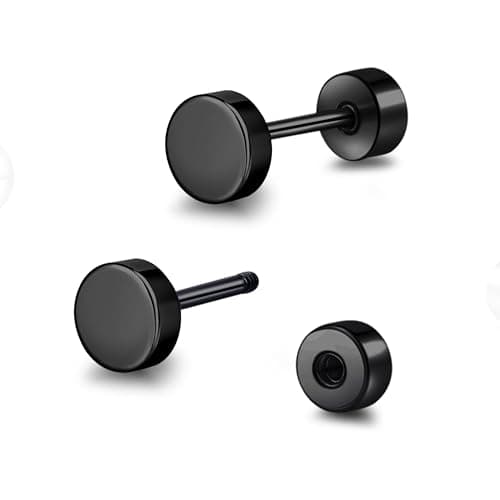
A plain dot on a screw-thread flat back. Nothing to snag, nothing to fall out, and a title that at least names the metal.
Post material
Titanium
From the seller’s own product title: “Titanium Screw Back Flat Back Dot Stud Earrings for Women Men”
Back material
Screw-on flat back; metal not separately named
Not named in the seller’s product title — the headline nearly every buyer reads. That omission is the finding, not a gap in our notes.
Nickel claim
Names a metal, makes no nickel claim. The seller’s own words: “Titanium Screw Back Flat Back Dot Stud Earrings”
The short title is the whole review. It says titanium, screw back, flat back, dot. There is no grade number, no standard, and no adjective doing work it cannot support — which is refreshing, and also less information than the Limerencia listings give you.
A screw-back flat disc is the most secure common fastening. It cannot be pulled off by a jumper, it does not press a point into the back of the lobe, and it is the shape you want if the earring is going to stay in permanently.
The trade-off is fiddliness. Screw threads on small jewelry are awkward with cold hands and easy to cross-thread, and a cross-threaded post is scrap.
Who it’s for
A piercing you want to keep open and stop thinking about, especially one that has to survive sleep and pillows.
Skip it if
Skip this if you change earrings often or have limited fine motor control. A screw fitting on a 20-gauge post is genuinely fiddly and a push-fit will make you happier.
Whatever your piercer fitted, for as long as they told you. When you can change, an implant-grade titanium flat-back stud, internally threaded or threadless, in the gauge you were pierced at.
Is surgical steel okay for a new piercing?+
It is what many older piercings were done with, and it is not what the trade uses now. Steel contains nickel and releases a small amount, and a healing channel is far less forgiving than healed skin. Implant-grade titanium is the standard for a reason.
What is the difference between internally and externally threaded jewelry?+
Externally threaded posts have the screw thread cut into the post, so sharp threads pass through the piercing on insertion. Internally threaded posts are smooth, with the thread on the decorative end. Threadless uses a friction pin. The last two are what piercers use.
How long before I can change my earrings?+
That depends on the placement, the method and how yours is healing, and it is a question for your piercer rather than for a website. Cartilage takes far longer than a lobe.
Can a new piercing cause a nickel allergy?+
Sensitization develops through exposure, and a healing piercing is a particularly permissive route. Wearing nickel-releasing jewelry through one is a recognized way for a lasting sensitivity to become established, which is the argument for titanium from day one.
My new piercing is red and sore. Is that an allergy?+
Some tenderness and redness is normal early on. Heat, swelling, throbbing, spreading redness or pus is not, and needs a clinician rather than a change of earring. We are not qualified to tell you which yours is.
The pharmacy-counter brand, judged on its own labels. It names the post metal — and then says nickel safe on three listings and nickel free on a fourth.