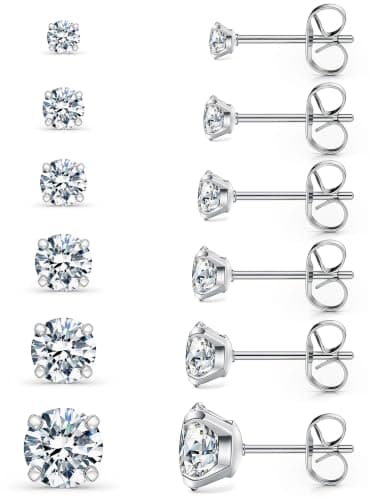
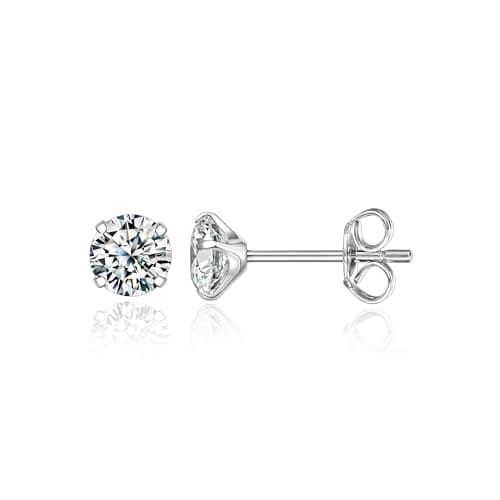
Cubic zirconia is the most common stone in jewelry and the least likely thing in your earring to cause a reaction. What it is set in is another matter entirely.
Gentle Carat earns a commission when you buy through the links on this page, at no extra cost to you. It never decides what we recommend or how we rank it — here is the full disclosure.
Yes, cubic zirconia is hypoallergenic in the only sense that matters: it is zirconium dioxide, a synthetic crystal, and it is inert against skin. Nobody reacts to the stone. The reason so many people believe CZ earrings bother them is that cubic zirconia is the stone of cheap jewelry, and cheap jewelry is where unnamed base metal and thin plating live. The question to ask a CZ listing is never about the stone. It is “what is the post made of”.
How we judged these
Criteria first, ranking second. Nobody here has worn these earrings, so the scores rate what each seller discloses and how the named metal suits reactive skin — never a test result. What we weighted, in order:
Is the post metal named, and how specifically? A cited standard (“ASTM F136”) beats a grade (“G23”), which beats a metal (“titanium”), which beats an adjective (“hypoallergenic”) with nothing behind it.
Is the setting plated — and over what? A plated piece is only as good as the base metal underneath, and the post is where plating wears first.
What fastens behind? Screw backs and flat backs beat butterfly clips, which are separately manufactured and usually undisclosed.
Is the stone size stated in millimeters? It decides both the look and the weight, and weight is its own problem.
Honest downsides on every pick, including the one we rank first.
What cubic zirconia actually is
Cubic zirconia is zirconium dioxide grown in a lab into a hard, clear, cubic crystal. It was developed as a diamond simulant and it is very good at the job: it is colorless, it takes a brilliant cut, and it disperses light slightly more than diamond does, which is why a CZ can look almost aggressively sparkly next to the real thing.
It is chemically stable and biologically inert. The same family of material — zirconia ceramic — is used for dental crowns and for the ceramic watches and rings covered elsewhere on this site, precisely because it does not react with tissue. A stone this stable is not what is irritating your ears.
So why do people blame the CZ?
Because of what CZ is attached to. Cubic zirconia costs almost nothing, so it is the stone of the fashion jewelry aisle, the multipack, the gift set and the twelve-pairs-for-nine-dollars listing. Those are exactly the products where the metal is described as “alloy”, “silver-tone” or not at all, and where a thin gold or rhodium plating hides whatever the base is.
The plating then wears through at the post first, because the post is the part dragged through a piercing channel twice a day. So the earring looks perfect from the front while the one part inside your body has become bare base metal. That is the mechanism, and it has nothing to do with the stone sitting on top.
How long a cubic zirconia lasts
This is the genuine downside of CZ and it is not a health one. Hardness is measured on the Mohs scale, and cubic zirconia sits around 8 to 8.5 — below moissanite at roughly 9.25 and diamond at 10. In practice that means a CZ worn daily picks up fine surface scratches on its facets over a few years, which scatter light and make the stone read cloudy or milky rather than bright.
It is also slightly porous to oils and soap film, so a good part of what looks like clouding on a two-year-old stud washes off. Warm water, a drop of dish soap and a soft brush recovers most CZ. If it still looks dull after that, the facets are worn and replacing a ten-dollar stud is the answer.
Cubic zirconia against the two stones people cross-shop it with.
Cubic zirconia
Moissanite
Diamond
What it is
Zirconium dioxide, lab-grown
Silicon carbide, lab-grown
Carbon, mined or lab-grown
Hardness (Mohs)
About 8–8.5
About 9.25
10
Over ten years of daily wear
Facets dull; often replaced rather than kept
Holds its edge
Holds its edge
Reacts with skin
No
No
No
Typical price bracket
Lowest
Middle
Highest
Cubic zirconia against the two stones people cross-shop it with.
All three are inert, so the stone is never the medical decision. It is a budget and longevity decision, and CZ is the honest choice for an earring you expect to lose, outgrow or replace.
Reading a CZ listing
The pattern this site keeps finding applies with unusual force here, because CZ listings spend their word count on the stone. You will be told the carat-equivalent weight, the cut, the color grade and the setting style, and then the entire metal component will be described as “silver” — which, used that way, is a color and not a material.
What a CZ earring listing says about its metal, and what it is worth.
What the listing says
What it means
Worth
“ASTM F136” or “G23 titanium”
A specific alloy with a published standard behind it
Strongest claim on the shelf
“Titanium” or “316L”
A named metal without a grade, or a named steel grade
Good — you can judge it
“925 sterling silver”
A fineness you can check against the hallmark
Good, and checkable on the piece
“Hypoallergenic” alone
A conclusion offered instead of a composition
Almost nothing
“Silver-tone”, “alloy”, “gold-plated” with no base named
The base metal is deliberately unstated
An open question — treat it as unknown
What a CZ earring listing says about its metal, and what it is worth.
The full method is on how to read a jewelry listing, and it comes down to one habit: find the specific claim about the part that touches you, and if there is not one, treat the question as open rather than as answered.
Where each pick fits
The two picks citing a standard lead, because a document number is a claim that could in principle be checked. The four-size titanium pair follows for letting you choose the stone size in millimeters. The screw-back sits mid-table: the most secure fastening here, on a titanium post without a stated grade. Sterling is next, checkable against its hallmark and softer than titanium. The 316L multipack is last — a stated grade at the lowest price per pair, and the only pick on the page whose metal contains nickel.
If you want the same metals in other shapes, the stud picks cover plain and stone-set studs more broadly, pearl earrings makes the same argument about a different stone, and cheap earrings that name their metal is the page for the lowest price bracket.
Quick picks
Ranked on what the seller actually discloses. Tap a row for the full write-up, or go straight to the listing.
#
Product
Best for
Score
Price
1
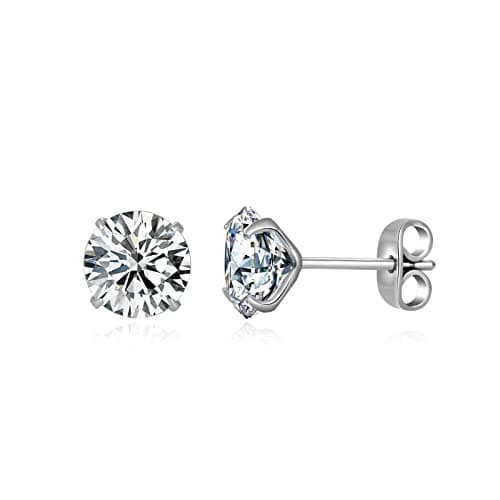
Limerencia F136 Titanium CZ Studs, 20G, 5mmCites ASTM F136 by number and states the gauge, which is two more specifications than a cubic zirconia stud listing usually offers.
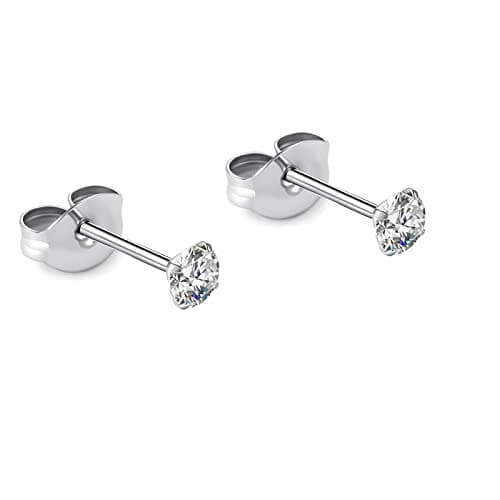
JUSTJANDM G23 Titanium CZ Stud, 3mmA single pair at a stated grade and a stated size — the opposite of how this shelf usually sells, which is a bag of twelve and no metal named.
BelezaDosas Implant-Grade Titanium CZ Studs, 3–6mmThe same G23 claim with four stone sizes offered, which matters more than it sounds on an earring whose weight hangs on a healed hole.
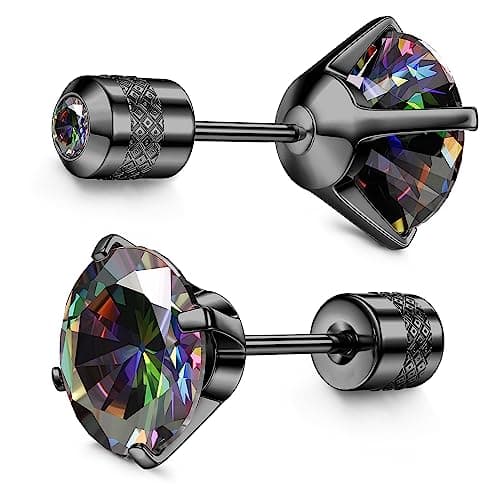
Subiceto Titanium CZ Screw-Back Sleep StudsA screw fitting on a titanium post, which is the combination for someone who wants to put earrings in and stop thinking about them.
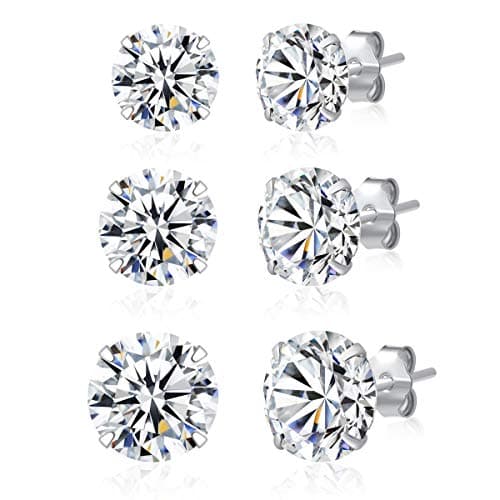
SILBERTALE 925 Sterling Silver CZ Studs, 3 pairs, 3–8mm925 is a claim you can check against the hallmark, and three sizes in one order covers most of what people actually wear.
316L Stainless Steel CZ Studs, 6 pairs (3–8mm)The grade number is in the title, which is the single thing that separates a useful steel listing from a decorative one.
“Score” is a disclosure score, not a test result. It rates how completely the seller states the post metal, the back metal and the nickel claim, and how that metal holds up for reactive skin. The full rubric is published on our methodology page.
#1 · The strongest metal claim on the shelf
Limerencia F136 Titanium CZ Studs, 20G, 5mm
Cites ASTM F136 by number and states the gauge, which is two more specifications than a cubic zirconia stud listing usually offers.
Post material
F136 implant-grade titanium, 20 gauge
From the seller’s own product title: “Limerencia G23 Pure Titanium Earrings F136 Implant Grade Titanium Studs 20G Hypoallergenic Round Cubic Zirconia/Princess-Cut/Square/Ball Earrings for Women Men Sensitive Ears(5mm Cubic Zirconia)”
Back material
Back type not named in the title
Not named in the seller’s product title — the headline nearly every buyer reads. That omission is the finding, not a gap in our notes.
Nickel claim
Says hypoallergenic, not nickel-free. The seller’s own words: “F136 Implant Grade Titanium Studs 20G Hypoallergenic”
ASTM F136 is the composition standard behind the phrase implant-grade titanium — Ti-6Al-4V ELI. A listing that cites the document number rather than the marketing phrase is making a claim that could in principle be checked, and on a shelf this cheap that is rare.
Cubic zirconia is zirconium dioxide, a synthetic crystal, and it is inert against skin. Nobody reacts to the stone. What people react to on a cheap CZ stud is the post, which is why this page ranks on the post and treats the stone as a durability question.
One inconsistency worth naming: the title says "G23", "pure titanium" and "F136" in the same breath. F136 and G23 both describe an alloy of titanium with aluminum and vanadium, so it is not pure titanium, and the two phrases cannot both be right. The standard citation is the specific claim and the one we score.
Who it’s for
Anyone who wants a classic sparkle stud and has already established that ordinary earring posts are the problem.
Skip it if
Skip this if you want a stone that stays sharp for a decade. Cubic zirconia is softer than moissanite or diamond and it dulls with years of daily wear.
A single pair at a stated grade and a stated size — the opposite of how this shelf usually sells, which is a bag of twelve and no metal named.
Post material
G23 titanium post
From the seller’s own product title: “G23 Titanium CZ Stud Earrings for Sensitive Ears, Titanium Cubic Zirconia Stud Earrings for Women (3mm)”
Back material
Back type not named in the title
Not named in the seller’s product title — the headline nearly every buyer reads. That omission is the finding, not a gap in our notes.
Nickel claim
Names a metal, makes no nickel claim. The seller’s own words: “G23 Titanium CZ Stud Earrings for Sensitive Ears”
G23 is the common trade name for Ti-6Al-4V ELI, the same composition ASTM F136 specifies for surgical implants. Naming the grade rather than saying "titanium" and stopping is the distinction this whole site turns on.
Three millimeters is the size that reads as a small everyday sparkle rather than a statement. It is also light, which matters if your lobes ache by evening — weight is a separate problem from metal and the two get confused constantly.
The back goes unnamed, which is the standard gap. A butterfly clip is separately manufactured and frequently a cheaper alloy than the earring it holds, so on a stud bought for the metal it is the remaining open question.
Who it’s for
Someone who wants one good pair for daily wear rather than a multipack to work through.
Skip it if
Skip this if you are filling several holes. The sets on this page cost far less per pair.
The same G23 claim with four stone sizes offered, which matters more than it sounds on an earring whose weight hangs on a healed hole.
Post material
G23 implant-grade titanium
From the seller’s own product title: “1 Pair Implant Grade Titanium Stud Earrings Set Hypoallergenic 3mm 4mm 5mm 6mm Cubic Zirconia G23 Titanium Earring Studs for Women Men for Sensitive Ear (3mm clear)”
Back material
Back type not named in the title
Not named in the seller’s product title — the headline nearly every buyer reads. That omission is the finding, not a gap in our notes.
Nickel claim
Says hypoallergenic, not nickel-free. The seller’s own words: “Implant Grade Titanium Stud Earrings Set Hypoallergenic”
Stone size is the specification most CZ listings skip and most buyers guess at. Three millimeters is discreet, five is clearly visible, six starts to have noticeable weight. Being offered the choice in millimeters rather than in adjectives is worth something.
The grade is stated as G23 and the claim adds "hypoallergenic" on top. On this site an allergy adjective adds nothing to a stated alloy — the alloy is the evidence and the adjective is the conclusion — but it does not subtract either.
Sold as a single pair. If you want one stone size in one metal without a bag of extras, that is the whole pitch.
Who it’s for
Someone who knows what size stud suits them and wants exactly that, on a stated alloy.
Skip it if
Skip the 6mm if your piercing already aches by evening. Bigger CZ is heavier CZ, and that is a load problem rather than a metal one.
A screw fitting on a titanium post, which is the combination for someone who wants to put earrings in and stop thinking about them.
Post material
Titanium post — no grade stated
From the seller’s own product title: “Subiceto Titanium Screw Back Earrings Sleep Stud Hypoallergenic for Women Men Sensitive Ears, Titanium, Cubic Zirconia”
Back material
Screw back — threads on, so it cannot be knocked off
From the seller’s own product title: “Titanium Screw Back Earrings”
Nickel claim
Says hypoallergenic, not nickel-free. The seller’s own words: “Titanium Screw Back Earrings Sleep Stud Hypoallergenic”
A screw back is the most secure fastening on a stud: it threads on rather than gripping by friction, so a jumper or a pillow cannot pull it off. It is the standard recommendation for anyone who keeps losing earrings.
"Sleep stud" is the seller's framing and it is a fair one, with a caveat this site would add: sleeping in earrings is comfortable when the profile behind the lobe is low, and a screw back is a raised fitting. A flat back is flatter. The screw back wins on security and loses on profile.
The metal is named as titanium without a grade, which is less specific than the G23 and F136 picks above but still contains no nickel as an alloying element.
Who it’s for
Anyone who has lost studs off a butterfly clip and wants the fastening settled.
Skip it if
Skip this if you change earrings daily. Screw backs are slow by design and that is the point of them.
925 is a claim you can check against the hallmark, and three sizes in one order covers most of what people actually wear.
Post material
925 sterling silver
From the seller’s own product title: “SILBERTALE 3 Pairs 925 Sterling Silver Cubic Zirconia Stud Earrings Set 3-8mm for Men Women”
Back material
Back type not named in the title
Not named in the seller’s product title — the headline nearly every buyer reads. That omission is the finding, not a gap in our notes.
Nickel claim
Names a metal, makes no nickel claim. The seller’s own words: “925 Sterling Silver Cubic Zirconia Stud Earrings”
Sterling silver is 92.5 percent silver with the balance conventionally copper. Silver itself very rarely causes contact allergy, and "925" is the fineness stamped inside a hallmark — one of the few claims on this shelf a buyer can verify on the piece itself.
The trade-off is tarnish. Silver reacts with sulfur in air and sweat to form a dark film, which can leave a gray mark on skin. That is a stain rather than a rash, it wipes off, and it tells you nothing about whether the metal suits you.
Silver is also soft, so a sterling post bends more easily than a titanium one. On a stud that is a durability note rather than a comfort one.
Who it’s for
Someone who wears sterling silver happily and wants a checkable claim at a low price.
Skip it if
Skip this if you will not polish anything. Sterling darkens, particularly if you sleep in it.
The grade number is in the title, which is the single thing that separates a useful steel listing from a decorative one.
Post material
316L stainless steel
From the seller’s own product title: “6 Pairs Stud Earrings Set, Hypoallergenic Cubic Zirconia 316L Earrings Stainless Steel CZ Earrings 3-8mm (Steel color)”
Back material
Not named in the title
Not named in the seller’s product title — the headline nearly every buyer reads. That omission is the finding, not a gap in our notes.
Nickel claim
Says hypoallergenic, not nickel-free. The seller’s own words: “Hypoallergenic Cubic Zirconia 316L”
'316L' is doing all the work in this title. Most steel jewelry is sold as 'surgical steel', which has no legal definition for jewelry and could be 304, 430 or something unnumbered. A specific alloy designation is a claim you can go and read about, and 316L is the good one — the molybdenum in it is what resists pitting in sweat.
Six sizes from 3mm to 8mm covers most of what anyone actually wears, and cubic zirconia at this price is exactly what you would expect: bright when new, gradually less so.
For the large majority of people, including many with a mild nickel sensitivity, this is the correct everyday answer and titanium is an upgrade they do not need.
Who it’s for
Anyone who wears steel without trouble and wants a full size range for the price of one titanium pair.
Skip it if
Skip this if you have reacted to surgical steel before. 316L contains eight to twelve percent nickel by weight even though it releases very little, and if you are past that threshold no grade number will help.
The stone is, completely. Cubic zirconia is zirconium dioxide — a stable synthetic crystal that is inert against skin, from the same family of material used for dental crowns. If a CZ earring bothers you, the cause is the post, the back or the plating, not the stone.
Is cubic zirconia good for sensitive ears?+
It depends entirely on what it is set in, which is why so many people have had a bad experience with it. Buy CZ on a stated post metal — implant-grade titanium, plain titanium, 316L steel or sterling silver — and it is as safe as any stone. Buy CZ in an unnamed plated setting and you have bought an unknown metal with a sparkle on top.
Why do my cubic zirconia earrings turn my ears green?+
Copper oxidizing. Either there is copper in the metal, or a plating has worn through to a copper-containing base such as brass. It washes off and it is not an allergic reaction — but it does tell you the post is not what you hoped, and the plating has failed exactly where it matters.
Does cubic zirconia get cloudy?+
Over years of daily wear, yes. CZ is about 8 to 8.5 on the Mohs scale, so its facets pick up fine scratches that scatter light. A good deal of apparent clouding is actually soap film and skin oil, which comes off with warm water, a drop of dish soap and a soft brush. If it is still dull after cleaning, the stone is worn.
Is cubic zirconia better than moissanite for sensitive ears?+
Neither is better for your skin — both are inert. The difference is durability and price: moissanite is harder at about 9.25 Mohs and holds its edge, and it costs considerably more. For an earring you expect to replace, CZ is the honest choice.