Five high-street brands, judged on one thing only: what each one publishes about its own metals. No brand paid to be here and none of them sells us anything.
Gentle Carat earns a commission when you buy through the links on this page, at no extra cost to you. It never decides what we recommend or how we rank it — here is the full disclosure.
Judged purely on published material claims: James Avery makes the strongest and most specific one, stating that its ear posts and wires are nickel-free sterling silver. Claire’s names its metals precisely but never uses the word nickel. Lovisa gives material-level guidance rather than per-product claims. Pandora publishes its silver composition and, in what we could read, no nickel statement. Evry Jewels uses the language in its marketing and we could not find it stated anywhere durable.
This page exists because the question gets asked constantly and answered by nobody neutral. Search for it and you get the brands’ own pages, or competitors’ blogs that cannot recommend anyone else, or forum threads full of anecdote. A brand store can never honestly answer “is this competitor safe?”. We have nothing to sell you except a click, so we can.
How we assessed this, and its limits
We fetched each brand’s own material or FAQ pages on 7 September 2026 and recorded what they state, verbatim. That is the entire method. It means this page has one real strength and two real limits, and you should know all three.
The strength: everything below is checkable. Every quote is the brand’s own wording and you can go and read it.
Limit one: a published claim is not a measurement. None of these brands publishes a nickel-release test result, and we have not measured anything. Limit two: two of the five brands returned errors or did not surface a materials statement on the pages we could read. Absence of a claim in what we read is not proof the brand has never made one, and we have marked those cases as unverified rather than as failures.
The five brands, side by side
Five brands on what they publish about their own metals, checked 7 September 2026. Quotes are the brands' own wording.
Brand
What it publishes about metals
Says 'nickel'?
Our read
James Avery
Ear posts and ear wires are nickel-free sterling silver, the same alloy as the rest of the range. Separately states its metals are sterling silver, 10K/14K/18K gold, stainless steel, copper, bronze and titanium.
Yes — explicitly, about the post
The strongest published claim of the five. Names the component that matters.
Claire’s
Starter earrings are 14kt gold, 24kt gold plated over medical grade stainless steel, medical grade titanium, or medical grade stainless steel.
No — the word does not appear
Names its metals precisely, which is genuinely useful. Silent on nickel.
Lovisa
Names titanium, surgical steel, gold-plated titanium and gold-plated surgical steel as nickel-free options, and tells shoppers to look for nickel-free or hypoallergenic labels.
Yes — as general guidance
Material-level advice rather than a per-product claim. Depends what you buy.
Pandora
Sterling silver of at least 92.5% pure silver alloyed with metals such as copper, stamped S925.
Not in what we could read
Publishes composition, not a nickel position. Their materials page returned an error for us.
Evry Jewels
Stainless steel with 18k gold plating; marketing describes the range as hypoallergenic and nickel-free.
In marketing copy, yes
We could not find it stated on the pages we could read. Treat as a marketing claim.
Five brands on what they publish about their own metals, checked 7 September 2026. Quotes are the brands' own wording.
Brand by brand
James Avery
The only one of the five that names the post. Its FAQ states: “All James Avery ear posts and ear wires are made of nickel-free sterling silver, the same alloy used in all our sterling silver jewelry.”
That sentence does three things almost nobody else does. It makes a nickel claim rather than a hypoallergenic one, it attaches that claim to the component in contact with the piercing rather than to the jewelry generally, and it says the same alloy runs through the whole range so you are not gambling on which item you pick.
Worth noting alongside it: their FAQ also answers “why do I occasionally have skin irritation when wearing my jewelry?” by pointing at soaps, detergents, waxes and creams building up under rings, rather than reaching for an allergy explanation. That is a genuinely honest answer and it matches what we say on the rings page.
Claire’s
Claire’s piercing guide states: “All Claire’s starter earrings are made from jeweler-quality hypoallergenic metals - 14kt gold, 24kt gold-plated over medical grade stainless steel, medical grade titanium, and medical grade stainless steel.”
That is more specificity than most of this category offers, and it is worth giving credit for. Two observations. First, the word nickel does not appear on that page — and “medical grade stainless steel” contains nickel, at eight to twelve percent by weight, releasing very little. Second, “medical grade” is not a standard. Unlike ASTM F-136 it points at no published document. The titanium option is the safer of the two if you are given the choice at the counter, and it is worth asking for it by name.
Lovisa
Lovisa runs a dedicated sensitive-jewelry section, which is more than most high-street brands bother with. Its guidance names “nickel-free options like titanium, surgical steel, gold plated titanium or gold plated surgical steel” and tells shoppers to “look for labels stating ‘nickel-free’ or ‘hypoallergenic’.”
That is advice about materials rather than a claim about a particular product, which makes it useful and not decisive: whether a given Lovisa earring suits you depends on which of those materials it is made from. If you are buying from them, buy from the titanium or surgical steel lines specifically rather than from the range generally.
Pandora
Pandora publishes composition rather than a position. Its own material pages describe sterling silver as at least 92.5 percent pure silver alloyed with metals such as copper, stamped S925.
That is a real specification and it is the useful half of the answer, because copper-alloyed sterling is generally well tolerated. What it does not do is address nickel. We tried to load Pandora’s materials page directly and it returned an error for us, so we are recording what we could read rather than concluding anything about what we could not.
The general caution about sterling applies here as it does anywhere: the 925 standard fixes the silver content and says nothing about what the remaining 7.5 percent is. More on sterling.
Evry Jewels
Evry Jewels describes its pieces as stainless steel with 18k gold plating and uses “hypoallergenic” and “nickel-free” in its marketing copy. Stainless steel under gold plating is a reasonable construction and a better one than plating over an unnamed base — that is the whole test for plated jewelry.
We could not find those claims stated on the brand’s FAQ or materials pages when we looked, only in marketing and blog copy. That is a smaller thing than it sounds — plenty of good brands put material facts in blog posts — but it means we are recording it as a marketing claim rather than a published specification.
The honest summary
None of these five is a bad choice for someone with ordinary skin. All of them are a gamble for someone who has already reacted to surgical steel, because four of the five lean on steel or sterling and neither is nickel-free by definition.
If you have reacted before, the answer is not a different high-street brand. It is a stated implant-grade titanium post from a seller that puts the standard number in the listing, which is what the picks below are.
And if a brand named here would like to correct us — if you publish a nickel statement we did not find, or a test result we should be citing — tell us. We correct in place with a dated note, and a published spec beats our reading of your website every time.
Quick picks
Ranked on what the seller actually discloses. Tap a row for the full write-up, or go straight to the listing.
#
Product
Best for
Score
Price
1
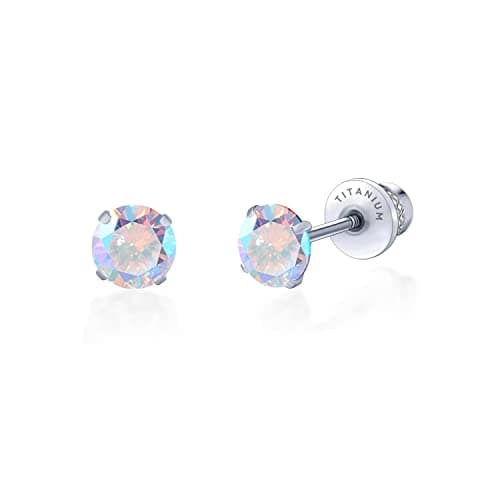
Limerencia F136 Titanium Screw-Back Flat-Back CZ Studs (20G)The clearest material claim in this whole category: the standard number, the gauge and the fastening are all in the title before you have clicked anything.
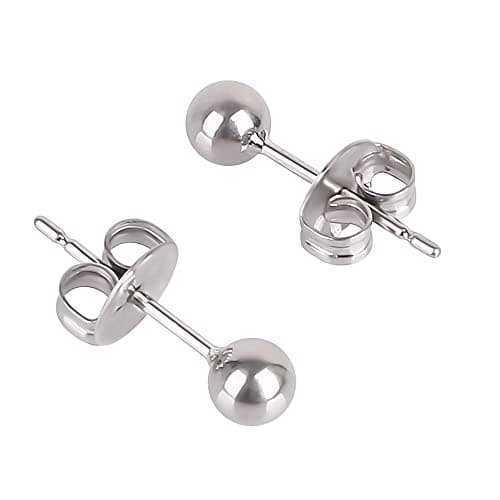
VGACETI Pure Titanium Ball Post Studs, 3mm and 4mmThe rare listing that says nickel-free rather than hypoallergenic, and names the post specifically rather than the earring generally.
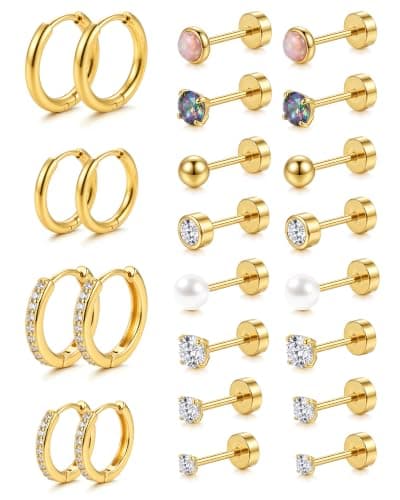
18K Gold-Plated Surgical Steel Flat-Back and Screw-Back Stack SetA plated set that names its base metal and says nickel-free rather than hypoallergenic — both unusual, both the right way round.
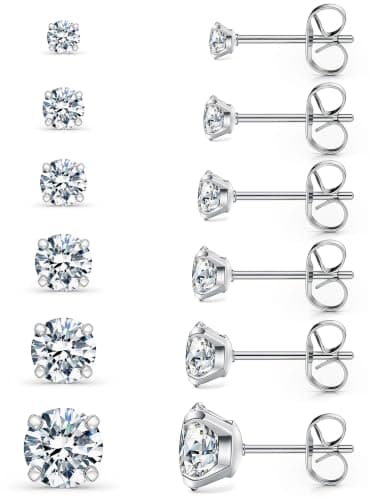
316L Stainless Steel CZ Studs, 6 pairs (3–8mm)The grade number is in the title, which is the single thing that separates a useful steel listing from a decorative one.
“Score” is a disclosure score, not a test result. It rates how completely the seller states the post metal, the back metal and the nickel claim, and how that metal holds up for reactive skin. The full rubric is published on our methodology page.
The clearest material claim in this whole category: the standard number, the gauge and the fastening are all in the title before you have clicked anything.
Post material
F136 implant-grade titanium, 20 gauge
From the seller’s own product title: “Limerencia Hypoallergenic G23 Implant Grade Titanium Screw Back Earrings | 20G F136 Pure Titanium Flat Back CZ Studs”
Back material
Screw-on flat back; the same titanium is implied but the metal is not separately named
Not named in the seller’s product title — the headline nearly every buyer reads. That omission is the finding, not a gap in our notes.
Nickel claim
Says hypoallergenic, not nickel-free. The seller’s own words: “Hypoallergenic G23 Implant Grade Titanium”
Two numbers do all the work here. F136 is the ASTM specification for the Ti-6Al-4V ELI alloy used in surgical implants, and G23 is the grade designation for that same alloy. A seller putting both in the title is pointing at a published document rather than reaching for an adjective, and that is rarer than it should be.
The flat back matters as much as the metal. A flat disc sits against the back of the lobe instead of a butterfly clip pressing a small area, which is why piercers use this shape for anything that has to be slept in. Combined with a screw thread rather than a friction push-fit, it is about as low-drama as an earring gets.
What the title does not do is name the back separately. In practice a screw-back on a titanium post is almost always the same titanium, and the design leaves little room for it to be anything else — but the seller has not committed to it in the headline, and we score what is stated rather than what is likely.
Who it’s for
Anyone who has reacted to something before and wants to stop running experiments. Also the sensible default for a piercing you intend to sleep in.
Skip it if
Skip this if you want a decorative statement earring. A 20-gauge flat-back CZ stud is deliberately unobtrusive, and if you want to be seen wearing something, this is not it.
VGACETI Pure Titanium Ball Post Studs, 3mm and 4mm
The rare listing that says nickel-free rather than hypoallergenic, and names the post specifically rather than the earring generally.
Post material
Pure titanium, ball post construction
From the seller’s own product title: “Ball Stud Titanium Earrings,Hypoallergenic for Women High Polished Colored for Sensitive Ears, 3mm and 4mm Pure Titanium Nickel-Free Lead-Free”
Back material
Not named in the title
Not named in the seller’s product title — the headline nearly every buyer reads. That omission is the finding, not a gap in our notes.
Nickel claim
Explicitly nickel-free. The seller’s own words: “Pure Titanium Nickel-Free Lead-Free”
This is the strongest nickel language on this page and the reason the pick is here. 'Nickel-free' is a definite factual claim about composition that the seller can be held to. 'Hypoallergenic' is not. Almost every competing listing chooses the second and this one chose the first.
Commercially pure titanium rather than the F136 alloy: no aluminum, no vanadium, one element. Slightly softer, which is why you see it as balls and discs rather than as thin structural parts, and completely fine for a healed lobe.
A 3mm or 4mm ball is the smallest sensible everyday earring. It is what you put in when you want the piercing to stay open and otherwise want to forget it exists, and at this price there is no reason to compromise on the metal to get it.
Who it’s for
First purchase for someone who has just worked out that nickel is the problem. Cheap enough to be a low-stakes test of whether titanium fixes it.
Skip it if
Skip this if you want the earring to be visible from more than a foot away. A polished 3mm ball is jewelry in the technical sense only.
18K Gold-Plated Surgical Steel Flat-Back and Screw-Back Stack Set
A plated set that names its base metal and says nickel-free rather than hypoallergenic — both unusual, both the right way round.
Post material
Surgical steel, 18K gold plated
From the seller’s own product title: “18K Gold Plated Hypoallergenic Earring Stack Set, Surgical Steel Flat Back & Screw Back Studs, Multi-Size Small Huggie Hoops, Nickel-Free CZ Pearl Opal Cartilage Earrings”
Back material
Flat backs and screw backs; both named as part of the surgical steel construction
From the seller’s own product title: “Surgical Steel Flat Back & Screw Back Studs”
Nickel claim
Explicitly nickel-free. The seller’s own words: “Nickel-Free CZ Pearl Opal Cartilage Earrings”
Two things make this the pick of the plated options. It names the base metal — surgical steel, not an unnamed alloy — and it says nickel-free explicitly rather than hedging with hypoallergenic. The plating is a finish over a metal you would have been willing to wear anyway.
That is the whole test for plated jewelry. Plating wears through at the post first, because the post is the highest-friction, highest-moisture part of the piece. When it eventually does, the question is what you are left standing on. Here, it is steel.
Both fastening types appear in the title and both are attributed to the steel construction, which is why this scores highest on back disclosure of anything on this page.
Who it’s for
Anyone who wants a warm gold-tone stacked ear and has been avoiding plated jewelry because of the base-metal question.
Skip it if
Skip this if surgical steel is what you react to. Plating buys you time, not immunity, and eventually you are wearing the base.
The grade number is in the title, which is the single thing that separates a useful steel listing from a decorative one.
Post material
316L stainless steel
From the seller’s own product title: “6 Pairs Stud Earrings Set, Hypoallergenic Cubic Zirconia 316L Earrings Stainless Steel CZ Earrings 3-8mm (Steel color)”
Back material
Not named in the title
Not named in the seller’s product title — the headline nearly every buyer reads. That omission is the finding, not a gap in our notes.
Nickel claim
Says hypoallergenic, not nickel-free. The seller’s own words: “Hypoallergenic Cubic Zirconia 316L”
'316L' is doing all the work in this title. Most steel jewelry is sold as 'surgical steel', which has no legal definition for jewelry and could be 304, 430 or something unnumbered. A specific alloy designation is a claim you can go and read about, and 316L is the good one — the molybdenum in it is what resists pitting in sweat.
Six sizes from 3mm to 8mm covers most of what anyone actually wears, and cubic zirconia at this price is exactly what you would expect: bright when new, gradually less so.
For the large majority of people, including many with a mild nickel sensitivity, this is the correct everyday answer and titanium is an upgrade they do not need.
Who it’s for
Anyone who wears steel without trouble and wants a full size range for the price of one titanium pair.
Skip it if
Skip this if you have reacted to surgical steel before. 316L contains eight to twelve percent nickel by weight even though it releases very little, and if you are past that threshold no grade number will help.
Claire’s publishes what its starter earrings are made of — 14kt gold, 24kt gold plated over medical grade stainless steel, medical grade titanium, and medical grade stainless steel — which is more than most high-street brands do. What it does not do anywhere on that page is use the word nickel. Medical grade stainless steel contains nickel and releases very little, so for most people it is fine; the titanium option is the safer of the two if you get the choice.
Are Pandora earrings safe for sensitive ears?+
Pandora’s own site describes its sterling silver as at least 92.5 percent pure silver alloyed with metals such as copper, and stamps it S925. We could not load Pandora’s materials page directly to check for a nickel statement, and none appeared in what we could read. Sterling silver alloyed with copper is generally well tolerated; the 925 standard fixes the silver content and says nothing about the balance.
Are Lovisa earrings safe for sensitive ears?+
Lovisa publishes a sensitive-jewelry section that tells shoppers to look for “nickel-free” or “hypoallergenic” labels and names titanium, surgical steel, gold-plated titanium and gold-plated surgical steel as nickel-free options. That is material-level guidance rather than a claim about a specific product, so it depends which item you buy.
Are James Avery earrings good for sensitive ears?+
James Avery makes the strongest published claim of the five brands here. Its FAQ states that “all James Avery ear posts and ear wires are made of nickel-free sterling silver, the same alloy used in all our sterling silver jewelry.” That is a specific claim about the post, which is the part that matters, and almost nobody else makes it.
Are Evry Jewels earrings safe for sensitive ears?+
Evry Jewels describes its pieces as stainless steel with 18k gold plating and uses the words hypoallergenic and nickel-free in its marketing. We could not verify those claims on the pages we were able to read, so treat it as a marketing claim rather than a published specification until the brand states it somewhere durable.
Which brand is best if I react to everything?+
None of these five, honestly. If you react to steel and sterling, what you want is stated implant-grade titanium or niobium, and that mostly comes from piercing suppliers rather than from high-street fashion jewelry brands.
Why do so many brands say hypoallergenic but not nickel-free?+
Because “hypoallergenic” is the safer thing to write. “Nickel-free” is a factual claim about composition that a company can be held to; “hypoallergenic” is an opinion about likelihood with no legal definition for jewelry in the US. The difference in full.
Does 'medical grade' mean anything?+
Less than it sounds. Unlike ASTM F-136, it does not point at a specific published document, so it carries whatever weight the seller intends. It is a reassuring phrase rather than a specification.
Sources
All pages fetched 7 September 2026. Quotes are verbatim from the brands’ own wording. Where a page returned an error or did not contain a materials statement, that is recorded above rather than filled in.
Pandora — Jewelry Materials — returned HTTP 403 to us on 7 September 2026. Composition details above come from Pandora’s other published material pages.
Evry Jewels — FAQ — no materials or nickel statement present when we read it.