Most sore earlobes are not infected, and the ones that are need a clinician rather than a new pair of earrings. Here is how to tell the difference, and what goes back in when it is over.
Gentle Carat earns a commission when you buy through the links on this page, at no extra cost to you. It never decides what we recommend or how we rank it — here is the full disclosure.
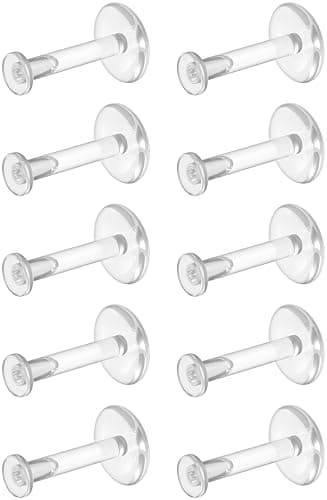
Most sore, weeping, angry earlobes are a contact reaction or friction, not an infection — and the usual culprit is the back of the earring rather than the earring. A genuine infection is one ear, getting worse, hot, with pus, and it needs a clinician. An allergy itches, affects both ears, and stays exactly where the metal touches. Once things have settled, the thing to put back in is a flat-back stud in stated implant-grade titanium — or, if the piercing needs to stay open while skin recovers, a plain plastic retainer.
Four things a sore earlobe usually is
This site has a whole page on the four causes and it is worth reading properly. The short version, because it is the thing people most often get wrong:
Telling them apart, from what you can see at home
Which ear
What it feels like
Fever
What it needs
Contact allergy
Usually both
Itchy, red where metal touches
No
A different, named metal
Friction or pressure
Either
Sore at the edges of the hole, not itchy
No
Correct post length, flat back
Trapped soap or sebum
Either
Smelly, slightly tender, not spreading
No
Rinsing, and a smoother post
Infection
Usually one
Hot, swollen, worsening, may have pus
Possible
A clinician, not a purchase
Telling them apart, from what you can see at home
The column that does the most work is the first one. An allergy is a property of your immune system and your immune system is in both ears, so a contact reaction to nickel is usually symmetrical. An infection is a thing that happened to one piercing. If one ear is furious and the other is completely fine, metal is the less likely explanation — unless, and this is the common exception, you are wearing two different backs.
Why the back is the usual suspect
Here is the pattern that catches people. You buy a pair of earrings. One back gets lost. You replace it from the jar of assorted backs everybody has in a drawer. Now you are wearing one metal on the left and a different, unnamed one on the right — and six weeks later one earlobe is angry and you are convinced you have an infection in one ear.
An earring back is a separately manufactured component, frequently a cheaper alloy than the earring it holds, and almost never named in the listing. It sits against the back of your lobe for exactly as long as the earring sits in the front. Before you replace a whole collection, replace the backs: it is the cheapest diagnostic in this entire category, and it resolves a surprising share of one-sided reactions.
Do not let it close
The instinct when a piercing goes wrong is to take everything out and let the ear rest. Sometimes that is right and sometimes it is the worst available move, and the difference is a judgement a clinician or piercer should make rather than you or us. The specific risk is that removing jewelry from an inflamed channel can let the surface close over while the irritation underneath is still there.
Where this site can help is with the middle option: a plain plastic retainer. It keeps the channel open, introduces no metal at all, and is the same product sold for getting a piercing through an MRI or an operation. If you have been told to take the metal out but would rather not lose a piercing you waited months for, that is the thing to ask about. The metal-free page covers the category properly.
What to put back in
When things have calmed down, this is the moment to stop repeating the experiment. Three changes, and they are the whole recommendation:
A named metal.Implant-grade titanium to ASTM F136 is the only common jewelry material pointing at a published composition specification. “Hypoallergenic” is not a specification — the FDA’s position on that word is that it has no legal definition, and there is no jewelry equivalent at all.
A flat back, not a butterfly. A flat disc spreads pressure instead of concentrating it, has nothing to catch on a pillow, and removes the separate clutch that is so often a different alloy. See flat-back earrings.
The correct post length. This is the one almost nobody thinks about. A post that is too short pulls the back tight against the lobe, which traps moisture and presses on tissue that is already unhappy, and it will keep doing it regardless of what the earring is made of. Our fit guide covers gauge and length.
Change those three together and give it time. If the same thing happens again on stated titanium with a flat back at the right length, then the problem is not the metal, and that is genuinely useful information to take to a dermatologist — who can patch test and tell you what you actually react to, instead of leaving you to work it out by trial and error across years and a drawer full of earrings.
Quick picks
Ranked on what the seller actually discloses. Tap a row for the full write-up, or go straight to the listing.
#
Product
Best for
Score
Price
1
WildVibe Clear Flat-Back Plastic Studs, 18g, 6mmThe only listing on this shelf that states gauge, post length and back type, which is what separates a retainer that fits your piercing from one that does not.
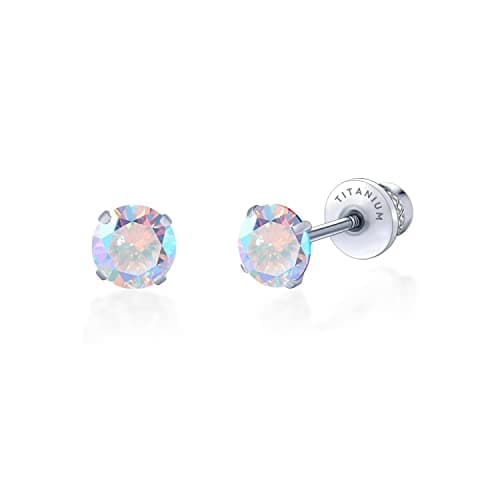
Limerencia F136 Titanium Screw-Back Flat-Back CZ Studs (20G)The clearest material claim in this whole category: the standard number, the gauge and the fastening are all in the title before you have clicked anything.
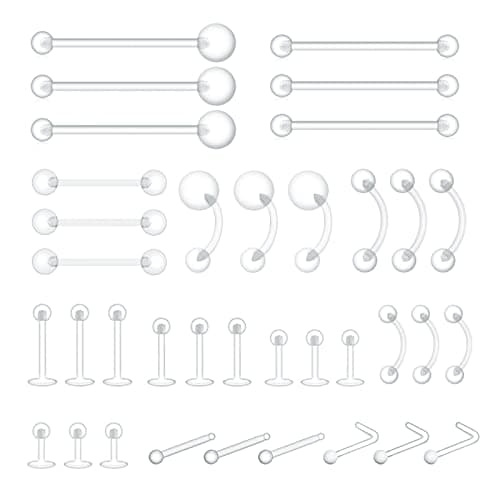
PiercingArt Clear Plastic Retainer Kit, 36 PiecesThirty-six retainers in assorted shapes for under ten dollars, which is the sensible thing to own before a hospital appointment rather than after one.
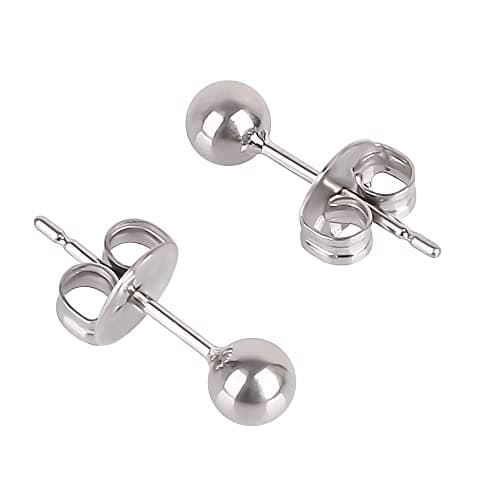
VGACETI Pure Titanium Ball Post Studs, 3mm and 4mmThe rare listing that says nickel-free rather than hypoallergenic, and names the post specifically rather than the earring generally.
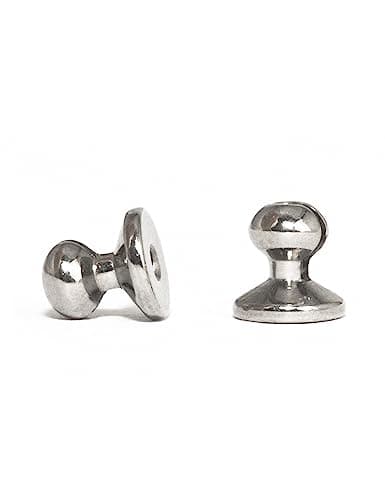
Limerencia Pure Titanium Replacement Earring Backs (2 pairs)The cheapest fix in this whole category: keep the earrings, replace the part that is actually touching you.
“Score” is a disclosure score, not a test result. It rates how completely the seller states the post metal, the back metal and the nickel claim, and how that metal holds up for reactive skin. The full rubric is published on our methodology page.
#1 · Gauge, length and back type all stated
WildVibe Clear Flat-Back Plastic Studs, 18g, 6mm
The only listing on this shelf that states gauge, post length and back type, which is what separates a retainer that fits your piercing from one that does not.
Post material
Plastic, described as Bioflex — a PTFE-based material; no metal in the post
From the seller’s own product title: “18g Clear Earrings for Sports for Ear, Work, Surgery, Mri, School - Bioflex Plastic Earrings for Sensitive Ears - Flatback Clear Piercing Earring Retainers - Plastic Post Flat Back Studs Earings - 6mm”
Back material
Flat back, same plastic as the post
From the seller’s own product title: “Flatback Clear Piercing Earring Retainers - Plastic Post Flat Back Studs”
Nickel claim
Names a metal, makes no nickel claim. The seller’s own words: “Bioflex Plastic Earrings for Sensitive Ears”
Three numbers make this the pick: 18 gauge, 6mm, flat back. Gauge has to match the hole or the post will not go in or will not stay; length has to match the thickness of the lobe or the back presses in; and a flat back is the shape that sits against the skin without a protruding clutch. Almost nothing else in this category states all three.
"Bioflex" is worth being precise about. It began as a brand name for a PTFE-based flexible plastic used in piercing jewelry, and listings now use it as a generic word. That means it describes a family of materials rather than certifying one, so treat it as "flexible plastic, probably PTFE-based" rather than as a specification you could check.
The use cases in the title are real, not padding. Metal jewelry has to come out for an MRI and for a great deal of surgery; a plastic retainer keeps the channel open without going near the scanner's magnetic field. That is the strongest practical argument for owning some.
Who it’s for
Anyone with an MRI or an operation scheduled, anyone in a job or a sport that bans visible jewelry, and anyone who reacts to titanium.
Skip it if
Skip this if the piercing is new. A fresh piercing is an open wound and implant-grade titanium remains the conventional first choice.
The clearest material claim in this whole category: the standard number, the gauge and the fastening are all in the title before you have clicked anything.
Post material
F136 implant-grade titanium, 20 gauge
From the seller’s own product title: “Limerencia Hypoallergenic G23 Implant Grade Titanium Screw Back Earrings | 20G F136 Pure Titanium Flat Back CZ Studs”
Back material
Screw-on flat back; the same titanium is implied but the metal is not separately named
Not named in the seller’s product title — the headline nearly every buyer reads. That omission is the finding, not a gap in our notes.
Nickel claim
Says hypoallergenic, not nickel-free. The seller’s own words: “Hypoallergenic G23 Implant Grade Titanium”
Two numbers do all the work here. F136 is the ASTM specification for the Ti-6Al-4V ELI alloy used in surgical implants, and G23 is the grade designation for that same alloy. A seller putting both in the title is pointing at a published document rather than reaching for an adjective, and that is rarer than it should be.
The flat back matters as much as the metal. A flat disc sits against the back of the lobe instead of a butterfly clip pressing a small area, which is why piercers use this shape for anything that has to be slept in. Combined with a screw thread rather than a friction push-fit, it is about as low-drama as an earring gets.
What the title does not do is name the back separately. In practice a screw-back on a titanium post is almost always the same titanium, and the design leaves little room for it to be anything else — but the seller has not committed to it in the headline, and we score what is stated rather than what is likely.
Who it’s for
Anyone who has reacted to something before and wants to stop running experiments. Also the sensible default for a piercing you intend to sleep in.
Skip it if
Skip this if you want a decorative statement earring. A 20-gauge flat-back CZ stud is deliberately unobtrusive, and if you want to be seen wearing something, this is not it.
Thirty-six retainers in assorted shapes for under ten dollars, which is the sensible thing to own before a hospital appointment rather than after one.
Post material
Clear plastic; the specific polymer is not named
From the seller’s own product title: “PiercingArt 36Pcs Clear Plastic Piercing Retainers for Surgery MRI”
Back material
Varies by piece; not described in the title
Not named in the seller’s product title — the headline nearly every buyer reads. That omission is the finding, not a gap in our notes.
Nickel claim
Names a metal, makes no nickel claim. The seller’s own words: “Clear Plastic Piercing Retainers”
The value here is coverage rather than quality. If you have several piercings in different gauges, being told at short notice to remove all metal is a problem a mixed box solves and a single pair does not.
The polymer is unnamed, which is the main mark against it. "Clear plastic" could be PTFE, acrylic or something else, and those behave differently — acrylic is rigid and can craze, PTFE stays flexible. For short-term use through a scan that distinction matters less than it would for daily wear.
Treat plastic retainers as consumable. Fine scratches in a polymer surface hold bacteria in a way polished metal does not, so replace them rather than cleaning the same pair indefinitely.
Who it’s for
Anyone with multiple piercings facing surgery, imaging, or a workplace jewelry ban.
Skip it if
Skip this as an everyday earring. It is a kit of placeholders, and most of the shapes are not meant to be seen.
VGACETI Pure Titanium Ball Post Studs, 3mm and 4mm
The rare listing that says nickel-free rather than hypoallergenic, and names the post specifically rather than the earring generally.
Post material
Pure titanium, ball post construction
From the seller’s own product title: “Ball Stud Titanium Earrings,Hypoallergenic for Women High Polished Colored for Sensitive Ears, 3mm and 4mm Pure Titanium Nickel-Free Lead-Free”
Back material
Not named in the title
Not named in the seller’s product title — the headline nearly every buyer reads. That omission is the finding, not a gap in our notes.
Nickel claim
Explicitly nickel-free. The seller’s own words: “Pure Titanium Nickel-Free Lead-Free”
This is the strongest nickel language on this page and the reason the pick is here. 'Nickel-free' is a definite factual claim about composition that the seller can be held to. 'Hypoallergenic' is not. Almost every competing listing chooses the second and this one chose the first.
Commercially pure titanium rather than the F136 alloy: no aluminum, no vanadium, one element. Slightly softer, which is why you see it as balls and discs rather than as thin structural parts, and completely fine for a healed lobe.
A 3mm or 4mm ball is the smallest sensible everyday earring. It is what you put in when you want the piercing to stay open and otherwise want to forget it exists, and at this price there is no reason to compromise on the metal to get it.
Who it’s for
First purchase for someone who has just worked out that nickel is the problem. Cheap enough to be a low-stakes test of whether titanium fixes it.
Skip it if
Skip this if you want the earring to be visible from more than a foot away. A polished 3mm ball is jewelry in the technical sense only.
Limerencia Pure Titanium Replacement Earring Backs (2 pairs)
The cheapest fix in this whole category: keep the earrings, replace the part that is actually touching you.
Post material
Not applicable — this is the back component
From the seller’s own product title: “Limerencia Pure Titanium Earring Backs Replacements”
Back material
Pure titanium
From the seller’s own product title: “Limerencia Pure Titanium Earring Backs Replacements, Hypoallergenic for Sensitive Ears, Secure Ear Locking for Stud Earrings for Posts”
Nickel claim
Says hypoallergenic, not nickel-free. The seller’s own words: “Pure Titanium Earring Backs ... Hypoallergenic”
This is the pick that most often solves the problem for the least money, and almost nobody writing about sensitive ears mentions it. A butterfly back is a separately manufactured part, frequently a cheaper alloy than the earring it holds on, and it sits against the back of your lobe for exactly as long as the earring does.
So if you have earrings you love that started irritating you, or one ear reacts and the other does not, changing the backs is the first thing to try. It costs a fraction of a new pair and it isolates the variable.
Titanium backs also grip differently from steel butterflies — generally more securely, which is a side benefit if you lose earrings.
Who it’s for
Anyone with a drawer of earrings they cannot wear. Try this before replacing any of them.
Skip it if
Skip this if the post itself is the problem. A titanium back on a plated brass post fixes half of a two-part contact and the half it does not fix is inside the piercing.
What earrings should I wear with an infected piercing?+
Ideally, whatever you are told to by the person treating it — an actively infected piercing is a clinical matter, not a shopping one. Once it has settled, the change worth making is a flat-back stud in stated implant-grade titanium at the correct post length, because that removes the three things most likely to have contributed: an unnamed alloy, a separate clutch of a different metal, and a post that pulls the back tight against the lobe.
How do I know if it is an allergy or an infection?+
As a rough guide: an allergy itches, affects both ears, and stays exactly where the metal touches. An infection tends to be one ear, hot, increasingly painful, possibly with pus, and can come with fever. MedlinePlus describes a spreading skin infection as redness that grows quickly, tight glossy skin, warmth, fever with chills and swollen lymph nodes nearby. If that is what you are looking at, see someone.
Should I take my earring out if the piercing is infected?+
Ask someone qualified before you do. The concern with removing jewelry from an inflamed piercing is that the surface can close over while the problem underneath is still there. If you have been told to get the metal out but want to keep the piercing, a plain plastic retainer is the thing to ask about — it keeps the channel open and introduces no metal.
Can cheap earrings cause an infection?+
Not directly, but they can set the scene. A rough or plated post irritates the channel mechanically, and a nickel-releasing alloy can cause a contact reaction that leaves the skin inflamed and broken. Inflamed, broken skin is easier to infect than intact skin. So the honest version is that cheap jewelry causes reactions, and reactions can make an infection more likely.
What is the best thing to clean a piercing with?+
Sterile saline at 0.9% sodium chloride is the standard answer and the only thing on that shelf with a specification you can read off the bottle. We do not rank or link aftercare products on this site, because it is not jewelry and we are not qualified to judge it — and because several listings in that aisle carry claims about removing bumps that nobody has substantiated to us. Your piercer or clinician is the right source.
Why does only one of my ears react?+
The commonest explanation is not biological, it is that you are wearing two different backs. Backs get lost and replaced from the assorted jar, so one lobe ends up against a different alloy from the other. Standardise both — a set of titanium backs is a few dollars — and the asymmetry very often disappears.
Sources
MedlinePlus (US National Library of Medicine) — cellulitis — The systemic picture that separates a spreading skin infection from local irritation: fever with chills and sweating, fatigue, redness that spreads and grows quickly, skin that is tight and glossy, warmth over the red area, and swollen lymph nodes near the site.
MedlinePlus (US National Library of Medicine) — piercing and tattoos — Lists the health risks as allergic reactions, keloids and infections. On choosing where to get pierced: 'make sure that the facility is clean, safe and has a good reputation', and 'Proper sterilization of the equipment is important.'